


Iraq will not allow a repeat of what happened in Mosul, Prime Minister Mustafa Al Kadhimi said on Wednesday during a trip to the city that was overrun by ISIS in June 2014.
The visit marked six years since the militants seized Mosul, where liberation in July 2017 was followed by a period of neglect, which Mr Al Kadhimi blamed on the previous Iraqi government.
“We will not allow the repetition of what happened, and we carry out military operations to support security and stability in Mosul and to hunt down the remaining terror cells,” Mr Al Kadhimi said.
The northern Iraqi city became the extremist group's de facto capital in the country between 2014 and 2017, before a grinding internationally backed military campaign ousted them from the city.
Three years after the battle to liberate Mosul, much remains in ruins.
The Prime Minister sent a strong message to the world that Nineveh province, just like the rest of Iraq, must be rebuilt, especially after the suffering it endured under ISIS rule.
The battle for Mosul lasted almost nine months,
Large parts of the city were destroyed during the nine-month battle to liberate Mosul, which killed thousands of civilians and displaced more than 900,000 others.
Almost 8 million tonnes of rubble were left where historical buildings and architectural sites once stood alongside homes, schools and businesses.
But booby traps, mines and unexploded ordnance left by ISIS have hampered reconstruction efforts.
The neglect that Iraq has undergone is a direct result of former dictator Saddam Hussein’s rule and the governments that took over after the US-led invasion of 2003, Mr Al Kadhimi said during his visit.
His government has “inherited a heavy task” with little to no budget, which is a result of “mismanagement and corruption,” he added.
-
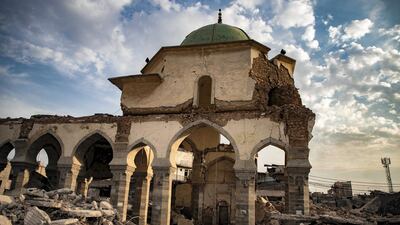
Unesco insists the local community must be involved in the projects. Moamin Al-Obeidi / Unesco -
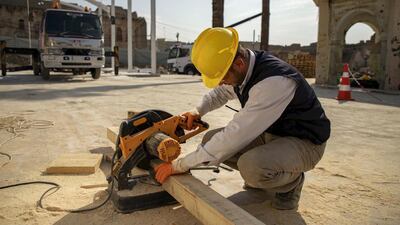
Work has already begun. Moamin Al-Obeidi / Unesco -
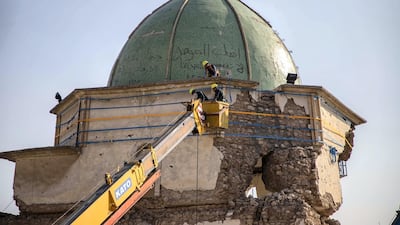
Al Nuri Mosque in Mosul. Moamin Al-Obeidi / Unesco -
Local people attend meeting about the proposed restoration works. Moamin Al-Obeidi / Unesco -
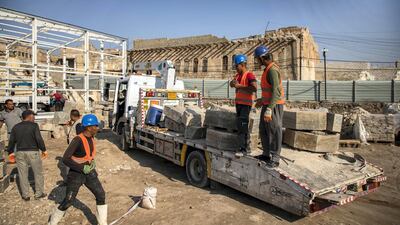
Moving rubble. Moamin Al-Obeidi / UNESCO -
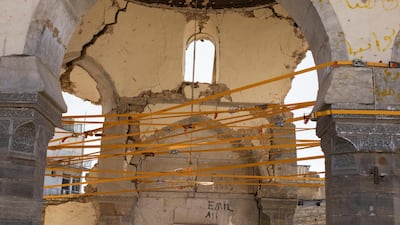
Straps around the pillars. Moamin Al-Obeidi / Unesco -

Al Nuri mosque - renovation work in progress. Moamin Al-Obeidi / Unesco


Mr Al Kadhimi's first meeting in Mosul on Wednesday morning was with military and security chiefs.
Lt Gen Abdul Wahab Al Saadi, the head of the Iraqi Counter-Terrorism Service – who was instrumental in defeating ISIS in Mosul and liberating it in June 2017 – accompanied the prime minister during the visit.
"All Iraqis played a part in the liberation of Mosul," he said. "Iraq was victorious thanks to their sacrifices and to the heroism of the Iraqi Armed Forces."
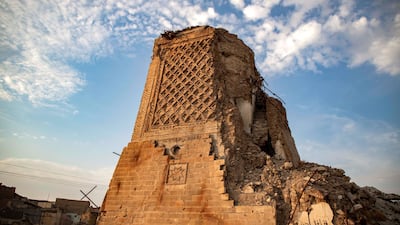
The official visited the iconic 12th century Al Nuri Mosque – nicknamed Al Hadba, Arabic for hunchback – for its leaning minaret, where ISIS leader Abu Bakr Al Baghdadi declared the formation of the so-called caliphate.
ISIS blew it up as government forces re-took the city in 2017.
“Al Hadba represents history, heritage, civilisation and humanity, it has been subjected to the terror. It was liberated due to the sacrifice and blood of all Iraqis and that is something we are proud of,” Mr Al Kadhimi said.
During the last two years the city has undergone major transformation and people are beginning to return.
The UAE has committed $50 million (Dh183.6m) to the reconstruction of Al Nuri Mosque. The project, which is a collaboration with Unesco and the Iraqi government, will also rebuild two of the city's historic churches - the 800-year-old Al Tahera Church and Al Saa’a Church.
Noura Al Kaabi, UAE Minister of Culture and Knowledge Development, declared the first phase of a collective rebuilding of the mosque complete last February.
During his visit on Wednesday, Mr Al Kadhimi inaugurated Mosul’s Al Hurriya (Freedom) Bridge, which straddles the Tigris River and was instrumental in recapturing the city from the militants.
His visit included Mosul’s iconic museum, where priceless Assyrian and Sumerian antiquities were looted and smashed by the terrorists for representing “a false God”.
The Prime Minister also visited the Christian town of Bartella, which was once home to thousands of Assyrian Christians. Most of Bartella’s residents fled to the autonomous Kurdish region in August 2014 when ISIS seized control over the town.
"The Christian component is one of the most authentic in Iraq, we grieve to see them leave the country," the prime minister said during a meeting with senior Christian officials.
The rebuilding of Mosul and its province has been a challenge to its residents who have little to live on.
Recent trials for residents include flooding and dealing with the outbreak of coronavirus pandemic.
Visiting the city may be a symbolic start to a planned offensive against ISIS, which still operates in the country.
The Iraqi public and western states have placed a lot of pressure on Mr Al Kadhimi’s cabinet to deliver and accomplish the goals he set for his government.
His office has projected him as a neutral leader who can fight off foreign interferences such as Iran and its armed militias who have played a hefty role in Iraqi politics since 2003.
Mr Al Kadhimi also spoke about the upcoming strategic dialogue Iraq will have with the US.
The premier stated that protecting Iraqi sovereignty and interests is a priority especially as the nation's finances struggle to recover from the fall in oil prices.

