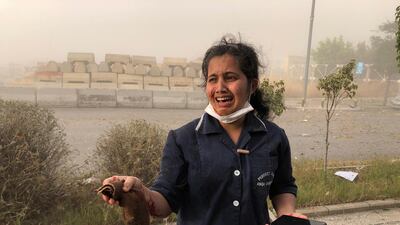
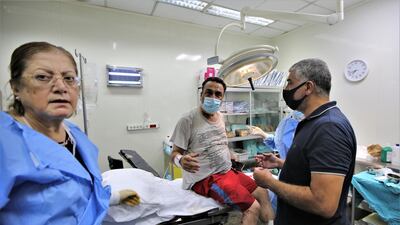
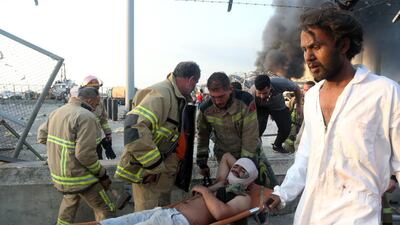
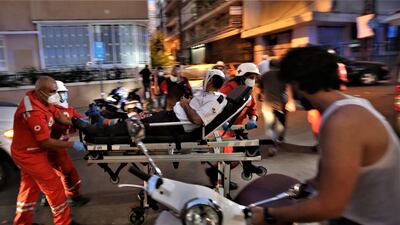
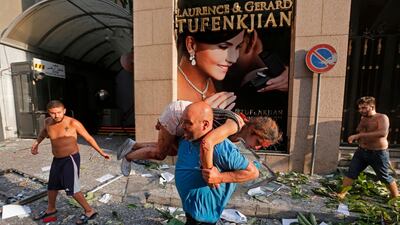
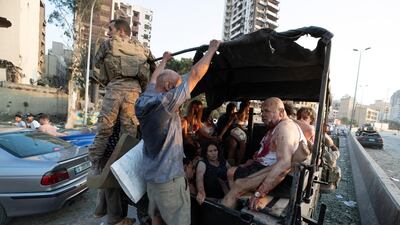
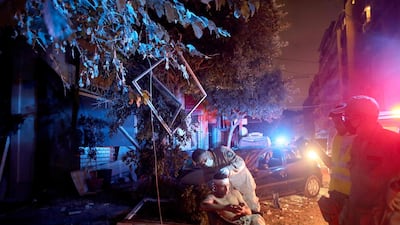
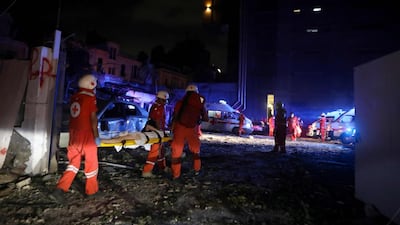
Amine Al Zahid, the father of two who went missing for 30 hours after the Beirut explosion before he was rescued alive at sea, has died, his family said on Tuesday.
The family’s search for the 42-year-old Lebanese national lasted five days after the Lebanese military confirmed his rescue from the Mediterranean last week.
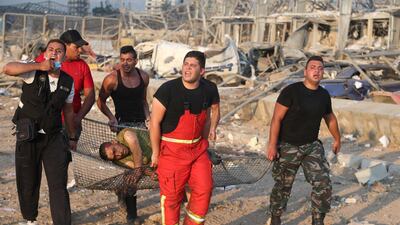
He was blown into the sea when 2,750 tonnes of ammonium nitrate exploded at the city's port, set alight by what port workers say was a cache of fireworks.
Al Zahid's relatives were unable to locate him in the Lebanese capital until Monday when Beirut's Al Zahra Hospital contacted the family to deliver the news of his death, his brother Mohammad told The National.
“We received a call from the hospital yesterday and they asked us to go and collect his body. Right now we are going to bury him in Al Shuhada graveyard,” he said as the family headed to his funeral.
An official at Al Zahra hospital confirmed that Al Zahid was brought in by ambulance dead on Sunday, three days after he was rescued.
The official would not disclose who delivered him to the hospital. It remains unclear where he was before Al Zahra hospital.
“He was already dead when we received his corpse. I cannot confirm what caused his death but he had a serious head injury,” said the official. The official would not disclose further details about his death.
Mohammad said the family had been kept in the dark and was not told any details about what had happened.
“I can only assume that they called and said my brother is dead without revealing any details. We don’t know what happened after we had been told that he was picked up alive but injured,” he said.
The manager of a company at Beirut's port was believed to have been thrown into the Mediterranean when the stockpile of ammonium nitrate exploded on Tuesday.
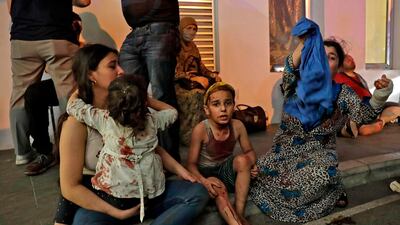
The health ministry on Saturday said 21 people were still missing after the blast. Beirut's governor said many foreign workers and truck drivers remained missing and were assumed to be among the casualties, complicating efforts to identify the victims.
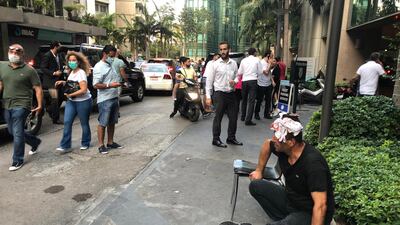
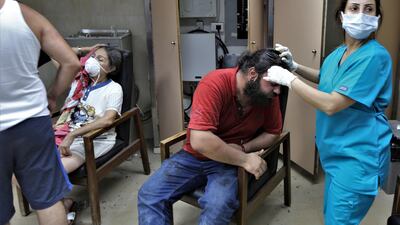
Before its resignation, the Lebanese Cabinet blamed negligence for the explosion that has so far killed 171 people, left more than 6,000 people injured and dozens missing.
Desperate for information, the family had posted a picture of Al Zahid and contact details on social media, alongside hundreds of other images being shared of loved ones who had not been seen since the blast.
A photo of him lying bloodied on a boat next to a military officer was circulated across social media.
“Ten minutes prior to the explosion, he sent me a photo of the fire that preceded the explosion,” Mohammad said last week.
As the family battled to find him, searching every hospital in Beirut and publicising the mystery of his case, at least three ministers from the now-collapsed government were drawn into the search efforts.
But he would become one of the 171 victims of the disaster at Beirut port, and they would never get to say goodbye.

Disability on screen
Empire — neuromuscular disease myasthenia gravis; bipolar disorder; post-traumatic stress disorder (PTSD)
Rosewood and Transparent — heart issues
24: Legacy — PTSD;
Superstore and NCIS: New Orleans — wheelchair-bound
Taken and This Is Us — cancer
Trial & Error — cognitive disorder prosopagnosia (facial blindness and dyslexia)
Grey’s Anatomy — prosthetic leg
Scorpion — obsessive compulsive disorder and anxiety
Switched at Birth — deafness
One Mississippi, Wentworth and Transparent — double mastectomy
Dragons — double amputee
Engine: 5.6-litre V8
Transmission: seven-speed automatic
Power: 400hp
Torque: 560Nm
Price: Dh234,000 - Dh329,000
On sale: now
Mercer, the investment consulting arm of US services company Marsh & McLennan, expects its wealth division to at least double its assets under management (AUM) in the Middle East as wealth in the region continues to grow despite economic headwinds, a company official said.
Mercer Wealth, which globally has $160 billion in AUM, plans to boost its AUM in the region to $2-$3bn in the next 2-3 years from the present $1bn, said Yasir AbuShaban, a Dubai-based principal with Mercer Wealth.
“Within the next two to three years, we are looking at reaching $2 to $3 billion as a conservative estimate and we do see an opportunity to do so,” said Mr AbuShaban.
Mercer does not directly make investments, but allocates clients’ money they have discretion to, to professional asset managers. They also provide advice to clients.
“We have buying power. We can negotiate on their (client’s) behalf with asset managers to provide them lower fees than they otherwise would have to get on their own,” he added.
Mercer Wealth’s clients include sovereign wealth funds, family offices, and insurance companies among others.
From its office in Dubai, Mercer also looks after Africa, India and Turkey, where they also see opportunity for growth.
Wealth creation in Middle East and Africa (MEA) grew 8.5 per cent to $8.1 trillion last year from $7.5tn in 2015, higher than last year’s global average of 6 per cent and the second-highest growth in a region after Asia-Pacific which grew 9.9 per cent, according to consultancy Boston Consulting Group (BCG). In the region, where wealth grew just 1.9 per cent in 2015 compared with 2014, a pickup in oil prices has helped in wealth generation.
BCG is forecasting MEA wealth will rise to $12tn by 2021, growing at an annual average of 8 per cent.
Drivers of wealth generation in the region will be split evenly between new wealth creation and growth of performance of existing assets, according to BCG.
Another general trend in the region is clients’ looking for a comprehensive approach to investing, according to Mr AbuShaban.
“Institutional investors or some of the families are seeing a slowdown in the available capital they have to invest and in that sense they are looking at optimizing the way they manage their portfolios and making sure they are not investing haphazardly and different parts of their investment are working together,” said Mr AbuShaban.
Some clients also have a higher appetite for risk, given the low interest-rate environment that does not provide enough yield for some institutional investors. These clients are keen to invest in illiquid assets, such as private equity and infrastructure.
“What we have seen is a desire for higher returns in what has been a low-return environment specifically in various fixed income or bonds,” he said.
“In this environment, we have seen a de facto increase in the risk that clients are taking in things like illiquid investments, private equity investments, infrastructure and private debt, those kind of investments were higher illiquidity results in incrementally higher returns.”
The Abu Dhabi Investment Authority, one of the largest sovereign wealth funds, said in its 2016 report that has gradually increased its exposure in direct private equity and private credit transactions, mainly in Asian markets and especially in China and India. The authority’s private equity department focused on structured equities owing to “their defensive characteristics.”
Qosty Byogaani
Starring: Hani Razmzi, Maya Nasir and Hassan Hosny
Four stars
Company%20Profile
%3Cp%3E%3Cstrong%3EName%3A%3C%2Fstrong%3E%20Raha%3Cbr%3E%3Cstrong%3EStarted%3A%3C%2Fstrong%3E%202022%3Cbr%3E%3Cstrong%3EBased%3A%3C%2Fstrong%3E%20Kuwait%2FSaudi%3Cbr%3E%3Cstrong%3EIndustry%3A%3C%2Fstrong%3E%20Tech%20Logistics%3Cbr%3E%3Cstrong%3EFunding%3A%3C%2Fstrong%3E%20%2414%20million%3Cbr%3E%3Cstrong%3EInvestors%3A%3C%2Fstrong%3E%20Soor%20Capital%2C%20eWTP%20Arabia%20Capital%2C%20Aujan%20Enterprises%2C%20Nox%20Management%2C%20Cedar%20Mundi%20Ventures%3Cbr%3E%3Cstrong%3ENumber%20of%20employees%3A%3C%2Fstrong%3E%20166%3C%2Fp%3E%0A
Read more from Aya Iskandarani
Sting & Shaggy
44/876
(Interscope)
Desert Warrior
Starring: Anthony Mackie, Aiysha Hart, Ben Kingsley
Director: Rupert Wyatt
Rating: 3/5
The%20Roundup%20%3A%20No%20Way%20Out
%3Cp%3E%3Cstrong%3EDirector%3A%3C%2Fstrong%3E%20Lee%20Sang-yong%3Cbr%3E%3Cstrong%3EStars%3A%3C%2Fstrong%3E%20Don%20Lee%2C%20Lee%20Jun-hyuk%2C%20Munetaka%20Aoki%3Cbr%3E%3Cstrong%3ERating%3A%20%3C%2Fstrong%3E3%2F5%3Cbr%3E%3Cbr%3E%3C%2Fp%3E%0A
Match info:
Real Betis v Sevilla, 10.45pm (UAE)
Pakistan squad
Sarfraz (c), Zaman, Imam, Masood, Azam, Malik, Asif, Sohail, Shadab, Nawaz, Ashraf, Hasan, Amir, Junaid, Shinwari and Afridi
Ten tax points to be aware of in 2026
1. Domestic VAT refund amendments: request your refund within five years
If a business does not apply for the refund on time, they lose their credit.
2. E-invoicing in the UAE
Businesses should continue preparing for the implementation of e-invoicing in the UAE, with 2026 a preparation and transition period ahead of phased mandatory adoption.
3. More tax audits
Tax authorities are increasingly using data already available across multiple filings to identify audit risks.
4. More beneficial VAT and excise tax penalty regime
Tax disputes are expected to become more frequent and more structured, with clearer administrative objection and appeal processes. The UAE has adopted a new penalty regime for VAT and excise disputes, which now mirrors the penalty regime for corporate tax.
5. Greater emphasis on statutory audit
There is a greater need for the accuracy of financial statements. The International Financial Reporting Standards standards need to be strictly adhered to and, as a result, the quality of the audits will need to increase.
6. Further transfer pricing enforcement
Transfer pricing enforcement, which refers to the practice of establishing prices for internal transactions between related entities, is expected to broaden in scope. The UAE will shortly open the possibility to negotiate advance pricing agreements, or essentially rulings for transfer pricing purposes.
7. Limited time periods for audits
Recent amendments also introduce a default five-year limitation period for tax audits and assessments, subject to specific statutory exceptions. While the standard audit and assessment period is five years, this may be extended to up to 15 years in cases involving fraud or tax evasion.
8. Pillar 2 implementation
Many multinational groups will begin to feel the practical effect of the Domestic Minimum Top-Up Tax (DMTT), the UAE's implementation of the OECD’s global minimum tax under Pillar 2. While the rules apply for financial years starting on or after January 1, 2025, it is 2026 that marks the transition to an operational phase.
9. Reduced compliance obligations for imported goods and services
Businesses that apply the reverse-charge mechanism for VAT purposes in the UAE may benefit from reduced compliance obligations.
10. Substance and CbC reporting focus
Tax authorities are expected to continue strengthening the enforcement of economic substance and Country-by-Country (CbC) reporting frameworks. In the UAE, these regimes are increasingly being used as risk-assessment tools, providing tax authorities with a comprehensive view of multinational groups’ global footprints and enabling them to assess whether profits are aligned with real economic activity.
Contributed by Thomas Vanhee and Hend Rashwan, Aurifer
SHOW COURTS ORDER OF PLAY
Centre Court (4pm UAE/12pm GMT)
Victoria Azarenka (BLR) v Heather Watson (GBR)
Rafael Nadal (ESP x4) v Karen Khachanov (RUS x30)
Andy Murray (GBR x1) v Fabio Fognini (ITA x28)
Court 1 (4pm UAE)
Steve Johnson (USA x26) v Marin Cilic (CRO x7)
Johanna Konta (GBR x6) v Maria Sakkari (GRE)
Naomi Osaka (JPN) v Venus Williams (USA x10)
Court 2 (2.30pm UAE)
Aljaz Bedene (GBR) v Gilles Muller (LUX x16)
Peng Shuai (CHN) v Simona Halep (ROM x2)
Jelena Ostapenko (LAT x13) v Camila Giorgi (ITA)
Jo-Wilfried Tsonga (FRA x12) v Sam Querrey (USA x24)
Court 3 (2.30pm UAE)
Kei Nishikori (JPN x9) v Roberto Bautista Agut (ESP x18)
Carina Witthoeft (GER) v Elina Svitolina (UKR x4)
Court 12 (2.30pm UAE)
Dominika Cibulkova (SVK x8) v Ana Konjuh (CRO x27)
Kevin Anderson (RSA) v Ruben Bemelmans (BEL)
Court 18 (2.30pm UAE)
Caroline Garcia (FRA x21) v Madison Brengle (USA)
Benoit Paire (FRA) v Jerzy Janowicz (POL)
WRESTLING HIGHLIGHTS