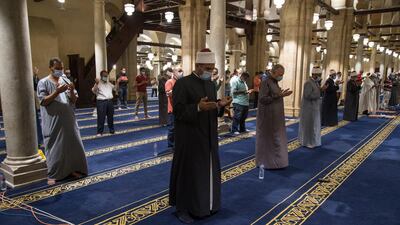
Muslims in Egypt pray inside Al Azhar mosque in Egypt. EPA

Egypt to take 1 per cent from salaries due to coronavirus


Hamza Hendawi
  • English
  • Arabic

Egypt will deduct 1 per cent from people’s salaries for 12 months starting on July 1 to offset the economic effects of the coronavirus, according to a draft law approved by the Cabinet on Wednesday.

The country announced its highest one-day number of coronavirus infections on Tuesday but the government said it still planned to ease restrictions after the Eid holidays.

The Health Ministry said 720 Covid-19 cases were registered over the previous 24 hours, taking to 13,484 the number of infections since the outbreak of the disease in February.

Tuesday’s figure was the third consecutive one-day record high but was a jump of almost 200 cases over Monday’s report of 535.

Although the number of infections and death toll of 659 remain relatively low for a country of 100 million people, their growth suggests that the worst is yet to come.

But the authorities are still planning to further relax restrictions after the Eid holidays at the end of Ramadan.

The government has complained that Egyptians are not seriously dealing with the coronavirus threat and that they need to observe social distancing and hygiene guidelines more diligently.

It has been trying to strike a balance between protecting people and preventing the economy from tanking, encouraging the return to business as usual with sufficiently protective measures.

A plea made last week by the doctors’ union for a complete lockdown until the end of the month was ignored by the government.

Critics say it is sacrificing lives for the sake of the economy.

A near complete lockdown is due to start on Sunday and will remain in force until May 29 to coincide with the Muslim holiday of Eid Al Fitr. EPA

The government’s response is that Egyptians must learn to live with the virus.

Without a vaccine, it says, anything else will lead to the collapse of the economy, wiping out hard-won gains made after years of austerity and harsh reforms.

That strategy, similar to the approach of several West European nations, is backed by Egypt’s business community, which says a collapsed economy would probably prove deadlier than Covid-19.

But in a bid to rapidly expand testing rates, the government also announced Wednesday that all 230 general hospitals would now offer testing to people showing symptoms of the illness.

People with minor symptoms will be sent home to wait for results, while those showing serious symptoms will be admitted to hospital, the government said. Since May 14, patients with minor symptoms have been asked to self-isolate at home.

While the government is not releasing information on the number of tests conducted, a presidential adviser said earlier this month that 105,000 tests had been done.

A near-complete lockdown is due to start on Sunday and will remain in force until May 29, to coincide with Eid Al Fitr.

A 5pm to 6am curfew will be in place, public parks and beaches will be closed and all public transport halted.

Private buses will be banned from travelling between provinces and shops other than pharmacies, supermarkets and bakeries will be shut, as will malls, restaurants and cafes.

Starting on May 30, wearing masks will be mandatory in public places such as banks, public transport and government offices. Offenders will be fined.

“These measures will limit the chances of the virus spreading because of the large gatherings to mark the big occasion,” the Egyptian Prime Minister, Mustafa Madbouli, said this week.

Mr Madbouli said that starting on June 15, the gradual return to normality will begin.

Sports clubs and youth centres will partly reopen but will operate with social distancing and other preventive measures.

Mr Madbouli said that also starting on June 15, authorities will consider holding some rituals at mosques and churches.


MATCH INFO

Uefa Champions League final:

Who: Real Madrid v Liverpool
Where: NSC Olimpiyskiy Stadium, Kiev, Ukraine
When: Saturday, May 26, 10.45pm (UAE)
TV: Match on BeIN Sports

Infiniti QX80 specs

Engine: twin-turbocharged 3.5-liter V6

Power: 450hp

Torque: 700Nm

Price: From Dh450,000, Autograph model from Dh510,000

Available: Now

Will the pound fall to parity with the dollar?

The idea of pound parity now seems less far-fetched as the risk grows that Britain may split away from the European Union without a deal.

Rupert Harrison, a fund manager at BlackRock, sees the risk of it falling to trade level with the dollar on a no-deal Brexit. The view echoes Morgan Stanley’s recent forecast that the currency can plunge toward $1 (Dh3.67) on such an outcome. That isn’t the majority view yet – a Bloomberg survey this month estimated the pound will slide to $1.10 should the UK exit the bloc without an agreement.

New Prime Minister Boris Johnson has repeatedly said that Britain will leave the EU on the October 31 deadline with or without an agreement, fuelling concern the nation is headed for a disorderly departure and fanning pessimism toward the pound. Sterling has fallen more than 7 per cent in the past three months, the worst performance among major developed-market currencies.

“The pound is at a much lower level now but I still think a no-deal exit would lead to significant volatility and we could be testing parity on a really bad outcome,” said Mr Harrison, who manages more than $10 billion in assets at BlackRock. “We will see this game of chicken continue through August and that’s likely negative for sterling,” he said about the deadlocked Brexit talks.

The pound fell 0.8 per cent to $1.2033 on Friday, its weakest closing level since the 1980s, after a report on the second quarter showed the UK economy shrank for the first time in six years. The data means it is likely the Bank of England will cut interest rates, according to Mizuho Bank.

The BOE said in November that the currency could fall even below $1 in an analysis on possible worst-case Brexit scenarios. Options-based calculations showed around a 6.4 per cent chance of pound-dollar parity in the next one year, markedly higher than 0.2 per cent in early March when prospects of a no-deal outcome were seemingly off the table.

Bloomberg

The%20specs
%3Cp%3E%3Cstrong%3EEngine%3A%20%3C%2Fstrong%3E77kWh%202%20motors%0D%3Cbr%3E%3Cstrong%3EPower%3A%20%3C%2Fstrong%3E178bhp%0D%3Cbr%3E%3Cstrong%3ETorque%3A%20%3C%2Fstrong%3E410Nm%0D%3Cbr%3E%3Cstrong%3ERange%3A%20%3C%2Fstrong%3E402km%0D%3Cbr%3E%3Cstrong%3EPrice%3A%20%3C%2Fstrong%3EDh%2C150%2C000%20(estimate)%0D%3Cbr%3E%3Cstrong%3EOn%20sale%3A%20%3C%2Fstrong%3ETBC%3C%2Fp%3E%0A
Analysis

Members of Syria's Alawite minority community face threat in their heartland after one of the deadliest days in country’s recent history. Read more

Skewed figures

In the village of Mevagissey in southwest England the housing stock has doubled in the last century while the number of residents is half the historic high. The village's Neighbourhood Development Plan states that 26% of homes are holiday retreats. Prices are high, averaging around £300,000, £50,000 more than the Cornish average of £250,000. The local average wage is £15,458. 

Mercer, the investment consulting arm of US services company Marsh & McLennan, expects its wealth division to at least double its assets under management (AUM) in the Middle East as wealth in the region continues to grow despite economic headwinds, a company official said.

Mercer Wealth, which globally has $160 billion in AUM, plans to boost its AUM in the region to $2-$3bn in the next 2-3 years from the present $1bn, said Yasir AbuShaban, a Dubai-based principal with Mercer Wealth.

Within the next two to three years, we are looking at reaching $2 to $3 billion as a conservative estimate and we do see an opportunity to do so,” said Mr AbuShaban.

Mercer does not directly make investments, but allocates clients’ money they have discretion to, to professional asset managers. They also provide advice to clients.

“We have buying power. We can negotiate on their (client’s) behalf with asset managers to provide them lower fees than they otherwise would have to get on their own,” he added.

Mercer Wealth’s clients include sovereign wealth funds, family offices, and insurance companies among others.

From its office in Dubai, Mercer also looks after Africa, India and Turkey, where they also see opportunity for growth.

Wealth creation in Middle East and Africa (MEA) grew 8.5 per cent to $8.1 trillion last year from $7.5tn in 2015, higher than last year’s global average of 6 per cent and the second-highest growth in a region after Asia-Pacific which grew 9.9 per cent, according to consultancy Boston Consulting Group (BCG). In the region, where wealth grew just 1.9 per cent in 2015 compared with 2014, a pickup in oil prices has helped in wealth generation.

BCG is forecasting MEA wealth will rise to $12tn by 2021, growing at an annual average of 8 per cent.

Drivers of wealth generation in the region will be split evenly between new wealth creation and growth of performance of existing assets, according to BCG.

Another general trend in the region is clients’ looking for a comprehensive approach to investing, according to Mr AbuShaban.

“Institutional investors or some of the families are seeing a slowdown in the available capital they have to invest and in that sense they are looking at optimizing the way they manage their portfolios and making sure they are not investing haphazardly and different parts of their investment are working together,” said Mr AbuShaban.

Some clients also have a higher appetite for risk, given the low interest-rate environment that does not provide enough yield for some institutional investors. These clients are keen to invest in illiquid assets, such as private equity and infrastructure.

“What we have seen is a desire for higher returns in what has been a low-return environment specifically in various fixed income or bonds,” he said.

“In this environment, we have seen a de facto increase in the risk that clients are taking in things like illiquid investments, private equity investments, infrastructure and private debt, those kind of investments were higher illiquidity results in incrementally higher returns.”

The Abu Dhabi Investment Authority, one of the largest sovereign wealth funds, said in its 2016 report that has gradually increased its exposure in direct private equity and private credit transactions, mainly in Asian markets and especially in China and India. The authority’s private equity department focused on structured equities owing to “their defensive characteristics.”