
Egypt on Saturday announced the discovery in the southern city of Luxor of a pharaonic tomb belonging to a royal goldsmith who lived more than 3,500 years ago during the reign of the 18th dynasty.
The tomb, located on the west bank of the river Nile in a cemetery for noblemen and top officials, is a relatively modest discovery, but the authorities have announced it with a great deal of fanfare in a bid to boost the country's slowly recovering tourism industry.
"We want tomorrow's newspapers to speak about Egypt and make people want to come to Egypt," antiquities minister Khaled el-Anani said.
The tomb was found in the Draa Abul Naga necropolis. Mr El-Anani said it was not in good condition, but it contains a statue of the goldsmith seated next to his wife with a portrait of their son painted between them.
-
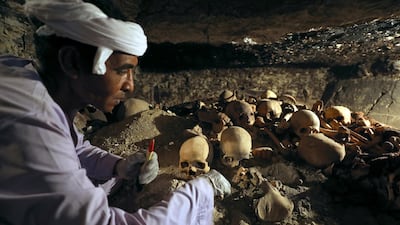
An antiquities worker is seen in the recently discovered tomb of Amenemhat, a goldsmith from the New Kingdom, at the Draa Abu-el Naga necropolis in Egypt. Mohamed Abd El Ghany / Reuters -
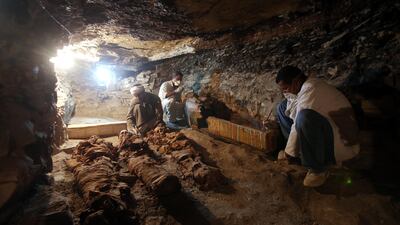
Egyptian archaeologists work on mummies and sarcophagus at a recently discovered tomb in the Draa Abul Nagaa necropolis in Egypt. Khaled Elfiqi / EPA -
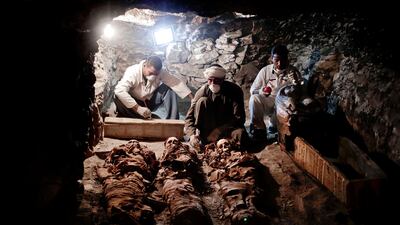
Archaeologists work on mummies found in the New Kingdom tomb belonging to a royal goldsmith in Luxor, Egypt. Nariman El-Mofty / AP Photo -
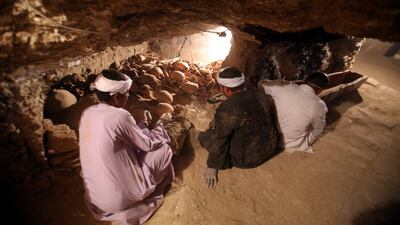
Egyptian archaeologists work inside a recently discovered tomb at the Draa Abul Nagaa necropolis in Luxor's West Bank in Egypt. Khaled Elfiqi / EPA -
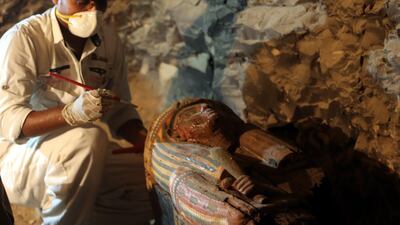
An Egyptian archaeologist works on sarcophagus at a recently discovered tomb in the Draa Abul Nagaa necropolis in Egypt. Khaled Elfiqi / EPA -
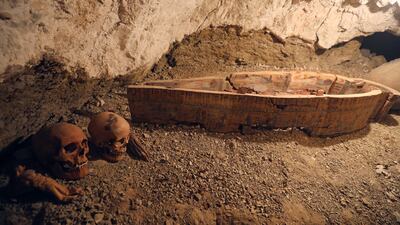
Skulls and hands are seen next to a coffin in the recently discovered tomb of Amenemhat in Egypt. Mohamed Abd El Ghany / Reuters -
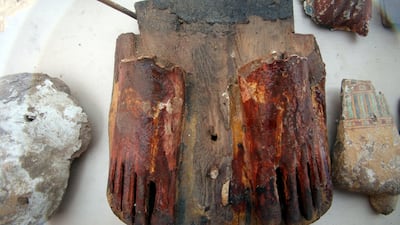
A part of a wooden statue that was found at a recently discovered tomb in the Draa Abul Nagaa necropolis in Egypt. Khaled Elfiqi / EPA -
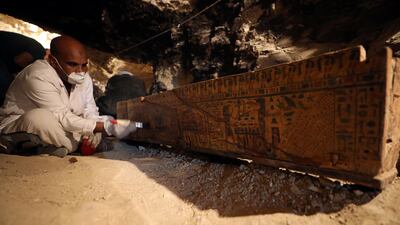
An antiquities worker brushes a coffin in the recently discovered tomb of Amenemhat, a goldsmith from the New Kingdom near the Nile city of Luxor, Egypt. Mohamed Abd El Ghany / Reuters


The minister identified the goldsmith as Amunhat and his tomb, which is dedicated to the ancient Egyptian god Amun, dates back to the New Kingdom (16th to 11th centuries BC),
A burial shaft in the tomb led to a chamber where the archaeologists discovered mummies, pottery, masks, coffins and about 150 small funerary statues carved in wood, clay and limestone, which belonged to Egyptians who lived during the 21st and 22nd dynasties.
The tomb was discovered by Egyptian archeologists, an indication of their growing professionalism and expertise, said Mustafa Waziri, Luxor's chief archaeologist.
"We used to escort foreign archeologists as observers, but that's now in the past. We are the leaders now," he said.

