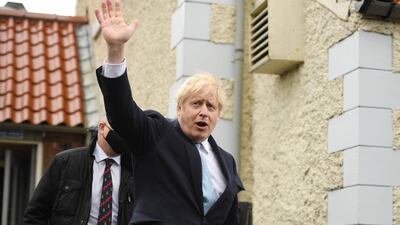
Britain's Prime Minister Boris Johnson celebrates his party's by-election victory in the former opposition Labour stronghold of Hartlepool in north-east England. AFP / Oli SCARFF

'Massive boost' for Boris Johnson in local elections as England's first Muslim MP says opposition Labour has lost its way


Nicky Harley
  • English
  • Arabic

Britain's ruling Conservative Party was given a "massive boost" on Saturday as it  took seats off the opposition in local elections.

As Labour reeled, the first head rolled on Saturday with Angela Raynor being fired as campaign coordinator, British media reported.

Prime Minister Boris Johnson's party won a crushing victory at the Westminster by-election in the northern England town of Hartlepool, breaking the Labour Party's decades-long stronghold on the seat, and across the country its success continued as it won more than 1,500 English council seats.

Despite recent criticism surrounding Mr Johnson's handling of the coronavirus pandemic, his party has strengthened his grip on working-class areas, and analysts said that success will secure the Conservatives' position in the coming years.

"What is interesting about Hartlepool is that the Conservatives winning has not come as much of a surprise in the end, but the scale of the victory with over 50 per cent of the people, a real majority, voting Conservative," Professor Matthew Flinders, president of the Political Studies Association of the United Kingdom, told The National.

"This is a massive boost for Boris. It is a real bounce back after the flat refurbishment scandal and a sign of the long-term commitment of the public believing in his broader 'levelling up' agenda.

"It shows his connection with the public and will cover him for the next few years from anyone seeking to unseat him.”

The loss of the Hartlepool seat was a major blow to Labour Party leader Sir Keir Starmer, who faced his first electoral test since promising to transform the party after its heavy general election defeat in 2019.

By Saturday, Labour had lost more than 200 council seats.

“Losing that seat was catastrophic for Keir Starmer,” Prof Flinders said.

“That massive vote for Boris is an implicit defeat for him. The Labour Party needs to ask itself where it goes from here. There are already questions about Sir Keir, and these will get louder in the wake of this defeat and he will need to come out offering a more clear, connected vision for them.”

England's first Muslim MP, Labour's Khalid Mahmood, who last month stood down from the party's frontbench, is standing by Mr Starmer.

He told The National he blamed the party's "London-based bourgeoisie" for it "losing touch".

"What we need to do is look at the reality of what the people we are there to represent is, and that is the real people working in the communities, who don't work from home, who actually physically go out to work, in industry, cafes or driving buses, who continue to struggle," he told The National.

"We have lost their support, and that is what is coming through in this election. We have to build that back up and go back to our roots.

"The Labour movement is based on working-class people. It was the Labour Party who brought in the minimum wage to make sure the lowest people in work are properly protected. “To an extent we have now lost our way. We have these people working from home through social media who do not have that experience of real life.

"These are now the London-based bourgeoisie attitudes of a particular group of people who we tend to be isolated by.

“I think Keir Starmer will look at this and want to ensure he is able to address these issues as the leader and I'm sure he will do this."

Mr Starmer has vowed to fix his party.

"I am bitterly disappointed in the results and I take full responsibility for the result and I will take full responsibility for fixing things," he said.

"We have changed as a party but we haven't set out a strong enough case to the country. Very often we have been talking to ourselves instead of to the country, and we've lost the trust of working people, particularly in places like Hartlepool. I intend to do whatever is necessary to fix that."

As a result of the coronavirus pandemic, two years of local elections were held across the UK in a single day on Thursday, including for 143 English councils, the Scottish and Welsh devolved parliaments and mayoral elections.

On Saturday, there was success for the Labour Party as its candidates held mayoral posts in Manchester, Liverpool and North Tyneside.

In Liverpool, Joanne Anderson became Britain's first directly elected black female mayor and vowed to stamp out corruption and “rebuild trust” in the “world-class city”.

“Today is the beginning of the fresh start that we all want and need," she said.

"Today we made history.”

The result for the winner of London mayor is still yet to come in.

It also retained power in Wales after matching its best election result yet, with half of the 60 seats in the Welsh Parliament.

For the Conservatives, Natasha Asghar made history by becoming the first female from a Black or Asian minority ethnic background to be elected to the Welsh Parliament.


Specs
Engine: Electric motor generating 54.2kWh (Cooper SE and Aceman SE), 64.6kW (Countryman All4 SE)
Power: 218hp (Cooper and Aceman), 313hp (Countryman)
Torque: 330Nm (Cooper and Aceman), 494Nm (Countryman)
On sale: Now
Price: From Dh158,000 (Cooper), Dh168,000 (Aceman), Dh190,000 (Countryman)
About Takalam

Date started: early 2020

Founders: Khawla Hammad and Inas Abu Shashieh

Based: Abu Dhabi

Sector: HealthTech and wellness

Number of staff: 4

Funding to date: Bootstrapped

LILO & STITCH

Starring: Sydney Elizebeth Agudong, Maia Kealoha, Chris Sanders

Director: Dean Fleischer Camp

Rating: 4.5/5

Pharaoh's curse

British aristocrat Lord Carnarvon, who funded the expedition to find the Tutankhamun tomb, died in a Cairo hotel four months after the crypt was opened.
He had been in poor health for many years after a car crash, and a mosquito bite made worse by a shaving cut led to blood poisoning and pneumonia.
Reports at the time said Lord Carnarvon suffered from “pain as the inflammation affected the nasal passages and eyes”.
Decades later, scientists contended he had died of aspergillosis after inhaling spores of the fungus aspergillus in the tomb, which can lie dormant for months. The fact several others who entered were also found dead withiin a short time led to the myth of the curse.

Fitness problems in men's tennis

Andy Murray - hip

Novak Djokovic - elbow

Roger Federer - back

Stan Wawrinka - knee

Kei Nishikori - wrist

Marin Cilic - adductor

UAE v Gibraltar

What: International friendly

When: 7pm kick off

Where: Rugby Park, Dubai Sports City

Admission: Free

Online: The match will be broadcast live on Dubai Exiles’ Facebook page

UAE squad: Lucas Waddington (Dubai Exiles), Gio Fourie (Exiles), Craig Nutt (Abu Dhabi Harlequins), Phil Brady (Harlequins), Daniel Perry (Dubai Hurricanes), Esekaia Dranibota (Harlequins), Matt Mills (Exiles), Jaen Botes (Exiles), Kristian Stinson (Exiles), Murray Reason (Abu Dhabi Saracens), Dave Knight (Hurricanes), Ross Samson (Jebel Ali Dragons), DuRandt Gerber (Exiles), Saki Naisau (Dragons), Andrew Powell (Hurricanes), Emosi Vacanau (Harlequins), Niko Volavola (Dragons), Matt Richards (Dragons), Luke Stevenson (Harlequins), Josh Ives (Dubai Sports City Eagles), Sean Stevens (Saracens), Thinus Steyn (Exiles)

Desert Warrior

Starring: Anthony Mackie, Aiysha Hart, Ben Kingsley

Director: Rupert Wyatt

Rating: 3/5

One in nine do not have enough to eat

Created in 1961, the World Food Programme is pledged to fight hunger worldwide as well as providing emergency food assistance in a crisis.

One of the organisation’s goals is the Zero Hunger Pledge, adopted by the international community in 2015 as one of the 17 Sustainable Goals for Sustainable Development, to end world hunger by 2030.

The WFP, a branch of the United Nations, is funded by voluntary donations from governments, businesses and private donations.

Almost two thirds of its operations currently take place in conflict zones, where it is calculated that people are more than three times likely to suffer from malnutrition than in peaceful countries.

It is currently estimated that one in nine people globally do not have enough to eat.

On any one day, the WFP estimates that it has 5,000 lorries, 20 ships and 70 aircraft on the move.

Outside emergencies, the WFP provides school meals to up to 25 million children in 63 countries, while working with communities to improve nutrition. Where possible, it buys supplies from developing countries to cut down transport cost and boost local economies.


Mercer, the investment consulting arm of US services company Marsh & McLennan, expects its wealth division to at least double its assets under management (AUM) in the Middle East as wealth in the region continues to grow despite economic headwinds, a company official said.

Mercer Wealth, which globally has $160 billion in AUM, plans to boost its AUM in the region to $2-$3bn in the next 2-3 years from the present $1bn, said Yasir AbuShaban, a Dubai-based principal with Mercer Wealth.

Within the next two to three years, we are looking at reaching $2 to $3 billion as a conservative estimate and we do see an opportunity to do so,” said Mr AbuShaban.

Mercer does not directly make investments, but allocates clients’ money they have discretion to, to professional asset managers. They also provide advice to clients.

“We have buying power. We can negotiate on their (client’s) behalf with asset managers to provide them lower fees than they otherwise would have to get on their own,” he added.

Mercer Wealth’s clients include sovereign wealth funds, family offices, and insurance companies among others.

From its office in Dubai, Mercer also looks after Africa, India and Turkey, where they also see opportunity for growth.

Wealth creation in Middle East and Africa (MEA) grew 8.5 per cent to $8.1 trillion last year from $7.5tn in 2015, higher than last year’s global average of 6 per cent and the second-highest growth in a region after Asia-Pacific which grew 9.9 per cent, according to consultancy Boston Consulting Group (BCG). In the region, where wealth grew just 1.9 per cent in 2015 compared with 2014, a pickup in oil prices has helped in wealth generation.

BCG is forecasting MEA wealth will rise to $12tn by 2021, growing at an annual average of 8 per cent.

Drivers of wealth generation in the region will be split evenly between new wealth creation and growth of performance of existing assets, according to BCG.

Another general trend in the region is clients’ looking for a comprehensive approach to investing, according to Mr AbuShaban.

“Institutional investors or some of the families are seeing a slowdown in the available capital they have to invest and in that sense they are looking at optimizing the way they manage their portfolios and making sure they are not investing haphazardly and different parts of their investment are working together,” said Mr AbuShaban.

Some clients also have a higher appetite for risk, given the low interest-rate environment that does not provide enough yield for some institutional investors. These clients are keen to invest in illiquid assets, such as private equity and infrastructure.

“What we have seen is a desire for higher returns in what has been a low-return environment specifically in various fixed income or bonds,” he said.

“In this environment, we have seen a de facto increase in the risk that clients are taking in things like illiquid investments, private equity investments, infrastructure and private debt, those kind of investments were higher illiquidity results in incrementally higher returns.”

The Abu Dhabi Investment Authority, one of the largest sovereign wealth funds, said in its 2016 report that has gradually increased its exposure in direct private equity and private credit transactions, mainly in Asian markets and especially in China and India. The authority’s private equity department focused on structured equities owing to “their defensive characteristics.”