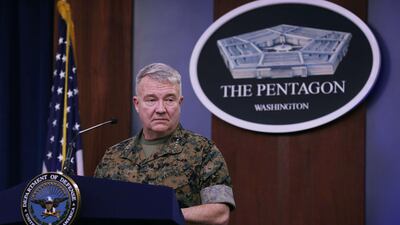
Former Iraqi PM Haidar Al Abadi has sparked a political row in Iraq after claiming that his successor Adel Abdul Mahdi had given permission for the US aircraft that were about to kill Iranian General Qassem Suleimani to enter Iraqi airspace.
Mr Al Abadi said "the plane that targeted the leaders [Suleimani and Abu Mahdi Al Muhandis] near Baghdad Airport had Iraqi permission". The statement alludes to responsibility of the government, without directly saying Iraqi officials knew what the mission of the plane was.
He made the remarks as an Iraqi Air Force document was released to the media, confirming that US aircraft, including drones, had been permitted to fly over Iraqi airspace on January 3, the day the targeting killing occurred.
The authorisation, signed by Iraqi air defence commander Jabbar Obeid Kazem hours after the air strike took place, said that “three drones had entered Baghdad airspace hours before the operation and flew towards the airport ”.
Mr Abdul Mahdi's media office denied the accusation in a lengthy Facebook post on Friday, saying "hours before the assassination" the US had sought removal of some flight restrictions place on coalition forces and entry into restricted airspace.
"None of the Iraqi authorities granted such permission," it wrote, urging anyone with contrary information to come forward.
"Anyone who possesses real information about the incident must submit it to the judiciary active in this matter, and it is wrong to accuse parties who have no immediate relationship to the matter... According to the daily orders and official records, there is nothing consistent with what was rumoured."
The killing of Suleimani, who was the commander of the Islamic Revolutionary Guard Corps Quds Force (IRGC-QF) almost led to war between Iran and the US.
Iran's supreme leader Ayatollah Ali Khamenei described Suleimani as a “living martyr” and Iran pledged to react by targeting US forces. Within a week, Iran had launched a barrage of ballistic missiles into Iraq, targeting joint US-Iraqi bases and injuring 100 American soldiers, who were sheltering in bunkers but suffered concussive injuries.
Since then, US and British forces stationed in Iraq have come under repeated attack from Iran-leaning Iraqi militias.
Alongside Suleimani, the January 3 drone strike also killed Abu Mahdi Al Muhandis, the de facto commander of Iraqi militia umbrella organisation the Popular Mobilisation Forces (PMF). Muhandis, a close associate of Suleimani, was a well-known loyalist of the Iranian regime, leading the Iran-funded militia group Kataib Hezbollah, itself a part of the PMF.
The latter killing also provoked a political storm in Iraq: Iran-leaning groups viewed Muhandis as being vital to the war on ISIS.
His detractors claim he was responsible for killing hundreds of Shiite anti-government protesters in October 2019; prior to that, Muhandis’ group were accused of killing hundreds of Sunni civilians in the war on ISIS. Kataib Hezbollah's numerous fatal attacks on US forces between 2008 and 2011, and again in December 2019, were also likely a factor in the US decision to launch the January 3 air strike.
Dangerous allegations
Because the attack occurred near Baghdad's airport after Suleimani's convoy had departed on the airport road, pro-Iranian groups in Iraq demanded an immediate investigation, claiming that Iraqi agents of the US had facilitated the killing.
In July, Kataib Hezbollah threatened current Prime Minister Mustafa Al Kadhimi, who is close to former Mr Al Abadi, accusing him of being directed by “his American masters”, due to his US-leaning policies, pledges to rein in militia power and his previous role as director of the Iraqi National Intelligence Service.
The latter organisation worked with US intelligence agencies when Mr Al Abadi was in power, at the height of the war against ISIS.
The allegation that Mr Abdul Mahdi may have known about the attacks in advance has caused a small political shockwave in Baghdad. Mr Abdul Mahdi was formerly a member of the Iran-leaning Islamic Supreme Council of Iraq and although he later left the group, critics say he never relinquished loyalty to Tehran. This perception only hardened when the former PM refused to investigate pro-Iran militia groups for gunning down protesters.
The accusations made by Mr Al Abadi point to a widening rift among the elites in Baghdad.
MP Moeen Al Kadhimi of the Iran-leaning Badr Organisation has claimed that Mr Abdul Mahdi only allowed Coalition aircraft to overfly Baghdad on January 3, not permitting them to conduct an airstrike.
But Mr Abdul Mahdi had previously demanded that all Coalition missions, including flights by drones, must be authorised by the Prime Minister’s Office, issuing instructions to the same effect in August 2019.
This suggests Mr Abdul Mahdi would have been aware that US aircraft were airborne and potentially, posed a threat to Suleimani and Muhandes.
A week prior to Suleimani’s killing, US aircraft launched a series of air strikes on Kataib Hezbollah, killing dozens of the group’s members after an American contractor was killed in a Kataib Hezbollah rocket attack on December 27, 2019.
Critics said that Mr Abdul Mahdi made the decision to restrict Coalition air strikes under Iranian pressure, since Iran-backed groups including Kataib Hezbollah were moving men and equipment across the Syrian border.
In response to Mr Al Abadi’s allegations, the Badr Organisation and its Fatah parliamentary bloc have called for an immediate investigation.
This could worsen an increasingly acrimonious row between Mr Al Abadi and Mr Al Kadhimi on one side, and Iran-leaning Shiite elites on the other, including Badr Organisation head Hadi Al Amiri and former PM Nouri Al Maliki.
This article was updated to reflect the tone of Mr Al Abadi's comments and add Mr Abdel Mahdi's response.

Full Party in the Park line-up
2pm – Andreah
3pm – Supernovas
4.30pm – The Boxtones
5.30pm – Lighthouse Family
7pm – Step On DJs
8pm – Richard Ashcroft
9.30pm – Chris Wright
10pm – Fatboy Slim
11pm – Hollaphonic
Company%20profile
%3Cp%3E%3Cstrong%3EName%3A%3C%2Fstrong%3E%20Belong%3Cbr%3E%3Cstrong%3EBased%3A%3C%2Fstrong%3E%20Dubai%3Cbr%3E%3Cstrong%3EFounders%3A%3C%2Fstrong%3E%20Michael%20Askew%20and%20Matthew%20Gaziano%3Cbr%3E%3Cstrong%3ESector%3A%3C%2Fstrong%3E%20Technology%3Cbr%3E%3Cstrong%3ETotal%20funding%3A%3C%2Fstrong%3E%20%243.5%20million%20from%20crowd%20funding%20and%20angel%20investors%3Cstrong%3E%3Cbr%3ENumber%20of%20employees%3A%3C%2Fstrong%3E%2012%3C%2Fp%3E%0A
Conflict, drought, famine
Estimates of the number of deaths caused by the famine range from 400,000 to 1 million, according to a document prepared for the UK House of Lords in 2024.
It has been claimed that the policies of the Ethiopian government, which took control after deposing Emperor Haile Selassie in a military-led revolution in 1974, contributed to the scale of the famine.
Dr Miriam Bradley, senior lecturer in humanitarian studies at the University of Manchester, has argued that, by the early 1980s, “several government policies combined to cause, rather than prevent, a famine which lasted from 1983 to 1985. Mengistu’s government imposed Stalinist-model agricultural policies involving forced collectivisation and villagisation [relocation of communities into planned villages].
The West became aware of the catastrophe through a series of BBC News reports by journalist Michael Buerk in October 1984 describing a “biblical famine” and containing graphic images of thousands of people, including children, facing starvation.
Band Aid
Bob Geldof, singer with the Irish rock group The Boomtown Rats, formed Band Aid in response to the horrific images shown in the news broadcasts.
With Midge Ure of the band Ultravox, he wrote the hit charity single Do They Know it’s Christmas in December 1984, featuring a string of high-profile musicians.
Following the single’s success, the idea to stage a rock concert evolved.
Live Aid was a series of simultaneous concerts that took place at Wembley Stadium in London, John F Kennedy Stadium in Philadelphia, the US, and at various other venues across the world.
The combined event was broadcast to an estimated worldwide audience of 1.5 billion.
Dengue%20fever%20symptoms
%3Cul%3E%0A%3Cli%3EHigh%20fever%3C%2Fli%3E%0A%3Cli%3EIntense%20pain%20behind%20your%20eyes%3C%2Fli%3E%0A%3Cli%3ESevere%20headache%3C%2Fli%3E%0A%3Cli%3EMuscle%20and%20joint%20pains%3C%2Fli%3E%0A%3Cli%3ENausea%3C%2Fli%3E%0A%3Cli%3EVomiting%3C%2Fli%3E%0A%3Cli%3ESwollen%20glands%3C%2Fli%3E%0A%3Cli%3ERash%3C%2Fli%3E%0A%3C%2Ful%3E%0A%3Cp%3EIf%20symptoms%20occur%2C%20they%20usually%20last%20for%20two-seven%20days%3C%2Fp%3E%0A
more from Janine di Giovanni
Bombshell
Director: Jay Roach
Stars: Nicole Kidman, Charlize Theron, Margot Robbie
Four out of five stars
Mercer, the investment consulting arm of US services company Marsh & McLennan, expects its wealth division to at least double its assets under management (AUM) in the Middle East as wealth in the region continues to grow despite economic headwinds, a company official said.
Mercer Wealth, which globally has $160 billion in AUM, plans to boost its AUM in the region to $2-$3bn in the next 2-3 years from the present $1bn, said Yasir AbuShaban, a Dubai-based principal with Mercer Wealth.
“Within the next two to three years, we are looking at reaching $2 to $3 billion as a conservative estimate and we do see an opportunity to do so,” said Mr AbuShaban.
Mercer does not directly make investments, but allocates clients’ money they have discretion to, to professional asset managers. They also provide advice to clients.
“We have buying power. We can negotiate on their (client’s) behalf with asset managers to provide them lower fees than they otherwise would have to get on their own,” he added.
Mercer Wealth’s clients include sovereign wealth funds, family offices, and insurance companies among others.
From its office in Dubai, Mercer also looks after Africa, India and Turkey, where they also see opportunity for growth.
Wealth creation in Middle East and Africa (MEA) grew 8.5 per cent to $8.1 trillion last year from $7.5tn in 2015, higher than last year’s global average of 6 per cent and the second-highest growth in a region after Asia-Pacific which grew 9.9 per cent, according to consultancy Boston Consulting Group (BCG). In the region, where wealth grew just 1.9 per cent in 2015 compared with 2014, a pickup in oil prices has helped in wealth generation.
BCG is forecasting MEA wealth will rise to $12tn by 2021, growing at an annual average of 8 per cent.
Drivers of wealth generation in the region will be split evenly between new wealth creation and growth of performance of existing assets, according to BCG.
Another general trend in the region is clients’ looking for a comprehensive approach to investing, according to Mr AbuShaban.
“Institutional investors or some of the families are seeing a slowdown in the available capital they have to invest and in that sense they are looking at optimizing the way they manage their portfolios and making sure they are not investing haphazardly and different parts of their investment are working together,” said Mr AbuShaban.
Some clients also have a higher appetite for risk, given the low interest-rate environment that does not provide enough yield for some institutional investors. These clients are keen to invest in illiquid assets, such as private equity and infrastructure.
“What we have seen is a desire for higher returns in what has been a low-return environment specifically in various fixed income or bonds,” he said.
“In this environment, we have seen a de facto increase in the risk that clients are taking in things like illiquid investments, private equity investments, infrastructure and private debt, those kind of investments were higher illiquidity results in incrementally higher returns.”
The Abu Dhabi Investment Authority, one of the largest sovereign wealth funds, said in its 2016 report that has gradually increased its exposure in direct private equity and private credit transactions, mainly in Asian markets and especially in China and India. The authority’s private equity department focused on structured equities owing to “their defensive characteristics.”
FIGHT CARD
From 5.30pm in the following order:
Featherweight
Marcelo Pontes (BRA) v Azouz Anwar (EGY)
Catchweight 90kg
Moustafa Rashid Nada (KSA) v Imad Al Howayeck (LEB)
Welterweight
Mohammed Al Khatib (JOR) v Gimbat Ismailov (RUS)
Flyweight (women)
Lucie Bertaud (FRA) v Kelig Pinson (BEL)
Lightweight
Alexandru Chitoran (BEL) v Regelo Enumerables Jr (PHI)
Catchweight 100kg
Mohamed Ali (EGY) v Marc Vleiger (NED)
Featherweight
James Bishop (AUS) v Mark Valerio (PHI)
Welterweight
Gerson Carvalho (BRA) v Abdelghani Saber (EGY)
Middleweight
Bakhtiyar Abbasov (AZE) v Igor Litoshik (BLR)
Bantamweight:
Fabio Mello (BRA) v Mark Alcoba (PHI)
Welterweight
Ahmed Labban (LEB) v Magomedsultan Magemedsultanov (RUS)
Bantamweight
Trent Girdham (AUS) v Jayson Margallo (PHI)
Lightweight
Usman Nurmagomedov (RUS) v Roman Golovinov (UKR)
Middleweight
Tarek Suleiman (SYR) v Steve Kennedy (AUS)
Lightweight
Dan Moret (USA) v Anton Kuivanen (FIN)
THE BIO
Ms Davison came to Dubai from Kerala after her marriage in 1996 when she was 21-years-old
Since 2001, Ms Davison has worked at many affordable schools such as Our Own English High School in Sharjah, and The Apple International School and Amled School in Dubai
Favourite Book: The Alchemist
Favourite quote: Failing to prepare is preparing to fail
Favourite place to Travel to: Vienna
Favourite cuisine: Italian food
Favourite Movie : Scent of a Woman
MATCH INFO
West Ham United 2 (Antonio 73', Ogbonna 90 5')
Tottenham Hotspur 3 (Son 36', Moura 42', Kane 49')
MEYDAN RESULTS
6.30pm Baniyas (PA) Group 2 Dh125,000 (Dirt) 1,400m
Winner ES Ajeeb, Sam Hitchcock (jockey), Ibrahim Aseel (trainer).
7.05pm Maiden (TB) Dh165,000 (D) 1,200m
Winner Galaxy Road, Antonio Fresu, Musabah Al Muhairi.
7.40pm Maiden (TB) Dh165,000 (D) 1,400m
Winner Al Modayar, Fernando Jara, Ali Rashid Al Raihe.
8.15pm Handicap (TB) Dh170,000 (D) 1,900m
Winner Gundogdu, Xavier Ziani, Salem bin Ghadayer.
8.50pm Rated Conditions (TB) Dh240,000 (D) 1,600m
Winner George Villiers, Tadhg O’Shea, Satish Seemar.
9.25pm Handicap (TB) Dh175,000 (D)1,200m
Winner Lady Parma, Connor Beasley, Satish Seemar
10pm Handicap (TB) Dh165,000 (D) 1,400m
Winner Zaajer, Fernando Jara, Ali Rashid Al Raihe
Anxiety and work stress major factors
Anxiety, work stress and social isolation are all factors in the recogised rise in mental health problems.
A study UAE Ministry of Health researchers published in the summer also cited struggles with weight and illnesses as major contributors.
Its authors analysed a dozen separate UAE studies between 2007 and 2017. Prevalence was often higher in university students, women and in people on low incomes.
One showed 28 per cent of female students at a Dubai university reported symptoms linked to depression. Another in Al Ain found 22.2 per cent of students had depressive symptoms - five times the global average.
It said the country has made strides to address mental health problems but said: “Our review highlights the overall prevalence of depressive symptoms and depression, which may long have been overlooked."
Prof Samir Al Adawi, of the department of behavioural medicine at Sultan Qaboos University in Oman, who was not involved in the study but is a recognised expert in the Gulf, said how mental health is discussed varies significantly between cultures and nationalities.
“The problem we have in the Gulf is the cross-cultural differences and how people articulate emotional distress," said Prof Al Adawi.
“Someone will say that I have physical complaints rather than emotional complaints. This is the major problem with any discussion around depression."
Daniel Bardsley
MOUNTAINHEAD REVIEW
Starring: Ramy Youssef, Steve Carell, Jason Schwartzman
Director: Jesse Armstrong
Rating: 3.5/5
What is a Ponzi scheme?
A fraudulent investment operation where the scammer provides fake reports and generates returns for old investors through money paid by new investors, rather than through ligitimate business activities.
MANDOOB
%3Cp%3EDirector%3A%20Ali%20Kalthami%3C%2Fp%3E%0A%3Cp%3EStarring%3A%20Mohammed%20Dokhei%2C%20Sarah%20Taibah%2C%20Hajar%20Alshammari%3C%2Fp%3E%0A%3Cp%3ERating%3A%204%2F5%3C%2Fp%3E%0A%3Cp%3E%3C%2Fp%3E%0A
Banthology: Stories from Unwanted Nations
Edited by Sarah Cleave, Comma Press
GIANT REVIEW
Starring: Amir El-Masry, Pierce Brosnan
Director: Athale
Rating: 4/5