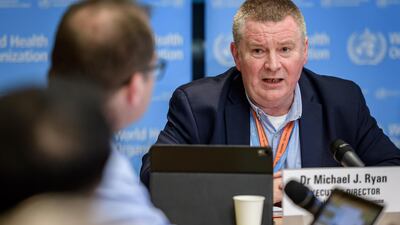
The supposedly more developed northern hemisphere needs to learn better from African and Asian countries’ response to the Covid-19 pandemic, a senior World Health Organisation (WHO) official said, as he condemned the abject failure of contact tracing.
Dr Michael Ryan, the director of the WHO’s emergencies programme, said the southern hemisphere had led the way in its response to the virus because of stronger community interventions, contact tracing, surveillance and controlling infections while engaging with communities.
The transfer of technology was no longer a binary movement from north to south, he told the virtual World Health Summit. “This is a four-point compass. Learning and knowledge moves in all directions,” he said, while also praising the work of Global Outbreak Alert and Response Network, which works to combat health epidemics.
Dr Ryan was also deeply critical of the inability to get contact tracing working at an optimal level, meaning that many were walking around unaware they have contracted the virus.
“One of the abject failures in this pandemic response, to be quite frank, has been that central principle of contact tracing - the ability to detect and isolate cases, to quarantine contacts in a supportive way and, importantly, to have communities buy into that,” Dr Ryan said.
Part of the issue, he said, was a lack of trust among people. In the UK there have been repeated issues with the track and trace system, as well as delays in its implementation.
“Trust is given by a community, it is not taken by the authorities. It is a gift from the community and it takes years to build that trust. You can’t build it overnight and you can break it in minutes or days,” he said.
“From that perspective, if we have trust then communities do accept things like contact tracing, they will accept things like supported quarantine, they will accept stay at home orders, but they will do that when they see public health authorities making ground and achieving success and delivering their economies and their social lives back to them.
“There has been a great breach in that trust.”
Dr Ryan said there needed to be a better understanding of what really drives concerns in the community because too often assumptions were made that may have been wrong.
While governments have also had a raft of wider issues to deal with emanating from Covid-19, such as managing the economy and breathing new life into business sectors, they have also faced criticism for loosening restrictions too soon.
But Dr Ryan urged health experts to stand up for their convictions amid an array of competing priorities among policymakers.
“This is a time, and I’m sorry to say it quite openly, where politics has crushed public health in many circumstances,” Dr Ryan said.
“It is time for public health leaders all over the world to stand up for our communities, to stand up for science, to stand up for what is right, and be open to criticism when we do that and be open to be challenged and be prepared to be wrong, because no one is right all the time.
“I do think we need courage and we need the courage of our convictions and we need to do that every day. The price we may pay for that sometimes is our career but what the hell, at the end of the day we serve people.”
WHO director-general Tedros Adhanom Ghebreyesus has warned it is a critical moment for many countries in the northern hemisphere as they grabble with a surge in cases, and governments introduce tougher restrictions on movement and social activities.

Tamkeen's offering
- Option 1: 70% in year 1, 50% in year 2, 30% in year 3
- Option 2: 50% across three years
- Option 3: 30% across five years
The specs
Engine: 2-litre 4-cylinder and 3.6-litre 6-cylinder
Power: 220 and 280 horsepower
Torque: 350 and 360Nm
Transmission: eight-speed automatic
Price: from Dh136,521 VAT and Dh166,464 VAT
On sale: now
Global state-owned investor ranking by size
|
1.
|
United States
|
|
2.
|
China
|
|
3.
|
UAE
|
|
4.
|
Japan
|
|
5
|
Norway
|
|
6.
|
Canada
|
|
7.
|
Singapore
|
|
8.
|
Australia
|
|
9.
|
Saudi Arabia
|
|
10.
|
South Korea
|
Mercer, the investment consulting arm of US services company Marsh & McLennan, expects its wealth division to at least double its assets under management (AUM) in the Middle East as wealth in the region continues to grow despite economic headwinds, a company official said.
Mercer Wealth, which globally has $160 billion in AUM, plans to boost its AUM in the region to $2-$3bn in the next 2-3 years from the present $1bn, said Yasir AbuShaban, a Dubai-based principal with Mercer Wealth.
“Within the next two to three years, we are looking at reaching $2 to $3 billion as a conservative estimate and we do see an opportunity to do so,” said Mr AbuShaban.
Mercer does not directly make investments, but allocates clients’ money they have discretion to, to professional asset managers. They also provide advice to clients.
“We have buying power. We can negotiate on their (client’s) behalf with asset managers to provide them lower fees than they otherwise would have to get on their own,” he added.
Mercer Wealth’s clients include sovereign wealth funds, family offices, and insurance companies among others.
From its office in Dubai, Mercer also looks after Africa, India and Turkey, where they also see opportunity for growth.
Wealth creation in Middle East and Africa (MEA) grew 8.5 per cent to $8.1 trillion last year from $7.5tn in 2015, higher than last year’s global average of 6 per cent and the second-highest growth in a region after Asia-Pacific which grew 9.9 per cent, according to consultancy Boston Consulting Group (BCG). In the region, where wealth grew just 1.9 per cent in 2015 compared with 2014, a pickup in oil prices has helped in wealth generation.
BCG is forecasting MEA wealth will rise to $12tn by 2021, growing at an annual average of 8 per cent.
Drivers of wealth generation in the region will be split evenly between new wealth creation and growth of performance of existing assets, according to BCG.
Another general trend in the region is clients’ looking for a comprehensive approach to investing, according to Mr AbuShaban.
“Institutional investors or some of the families are seeing a slowdown in the available capital they have to invest and in that sense they are looking at optimizing the way they manage their portfolios and making sure they are not investing haphazardly and different parts of their investment are working together,” said Mr AbuShaban.
Some clients also have a higher appetite for risk, given the low interest-rate environment that does not provide enough yield for some institutional investors. These clients are keen to invest in illiquid assets, such as private equity and infrastructure.
“What we have seen is a desire for higher returns in what has been a low-return environment specifically in various fixed income or bonds,” he said.
“In this environment, we have seen a de facto increase in the risk that clients are taking in things like illiquid investments, private equity investments, infrastructure and private debt, those kind of investments were higher illiquidity results in incrementally higher returns.”
The Abu Dhabi Investment Authority, one of the largest sovereign wealth funds, said in its 2016 report that has gradually increased its exposure in direct private equity and private credit transactions, mainly in Asian markets and especially in China and India. The authority’s private equity department focused on structured equities owing to “their defensive characteristics.”
The biog
Name: Sari Al Zubaidi
Occupation: co-founder of Cafe di Rosati
Age: 42
Marital status: single
Favourite drink: drip coffee V60
Favourite destination: Bali, Indonesia
Favourite book: 100 Years of Solitude
GOLF’S RAHMBO
- 5 wins in 22 months as pro
- Three wins in past 10 starts
- 45 pro starts worldwide: 5 wins, 17 top 5s
- Ranked 551th in world on debut, now No 4 (was No 2 earlier this year)
- 5th player in last 30 years to win 3 European Tour and 2 PGA Tour titles before age 24 (Woods, Garcia, McIlroy, Spieth)
ENGLAND SQUAD
Team: 15 Mike Brown, 14 Anthony Watson, 13 Ben Te'o, 12 Owen Farrell, 11 Jonny May, 10 George Ford, 9 Ben Youngs, 1 Mako Vunipola, 2 Dylan Hartley, 3 Dan Cole, 4 Joe Launchbury, 5 Maro Itoje, 6 Courtney Lawes, 7 Chris Robshaw, 8 Sam Simmonds
Replacements 16 Jamie George, 17 Alec Hepburn, 18 Harry Williams, 19 George Kruis, 20 Sam Underhill, 21 Danny Care, 22 Jonathan Joseph, 23 Jack Nowell
Key Points
- Protests against President Omar Al Bashir enter their sixth day
- Reports of President Bashir's resignation and arrests of senior government officials
Various Artists
Habibi Funk: An Eclectic Selection Of Music From The Arab World (Habibi Funk)
