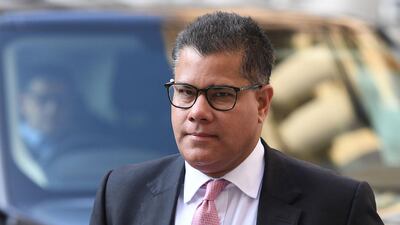
UN climate talks must go ahead in June even if negotiations are held online, Britain's president of the Cop26 summit said on Tuesday, despite "valid concerns" over the lack of direct dialogue.
In an open letter to countries that are party to the UN Framework Convention on Climate Change, Alok Sharma said formal talks were needed to lay the groundwork for the agenda at Cop26, set for November in Glasgow.
Mr Sharma said that Covid-19 restrictions would probably mean the session, traditionally held at the convention's headquarters in the German city of Bonn, would probably take place online.
This is despite concerns raised by several countries that remote talks could prejudice their position as equal parties to richer emitters at the crucial negotiations.
"The UNFCCC are taking the necessary steps to accommodate those challenges, including connectivity, working across time zones, and group co-ordination," Mr Sharma said.
Cop26 was originally scheduled for November 2020 but was pushed back 12 months by the pandemic.
There are fears that some countries will be unable to attend the talks in person because of sluggish or non-existent vaccination campaigns.
Mr Sharma again indicated his strong preference for Cop26 to take place "in person" but said delegates needed to arrive in Glasgow "having done our homework".
The list facing participants in Glasgow is daunting.
Delegates are faced with dire warnings from scientists about the scale of emissions cuts needed to keep withingoal of limiting global warming to 1.5°C above pre-industrial levels, as laid out in the Paris agreement.
The deal, struck more than five years ago, committed nations to resubmit their emissions-cutting plans every five years.
Yet many of the largest emitters have so far failed to do so and countries have not even agreed on unified rules governing how the Paris agreement works in practice.
Mr Sharma said Cop26 must see "substantive decisions" on the issue of emissions trading and accounting, as well as significantly increasing finance to climate-vulnerable nations to help them adapt to the warming world.
The UN says that emissions must fall nearly 8 per cent a year to keep the target within reach, equal to the emissions saved during the pandemic for every single year to 2030.
Mr Sharma indicated that another negotiating session might be needed to bring countries closer together before Glasgow, "in person, should it be feasible".
"Such an approach to formal sessions and capturing progress is, in my view, the only way we will make sufficient progress ahead of meeting in person in Glasgow to ensure Cop26 delivers on its mandates and what the world expects of us," he said.

Killing of Qassem Suleimani
The drill
Recharge as needed, says Mat Dryden: “We try to make it a rule that every two to three months, even if it’s for four days, we get away, get some time together, recharge, refresh.” The couple take an hour a day to check into their businesses and that’s it.
Stick to the schedule, says Mike Addo: “We have an entire wall known as ‘The Lab,’ covered with colour-coded Post-it notes dedicated to our joint weekly planner, content board, marketing strategy, trends, ideas and upcoming meetings.”
Be a team, suggests Addo: “When training together, you have to trust in each other’s abilities. Otherwise working out together very quickly becomes one person training the other.”
Pull your weight, says Thuymi Do: “To do what we do, there definitely can be no lazy member of the team.”
Ten tax points to be aware of in 2026
1. Domestic VAT refund amendments: request your refund within five years
If a business does not apply for the refund on time, they lose their credit.
2. E-invoicing in the UAE
Businesses should continue preparing for the implementation of e-invoicing in the UAE, with 2026 a preparation and transition period ahead of phased mandatory adoption.
3. More tax audits
Tax authorities are increasingly using data already available across multiple filings to identify audit risks.
4. More beneficial VAT and excise tax penalty regime
Tax disputes are expected to become more frequent and more structured, with clearer administrative objection and appeal processes. The UAE has adopted a new penalty regime for VAT and excise disputes, which now mirrors the penalty regime for corporate tax.
5. Greater emphasis on statutory audit
There is a greater need for the accuracy of financial statements. The International Financial Reporting Standards standards need to be strictly adhered to and, as a result, the quality of the audits will need to increase.
6. Further transfer pricing enforcement
Transfer pricing enforcement, which refers to the practice of establishing prices for internal transactions between related entities, is expected to broaden in scope. The UAE will shortly open the possibility to negotiate advance pricing agreements, or essentially rulings for transfer pricing purposes.
7. Limited time periods for audits
Recent amendments also introduce a default five-year limitation period for tax audits and assessments, subject to specific statutory exceptions. While the standard audit and assessment period is five years, this may be extended to up to 15 years in cases involving fraud or tax evasion.
8. Pillar 2 implementation
Many multinational groups will begin to feel the practical effect of the Domestic Minimum Top-Up Tax (DMTT), the UAE's implementation of the OECD’s global minimum tax under Pillar 2. While the rules apply for financial years starting on or after January 1, 2025, it is 2026 that marks the transition to an operational phase.
9. Reduced compliance obligations for imported goods and services
Businesses that apply the reverse-charge mechanism for VAT purposes in the UAE may benefit from reduced compliance obligations.
10. Substance and CbC reporting focus
Tax authorities are expected to continue strengthening the enforcement of economic substance and Country-by-Country (CbC) reporting frameworks. In the UAE, these regimes are increasingly being used as risk-assessment tools, providing tax authorities with a comprehensive view of multinational groups’ global footprints and enabling them to assess whether profits are aligned with real economic activity.
Contributed by Thomas Vanhee and Hend Rashwan, Aurifer
