
Turkey’s Parliament passed a law on Wednesday introducing powers to regulate social media despite concerns it will increase online censorship and silence dissent.
The law, which was backed by President Tayyip Erdogan’s ruling AKP, requires foreign media sites such as Twitter and Facebook to keep representative offices in Turkey to respond to complaints from authorities against content on their platforms.
Companies could face steep fines, blocked advertisements and bandwidth reductions if they refuse to comply with requests under the regulations, which lay out deadlines for the removal of content deemed offensive.
The new legislation also requires social media providers to store user data in Turkey.
The government said the legislation is needed to combat cyber crime and protect users.
In Parliament on Wednesday morning, ruling party politician Rumeysa Kadak said it would be used to remove posts that contain bullying and insults against women.
Critics said the law will further limit freedom of expression in a country where the media is already under tight government control and dozens of journalists are in jail.
“The new law will enable the government to control social media, to get content removed at will, and to arbitrarily target individual users,” said Tom Porteous, deputy programme director at Human Rights Watch. “Social media is a lifeline for many people who use it to access news, so this law signals a new dark era of online censorship.”
Mr Erdogan has said the new law was needed to “control social media platforms” and eradicate immorality.
Turkey leads the world in removal requests to Twitter, with more than 6,000 demands in the first half of 2019. According to the Freedom of Expression Association, more than 408,000 websites are blocked in Turkey.
-

Turkey's President Recep Tayyip Erdogan and invited guests at the Hagia Sophia in Istanbul on July 24, 2020 to attend the first Friday prayers there since it was converted back to mosque by his government. Turkish Presidential Service / AFP -

President Erdogan said afterwards that reverting the 6th-century structure from a museum to a mosque 'was a dream of my youth'. Turkish Presidential Service / AFP -

About 500 dignitaries were invited to attend the inaugural Friday prayers at the converted mosque. Turkish Presidential Service / AFP -

The Turkish president estimated that about 350,000 worshippers converged on the mosque for the occasion. Turkish Presidential Service / AFP -

The Hagia Sophia's famed Byzantine frescoes and mosaics were obscured by curtains during the prayers. Turkish Presidential Service / AFP -

A man wearing a t-shirt with the Turkish flag stands as people wait for the beginning of Friday prayers outside Hagia Sophia Grand Mosque, after it was once again declared a mosque after 86 years, in Istanbul, Turkey. Reuters -

People wait for the beginning of Friday prayers outside Hagia Sophia. Reuters -

Turkish President Recep Tayyip Erdogan is due attend the inaugural prayers. EPA -

The Turkish president, Recep Tayyip Erdogan said the move was the 'yearning of our people'. EPA -

Dozens of worshippers broke through one police checkpoint to rush toward Hagia Sophia and social distancing practices, in place due to the coronavirus outbreak, were being ignored, Turkish media reported. Reuters -

Thousands of men and women, including many who travelled from across Turkey, quickly filled segregated areas outside of Hagia Sophia to be part of the first prayers. AP -
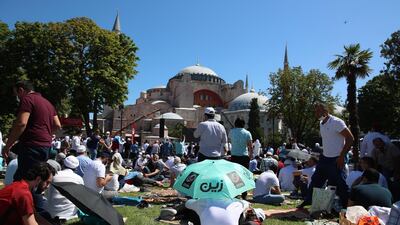
Brushing aside international criticism, Erdogan issued a decree restoring the iconic building as a mosque earlier this month, shortly after a Turkish high court ruled that the Hagia Sophia had been illegally made into a museum more than eight decades ago. EPA -

The move sparked dismay in Greece, the US and among Christian churches who had called on Mr Erdogan to maintain it as a museum as a nod to Istanbul's multi-religious heritage. EPA -

Built by the Byzantine Emperor Justinian in 537, Hagia Sophia was turned into a mosque with the 1453 Ottoman conquest of Istanbul. EPA -

Mustafa Kemal Ataturk, the founding leader of the secular Turkish republic converted the structure into a museum in 1934. Reuters


Online encyclopedia Wikipedia was blocked for nearly three years before Turkey’s highest court ruled that the ban violated the right to freedom of expression and ordered it unblocked.
The law passed after 16 hours of tense deliberations in Parliament, where Mr Erdogan’s ruling party and its nationalist ally hold the majority of seats. It will be published in the Official Gazette after Mr Erdogan approves it.

