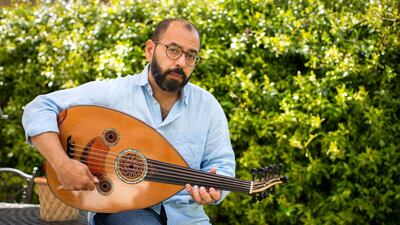
Through the walls of his teenage bedroom, Attab Haddad’s ears pricked up at the unfamiliar strains of a stringed instrument being plucked by his brother next door.
Haddad had found himself, at the age of 27, back living in the family home in Wimbledon, south-west London, after drifting from one job to another.
When he walked away from a career in finance in the City, his parents even feared that he was having a breakdown.
But the fruitless search to find something, anything, that he was passionate about was about to come to an end.
"The first time I heard the oud is very clear in my mind," Haddad tells The National. "My brother Mishaal had been to the Emirates to visit our dad, who was working there.
“He had an oud stored in his closet that he had bought 20 years earlier but never touched. Mishaal brought it back with him, found a teacher in London and started taking lessons.
“I could hear him in his room, practising and noodling. So I started playing it myself, just trying to replicate melodies that I had heard. I found I had an aptitude for it, began taking lessons – and then I became completely obsessed.”
Nearly two decades on, Haddad, now 45, is an aficionado of the instrument that has been played in his parents' homeland of Iraq for thousands of years. Instead of adopting a traditional style, though, his original compositions fuse Arabic and Turkish music with elements of jazz and flamenco.
That old Syrian oud was, he recalls, in such a pitiful condition that he could slide his fingers between the strings and the fingerboard. But, as Haddad says, “if you could play an instrument that was that bad, you could play anything”.
His mastery of the lute-like instrument has led to collaborations with Catatonia singer Cerys Matthews, flamenco guitarist Ramon Ruiz, U2 composer and music arranger John Metcalfe and chamber musician Max Baillie.
But his route to discovering his metier was far from straightforward. It took him via the business, banking and restaurant worlds, before he realised that the musical talent he first exhibited at the age of 3 was his true calling.

Haddad’s love of the oud has brought him closer to his Middle Eastern heritage, too, despite last visiting Baghdad in 1990.
His lineage is woven through the history and political fabric of Iraq, a relationship that continues to this day with his youngest brother Fanar, 40, who is a senior adviser to Prime Minister Mustafa Al Kadhimi.
Their maternal great-grandfather, Salman Al-Barrak, was a sheikh of the Albu Sultan tribe and took part in the 1920 Iraqi revolt. He was jailed by the British for his efforts.
On his release, Al-Barrak held several ministerial posts in the Iraqi government and completed two stints as the speaker of Parliament, as well as forming part of the country’s first delegation to the League of Nations in 1932. His son Abood Al-Haimous also became an MP.
Haddad himself was born in London after his parents Ali, now 75, and Ghada, 66, left Baghdad in the 1970s as the oppressive Baathist regime gained power.

The family relocated to Abu Dhabi when he was 3, where he spent a happy childhood in Al Bateen, attending first the British School Al Khubairat and then Choueifat International School.
“I feel really at home in Abu Dhabi,” he says. “They speak of multiculturalism in London but it really is multicultural there. I grew up with friends from everywhere – from Ethiopia, to European countries, to Indians and all kinds of Arabs from the Levant and Egypt to Iraq and the Gulf.”
Summers were spent visiting family in Baghdad, where get-togethers usually involved an assortment of musical instruments being produced for an impromptu session and singalong.
"I started drumming when I was 3 and was introduced to keyboards when I was 9," says Haddad. "Everyone had some sort of musical instrument. I came across a darbuka [drum] and it was a natural thing for me. I'm told I used to fall asleep drumming on my belly. It was all Iraqi music because that was what I learnt from my cousins."

When he was 15, Haddad moved back to London with Ghada and his brothers while his father carried on working in the UAE.
“The first year was very hard,” he says. “We went to a boarding school as day pupils. We were the only non-white people in the school and were treated differently. It wasn’t an easy transition but things gradually got better and we made friends.”
He did, he admits, "coast through" the education system, immersing himself in pop music and plastering his walls with posters of the new-wave band Duran Duran and singer/songwriter Nik Kershaw.
Later, during his business degree at the University of Westminster, his interest turned to the genres of dance and techno, and he was frequently to be found out clubbing.
“I was having far too much fun,” he says. “I went off the rails a bit and ended up taking a year out. When the university threatened to kick me out, that snapped me back to reality.”
He graduated in 1998 and worked for a year for his father in Abu Dhabi as a compliance officer. “It was a logical move to join the family business,” he says, “but it wasn’t something I was passionate about at all.
"Even then, it was music I was passionate about but it was never something I thought I could make a living out of at the time.”
On his return to London, he secured a job at a City bank working in hedge fund settlements. Eighteen months into that role, two hijacked planes struck the twin towers of the World Trade Centre in New York.
For Haddad, the atmosphere in the office changed overnight. "Colleagues I was friends with suddenly didn't want to speak to me any more. One of the most senior bankers was ranting in his office about Arabs," he says, still dismayed at the racist backlash he experienced after 9/11.
“It was a catalyst to move on. I woke one morning and thought, ‘I don’t even like this job or this world. I don’t want to be part of it any more.’ So I resigned.”
He turned his business acumen instead to working on an Italian restaurant launch with a family friend. That did not last long either. “You have to love it. I thought about it quite deeply and realised the only constant was the love for music.”
Deciding that he could carve out a career as a music producer, he embarked on a diploma course in sound engineering and music technology at Kingston University’s Gateway School of Music.
It was then that Mishaal played the fateful notes that would irresistibly compel his older brother to perpetuate a long tradition.
The oud, a fretless instrument with a short neck and pear-shaped body, is thought to have originated in ancient Mesopotamia more than 5,000 years ago during the Uruk period. It found its way to Europe in the Middle Ages and by the ninth century the celebrated Iraqi oud player Ziryab was holding the court in Cordoba in thrall.
“It felt right, even before I picked up the oud,” Haddad says, explaining that the sound just spoke to him.

After spending up to 10 hours a day practising, he sought out the best players in the world, signing up to a six-month course with the Iraqi and Egyptian virtuosos Naseer Shamma and Nehad El-Sayed at the Arab Oud House in Cairo.
Shamma, who opened a branch of the prestigious music school Beit Al Oud in Abu Dhabi in 2008, would give masterclasses in the courtyard of a 17th-century merchant's house, an oasis from the chaos of Egypt's capital.
Haddad had invested in a delicately crafted instrument by the famed Basra oud maker Fawzi Munshid, and played diligently from morning until night.
He was, he says, an old student and maintains that he is still getting to grips with the instrument. “Most oud players start at the age of 5 or 6 and even then they spend a lifetime learning.”
Having steeped himself in conventional oud music, he experimented with different styles and sounds. After a friend introduced him to the rhythms of southern Spain, Haddad took flamenco guitar lessons in Granada and adapted the genre for the oud.

“It was a connection bridging East and West,” he says, “a bit like me.”
He has played with several bands and musicians, including Azerbaijani jazz violinist Sabina Rakcheyeva and singer Clara Sanabras. His partnership with the flamenco guitarist Ramon Ruiz led to the formation of a fusion band called Alcazaba. And since 2011, the Attab Haddad Quintet has performed in many London venues, and even taken him as far as Saudi Arabia.
Though he has yet to play in Iraq, Haddad has of late been finding a way back to his regional roots. Since 2016, he has been studying with the Turkish pedagogue Yurdal Tokcan, who innovates with more traditional rhythms.
“For me,” he says, “it’s about getting to the point where you are speaking the same language and you are making a homogeneous thing, rather than saying: ‘Here’s an eastern instrument playing some western music.’”
Along his musical way, Haddad met his wife. Duygu Camurcuoglu, 44, an Istanbul-born conservationist at the British Museum, approached him after a gig and asked for oud lessons.

She never did learn but the pair married in Turkey in 2015 and set up home in Raynes Park on the outskirts of London, where Haddad spends two hours a day tending to their garden, practising his music, and cooking paella and barbecues more often than Middle Eastern dishes.
After a difficult year for musicians in lockdown, Haddad is starting to gig again and manages property as another income stream. He has been writing his third album during the pandemic and hopes that audiences come to appreciate his beloved instrument “on its own merits, rather than because they like Middle Eastern culture”.
Like Haddad senior before him, he has long had an oud sequestered in a closet – a rare model from the early 1900s by Manol, the Greek luthier with a reputation akin to that of Stradivarius. A gift from his father, it has been retired because it is cracked and too delicate to play.
There’s still plenty of life left in the other ouds in Haddad’s collection, though. With a string of luck, they will have many outings yet on his meandering musical journey from East to West, and back again.

