
Reverting Istanbul’s Hagia Sophia to a mosque will further undermine Turkey’s global standing on freedom of religion and minority rights,a leading expert on religious heritage said.
Turkey’s top administrative court on Friday announced its decision to revoke the 1,500-year-old former cathedral’s status as a museum.
The ruling paved the way for it to be opened as a mosque again, in a change championed by President Recep Tayyip Erdogan.
“Erdogan’s decision to convert Hagia Sophia into a mosque is a political ploy to boost his waning voter support while also a move to mark his legacy,” said Tugba Tanyeri Erdemir, a member of Turkey’s Association for the Protection of Cultural Heritage.
But taking such a step would also harm Turkey’s reputation, said Dr Erdemir, who is also a research associate at the University of Pittsburgh.
“Turkey already has a problematic track record when it comes to minority rights and freedom of religion or belief,” she said.
“Hagia Sophia's conversion will further undermine the country’s global image.
"Senior officials from the US, Russia and Greece have already expressed their concerns over Erdogan's proposed conversion plans, and many others from around the world will without a doubt join them.”
Built by the Byzantines in the 6th century, the Hagia Sophia was for centuries the world’s largest building, a centrepiece for Christianity and an engineering marvel.
After conquering Istanbul in 1453, Ottoman Sultan Mehmet II converted it into a mosque.
In 1934, Mustafa Kemal Ataturk’s secular regime turned it into a museum, a decree at the centre of Friday’s announcement by the Council of State.
It was designated a Unesco World Heritage site in the 1980s.
-
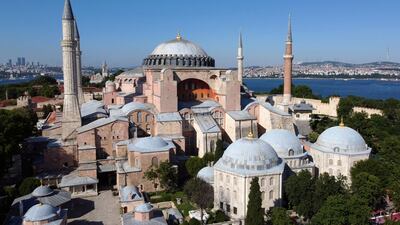
Hagia Sophia, a Unesco World Heritage Site in Istanbul. Turkey’s top administrative court revoked the 1,500-year-old former cathedral’s status as a museum. Reuters -
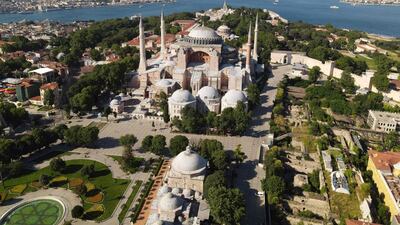
Hagia Sophia museum in Istanbul. Turkey’s top administrative court announced its decision to revoke the 1,500-year-old former cathedral’s status as a museum. AFP -
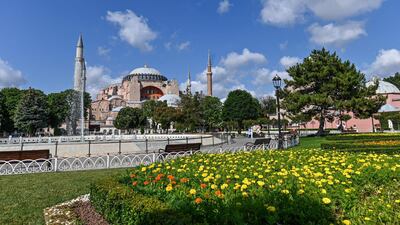
Hagia Sophia museum in Istanbul. Turkey’s top administrative court announced its decision to revoke the 1,500-year-old former cathedral’s status as a museum. AFP -
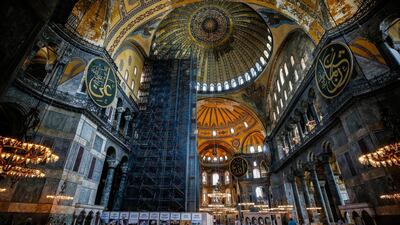
People visit the Byzantine-era Hagia Sophia, one of Istanbul's main tourist attractions. Turkey’s top administrative courtannounced its decision to revoke the 1,500-year-old former cathedral’s status as a museum. AP Photo -
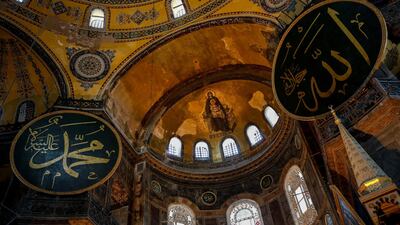
A view of the Byzantine-era Hagia Sophia, one of Istanbul's main tourist attractions. Turkey’s top administrative court announced its decision to revoke the 1,500-year-old former cathedral’s status as a museum. AP Photo -
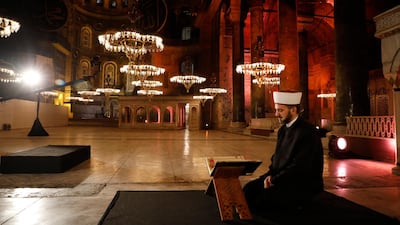
An imam recites the Quran inside Istanbul's 6th-century Hagia Sophia museum. Turkey’s top administrative court announced its decision to revoke the 1,500-year-old former cathedral’s status as a museum. AP Photo -
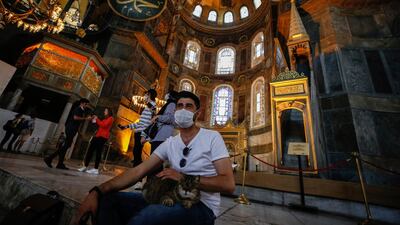
People visit the Byzantine-era Hagia Sophia, one of Istanbul's main tourist attractions. Turkey’s top administrative court announced its decision to revoke the 1,500-year-old former cathedral’s status as a museum. AP Photo -
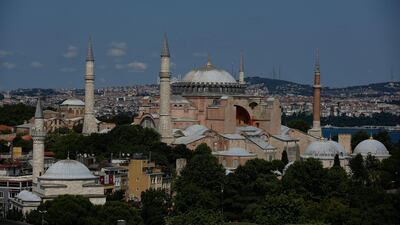
An aerial view of the Byzantine-era Hagia Sophia, one of Istanbul's main tourist attractions. Turkey’s top administrative court announced its decision to revoke the 1,500-year-old former cathedral’s status as a museum. AP Photo -

People walk by the Byzantine-era Hagia Sophia, one of Istanbul's main tourist attractions, in March 2017. Turkey’s top administrative court announced its decision to revoke the 1,500-year-old former cathedral’s status as a museum. AP Photo -
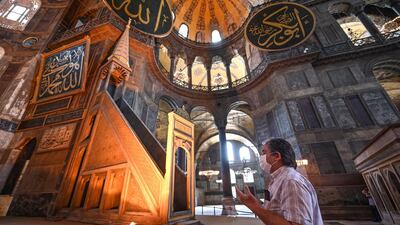
A Turkish visitor prays in Hagia Sophia museum in Istanbul. Turkey’s top administrative court announced its decision to revoke the 1,500-year-old former cathedral’s status as a museum. AFP -

A Turkish visitor prays in front of the Apsis, facing the eastern direction of Hagia Sophia, in Istanbul. Turkey’s top administrative court on Friday announced its decision to revoke the 1,500-year-old former cathedral’s status as a museum. AFP -
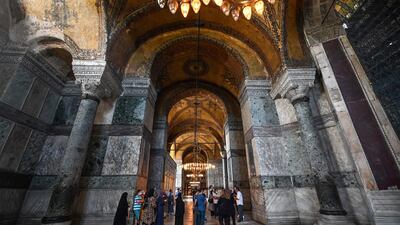
People visit Hagia Sophia museum in Istanbul. Turkey’s top administrative court announced its decision to revoke the 1,500-year-old former cathedral’s status as a museum. AFP -
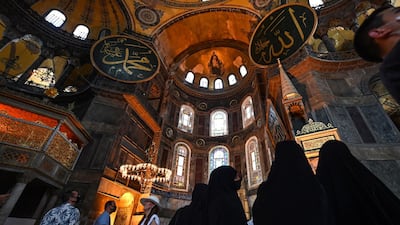
People visit Hagia Sophia museum in Istanbul. Turkey’s top administrative court announced its decision to revoke the 1,500-year-old former cathedral’s status as a museum. AFP -
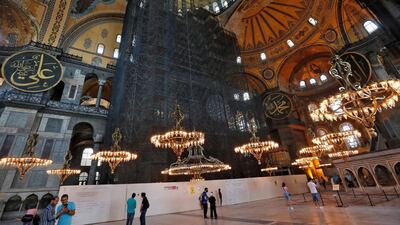
People visit Hagia Sophia, a Unesco World Heritage Site, in Istanbul. Turkey’s top administrative court announced its decision to revoke the 1,500-year-old former cathedral’s status as a museum. Reuters


The verdict has been highly anticipated since Mr Erdogan revived the debate in recent weeks.
Before last year, he remained outwardly ambivalent about the Hagia Sophia but in the run-up to local elections he outlined his support for its role as a mosque.
In May, Mr Erdogan appeared on a giant screen as an imam recited the Quran from the iconic monument to mark the anniversary of the Ottoman conquest, which sparked an outpouring of support for redesignating the site.
The status of the building, which received 3.7 million visitors last year, has served as a rallying cry for Mr Erdogan’s conservative and nationalist base, and some observers say the president has used the issue to distract voters.
Pro-government media has suggested the multi-domed structure could open as a mosque on July 15, the fourth anniversary of a coup attempt against Mr Erdogan.
Dr Erdemir said the move could also inspire religious extremists and threatened other cultural sites across the region.
Mr Erdogan’s use of “a rhetoric of conquest” in justifying the change set a dangerous precedent for religious minorities in Turkey and the Middle East, she said.
“It can embolden extremists to intensify their campaign of forced conversion and destruction of minority heritage sites,” Dr Erdemir said.

Berk Esen, at Bilkent University in Ankara, said although the Hagia Sophia had been a significant issue for pious voters since it was made a museum, he did not think it would “change the situation very much for Erdogan and Turkish politics”.
“I don’t think many voters, in the middle of an economic crisis, have been waiting anxiously for this,” Dr Esen said.
He said religious minorities in Turkey had “no illusions about the current government, which has been proceeding in this direction for some time, so this will only solidify that image”.
Changing the building’s status was foreshadowed in several other cases since 2011 where museums that had been churches and later mosques were reverted to Muslim places of worship.
The case led to foreign officials and church leaders calling on Turkey to back away from reclaiming the building, known as Aya Sofya in Turkish, for a mosque.
But Talha Kose, chairman of political science and international relations at Istanbul’s Ibn Haldun University, said the monument could remain open to non-Muslims outside prayer times, as does the nearby Blue Mosque.
“I don’t think other nations or political actors should intervene in Turkey’s decisions in this issue, this is totally a domestic matter,” Dr Kose said.
“Pressuring Turkey in this matter is counterproductive. There may be a dialogue with Unesco, though.
"It is a cultural heritage site and should stay like that, but it does not contradict the decision of opening as a mosque.”
On Friday, Unesco said governments “must ensure that no modification is made to the outstanding universal value” of World Heritage sites.
The agency called on Turkey to “engage in dialogue before taking any decision that might impact the universal value of the site”.
The Hagia Sophia’s transformation has also raised fears about the preservation of the building and its historic treasures.
Dr Erdemir said the conversion of three other former churches that had been turned into museums had resulted in “substantial damage to the historical fabric of the edifices”.

