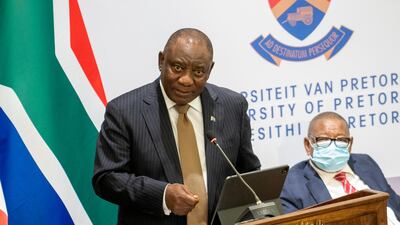

G7 guest South Africa will use its presence at this week's summit in the UK to push for the suspension of vaccine patents.
South African President Cyril Ramaphosa said his country was in favour of the waiver, as was India, another G7 guest.
He said the summit was an opportunity to seek broader support for “the struggle we are waging alongside India and more than 100 other countries”.
Wealthy countries are under pressure from the World Health Organisation and other institutions to address a global imbalance in Covid-19 vaccinations.
US President Joe Biden’s administration came out in favour of a patent suspension last month.
But European countries expressed doubts and German Chancellor Angela Merkel is firmly against the idea.
The EU said last month it would instead offer 100 million doses to poorer countries by the end of 2021.
Making his case before travelling to the G7 summit on Cornwall, Mr Ramaphosa said a suspension would allow more countries to create their own vaccines.
This would “pave the way for the development of a local pharmaceutical manufacturing industry in our own country and on the continent”, he said.
The G7 leaders face calls from organisations such as Oxfam and Amnesty International to agree to a patent suspension at the summit.
“G7 leaders must take this moment to stand on the right side of history by putting their full support behind the vaccine patent waiver,” Oxfam’s health policy manager Anna Marriott said.
“The G7 may be getting the vaccines they need but too much of the world is not and people are paying for patent protection with their lives.”
Mr Ramaphosa said the G7 was an opportunity for South Africa to promote itself as a destination for business and investment.
“The message I will be taking to the G7 summit will be one of hope about the prospects for our country’s recovery, and indeed the global recovery,” he said.
-
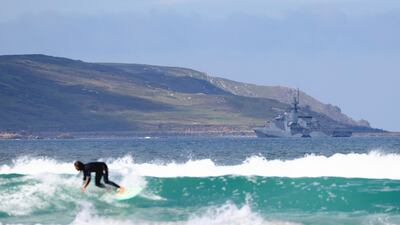
A surfer catches a wave in front of a naval vessel in St Ives Bay. Reuters -

A coastal train passes near the Carbis Bay hotel and beach, where an in-person G7 summit of global leaders is due to take place, in St Ives, Cornwall. Reuters -
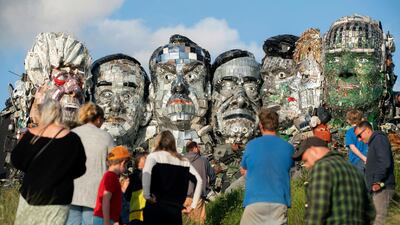
People look at artwork called Mount Recyclemore: The E7, which has been created out of e-waste, in the likeness of the G7 leaders and in the style of Mount Rushmore by British artist Joe Rush on Sandy Acres Beach in Cornwall. AP Photo -
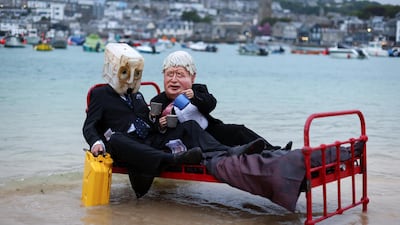
Activists from climate action group Ocean Rebellion demonstrate in St Ives Harbour. Reuters -
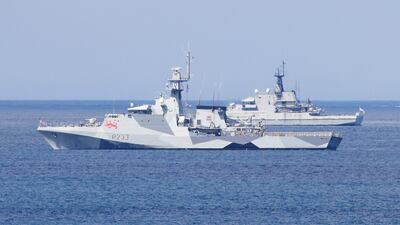
Naval vessels are moored in St Ives Bay, ahead of the G7 summit. Reuters -
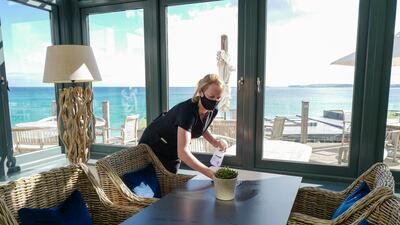
A member of the hotel staff cleans tables in the new orangery at the Carbis Bay Hotel. Getty Images -
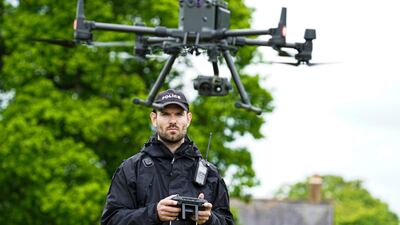
A police drone operator during a demonstration organised by Devon And Cornwall Police to illustrate the skills they may have to draw upon on order to police the forthcoming G7 Summit. Getty Images -
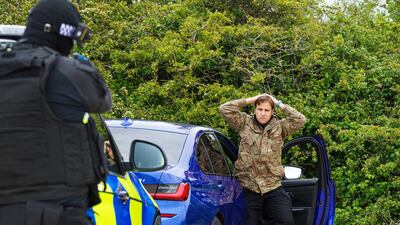
Devon and Cornwall police officers demonstrate armed stop and arrest techniques. Getty Images -
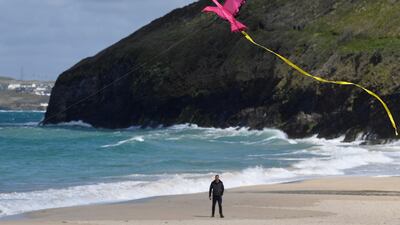
A man views a kite being flown on the beach at Carbis Bay. Reuters -
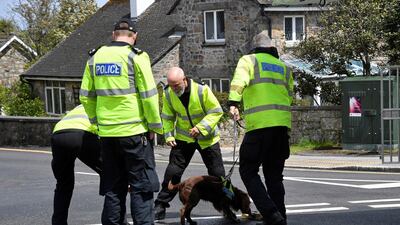
Police officers make advance security checks on entrance routes to the Carbis Bay resort. Reuters -

A person walks past The Cornish Arms pub as the G7 nations' flags flutter next to the Cornish flag. Reuters -

Police officers patrol on the beach in front of the Carbis Bay Hotel. Getty Images -
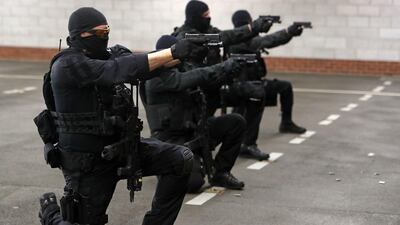
Police firearms officers hold their weapons as they take part in a live firing training exercise. AFP -

Bulding works continue at the Carbis Bay Hotel ahead of the summit. Reuters -
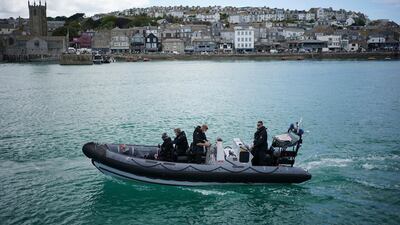
Police officers patrol the harbour in St. Ives. AP Photo


South Africa, India, Australia and South Korea are the four countries attending the summit as guests.
They were invited by the UK, which is hosting the talks with G7 members Germany, France, Italy, Japan, Canada and the US.
It comes as Britain makes a strategic tilt to the Indo-Pacific after Brexit and seeks to forge an alliance of the world's leading democracies.
While Mr Ramaphosa is travelling to the UK this week, Indian Prime Minister Narendra Modi is not taking part in person.
India’s Foreign Ministry said last month that Mr Modi would stay at home because of the prevailing Covid-19 situation in India.

