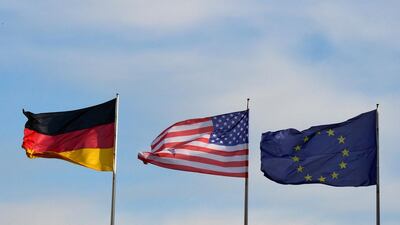
After 9/11, authorities in Europe agreed to share sensitive details about outbound travellers with the US in return for certain privacy protections. AFP

Experts urge EU and US to strike privacy deal amid row over air passenger data sharing


Neil Murphy
  • English
  • Arabic

Experts are urging the US and the EU to strike an agreement for digital privacy amid a continuing dispute over the sharing of civilian airline passenger data.

Experts at an online Atlantic Council event said the clash between national security and civil liberties is set to grow unless a deal on sharing information can be reached.

After 9/11, authorities in Europe agreed to share sensitive information about outbound travellers with the US Department of Homeland Security in return for privacy protection.

Data such as passenger name records includes information on air passengers' email addresses, itineraries and credit card numbers.

The records have been used by many countries in recent years to help foil terror attacks and prevent funding of extremist activity.

But the previously successful data-sharing agreement has come under scrutiny from European privacy campaigners, especially after a 2017 EU Court of Justice opinion that demanded new privacy rules.

Those rules are incompatible with how US authorities have used the records.

At the council's "Avoiding the Next Transatlantic Security Crisis" event, Dr Frances Burwell, senior director at McLarty Associates, said the digital economy between the US and the EU was of growing importance.

An summit between the EU and US in Brussels on June 15 would be an ideal time to create the basis for a transatlantic agreement on the use of passenger data, Dr Burwell said.

She said now was the time to think about an agreement and that it would be unsustainable to continue without a "better basis for the transfer of data".

"It is the growing part of our economic relationship and therefore any rules, any arrangements, that we make between ourselves that have to do with data transfers, et cetera, are only going to become much more important in the future," Dr Burwell said.

She said every democracy that has tried to tackle online privacy and national security faced challenges that would grow as data protocols spread around the world.

"This is something that every democracy struggles with," Dr Burwell said. "This is not just a US issue and a European issue.

"So I'm hoping that we will see the establishment next week of a digital council or tech and trade council, whatever you call it – some high-level forum that will provide oversight for these issues and provide the political impetus to get them moving towards resolution."

Despite the difference of opinion, the two sides were "pretty close to each other" and Europe has had the same impetus to stop terror activities, such as the 2015 Paris attacks.

Ken Propp, professor of EU law at Georgetown University, told the event that the US must take advantage of the EU as it is in a "reflection period" on data law.

The perception that the US is reckless about privacy rights is something policymakers will have to contend with in the future, Prof Propp said.

He said the US would soon be the last significant country in the world without a comprehensive privacy law, a situation he called "catastrophic".

"China's going to pass [a law], India's going to pass one," Prof Propp said. "The perception of that is really a problem in the international forum."

But he said he was hopeful agreements on data retention and deletion could be drawn up in future bilateral discussions.

Mercer, the investment consulting arm of US services company Marsh & McLennan, expects its wealth division to at least double its assets under management (AUM) in the Middle East as wealth in the region continues to grow despite economic headwinds, a company official said.

Mercer Wealth, which globally has $160 billion in AUM, plans to boost its AUM in the region to $2-$3bn in the next 2-3 years from the present $1bn, said Yasir AbuShaban, a Dubai-based principal with Mercer Wealth.

Within the next two to three years, we are looking at reaching $2 to $3 billion as a conservative estimate and we do see an opportunity to do so,” said Mr AbuShaban.

Mercer does not directly make investments, but allocates clients’ money they have discretion to, to professional asset managers. They also provide advice to clients.

“We have buying power. We can negotiate on their (client’s) behalf with asset managers to provide them lower fees than they otherwise would have to get on their own,” he added.

Mercer Wealth’s clients include sovereign wealth funds, family offices, and insurance companies among others.

From its office in Dubai, Mercer also looks after Africa, India and Turkey, where they also see opportunity for growth.

Wealth creation in Middle East and Africa (MEA) grew 8.5 per cent to $8.1 trillion last year from $7.5tn in 2015, higher than last year’s global average of 6 per cent and the second-highest growth in a region after Asia-Pacific which grew 9.9 per cent, according to consultancy Boston Consulting Group (BCG). In the region, where wealth grew just 1.9 per cent in 2015 compared with 2014, a pickup in oil prices has helped in wealth generation.

BCG is forecasting MEA wealth will rise to $12tn by 2021, growing at an annual average of 8 per cent.

Drivers of wealth generation in the region will be split evenly between new wealth creation and growth of performance of existing assets, according to BCG.

Another general trend in the region is clients’ looking for a comprehensive approach to investing, according to Mr AbuShaban.

“Institutional investors or some of the families are seeing a slowdown in the available capital they have to invest and in that sense they are looking at optimizing the way they manage their portfolios and making sure they are not investing haphazardly and different parts of their investment are working together,” said Mr AbuShaban.

Some clients also have a higher appetite for risk, given the low interest-rate environment that does not provide enough yield for some institutional investors. These clients are keen to invest in illiquid assets, such as private equity and infrastructure.

“What we have seen is a desire for higher returns in what has been a low-return environment specifically in various fixed income or bonds,” he said.

“In this environment, we have seen a de facto increase in the risk that clients are taking in things like illiquid investments, private equity investments, infrastructure and private debt, those kind of investments were higher illiquidity results in incrementally higher returns.”

The Abu Dhabi Investment Authority, one of the largest sovereign wealth funds, said in its 2016 report that has gradually increased its exposure in direct private equity and private credit transactions, mainly in Asian markets and especially in China and India. The authority’s private equity department focused on structured equities owing to “their defensive characteristics.”

Company profile

Date started: 2015

Founder: John Tsioris and Ioanna Angelidaki

Based: Dubai

Sector: Online grocery delivery

Staff: 200

Funding: Undisclosed, but investors include the Jabbar Internet Group and Venture Friends

RESULTS

5pm: Wathba Stallions Cup – Maiden (PA) Dh70,000 (Dirt) 1,400m
Winner: Yas Xmnsor, Sean Kirrane (jockey), Khalifa Al Neyadi (trainer)

5.30pm: Falaj Hazza – Handicap (PA) Dh70,000 (D) 1,600m
Winner: Arim W’Rsan, Dane O’Neill, Jaci Wickham

6pm: Al Basrah – Maiden (PA) Dh70,000 (D) 1,800m
Winner: Kalifano De Ghazal, Abdul Aziz Al Balushi, Helal Al Alawi

6.30pm: Oud Al Touba – Handicap (PA) Dh70,000 (D) 1,800m
Winner: Pharitz Oubai, Sean Kirrane, Ibrahim Al Hadhrami

7pm: Sieh bin Amaar – Conditions (PA) Dh80,000 (D) 1,800m
Winner: Oxord, Richard Mullen, Abdalla Al Hammadi

7.30pm: Jebel Hafeet – Conditions (PA) Dh85,000 (D) 2,000m
Winner: AF Ramz, Sean Kirrane, Khalifa Al Neyadi

8pm: Al Saad – Handicap (TB) Dh70,000 (D) 2,000m
Winner: Sea Skimmer, Gabriele Malune, Kareem Ramadan

RESULT

Manchester United 2 Burnley 2
Man United:
 Lingard (53', 90' 1)
Burnley: Barnes (3'), Defour (36')

Man of the Match: Jesse Lingard (Manchester United)

Who's who in Yemen conflict

Houthis: Iran-backed rebels who occupy Sanaa and run unrecognised government

Yemeni government: Exiled government in Aden led by eight-member Presidential Leadership Council

Southern Transitional Council: Faction in Yemeni government that seeks autonomy for the south

Habrish 'rebels': Tribal-backed forces feuding with STC over control of oil in government territory

Results

2pm: Al Sahel Contracting Company – Maiden (PA) Dh50,000 (Dirt) 1,200m; Winner: AF Mutakafel, Tadhg O’Shea (jockey), Ernst Oertel (trainer)

2.30pm: Dubai Real Estate Centre – Maiden (TB) Dh60,000 (D) 1,200m; Winner: El Baareq, Antonio Fresu, Rashed Bouresly

3pm: Shadwell – Rated Conditions (TB) Dh100,000 (D) 1,950m; Winner: Lost Eden, Andrea Atzeni, Doug Watson

3.30pm: Keeneland – Handicap (TB) Dh84,000 (D) 1,000m; Winner: Alkaraama, Dane O’Neill, Musabah Al Muhairi

4pm: Keeneland – Handicap (TB) Dh76,000 (D) 1,800m; Winner: Lady Snazz, Saif Al Balushi, Bhupat Seemar

4.30pm: Hive – Conditions (TB) Dh100,000 (D) 1,600m; Winner: Down On Da Bayou, Royston Ffrench, Salem bin Ghadayer

5pm: Dubai Real Estate Centre – (TB) Handicap Dh64,000 (D) 1,600m; Winner: Lahmoom, Royston Ffrench, Salem bin Ghadayer
