

One of the people behind the AstraZeneca-Oxford vaccine criticised Denmark for halting use of the drug completely and said it could lead to many more lives being lost.
Sir John Bell, regius professor of medicine at the University of Oxford, said a mix-and-match approach to coronavirus vaccines could offer better protection than using a single drug.
Denmark this week stopped using the AstraZeneca vaccine, the first country to impose a full ban because of links to rare blood clotting.
"They will have a lot of dead people, many more people than if they had used the AstraZeneca vaccine," Sir John said.
“They have to make their own decisions and live with those decisions and that may be more difficult as reality sinks in.
-
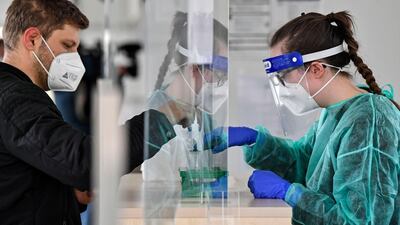
Students and employees hand over samples after testing themselves at a newly built Covid-19 test centre at the university in Dortmund, Germany. AP Photo -
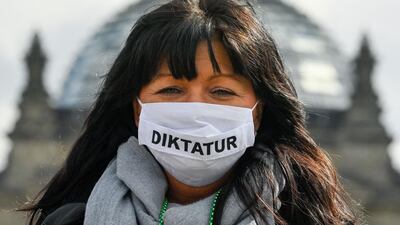
A protester wearing a mask reading 'dictatorship' takes part in a demonstration in Berlin, as anti lockdown critics gathered outside the German Parliament. AFP -

Senior doctor Thomas Marx talks to a patient infected with the coronavirus in an intensive care unit at a hospital in Freising, southern Germany. AFP -
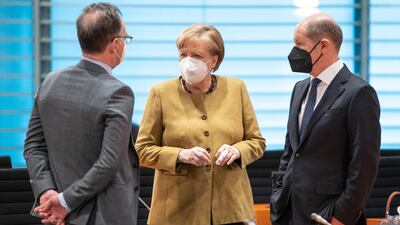
Federal Foreign Minister Heiko Maas, German Chancellor Angela Merkel and German Finance Minister Olaf Scholz converse at a Cabinet meeting in Berlin. EPA -

The Neumarkt square in front of Frauenkirche is pictured nearly empty in Dresden, Germany. Getty Images -

Travellers check-in at Schiphol in Amsterdam, the Netherlands. 189 holidaymakers left from the airport for a test holiday, with the aim of establishing whether a test protocol makes it possible to travel during the pandemic. EPA -

The imam of the Turkish Mevlana Mosque wears a protective face mask as he recites a prayer, in Hilversum, the Netherlands. EPA -
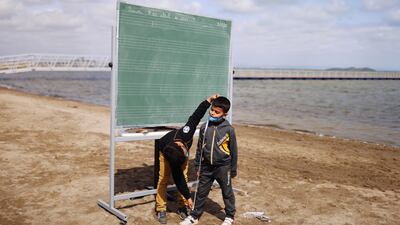
Students of the Felix Rodriguez de la Fuente school joke at the end of their class, as part of a project known as 'Aire Limpio' (Fresh Air) at the Playa de los Nietos, which aims to provide better air quality for children during the pandemic, near Cartagena, southern Spain. EPA -
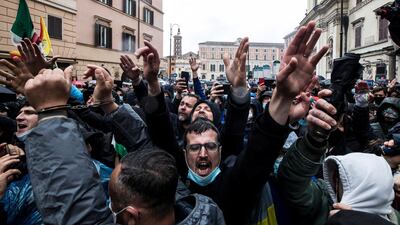
Demonstrators shout slogans during a protest by traders, shopkeepers and restaurateurs, in Piazza San Silvestro in Rome, Italy. EPA -
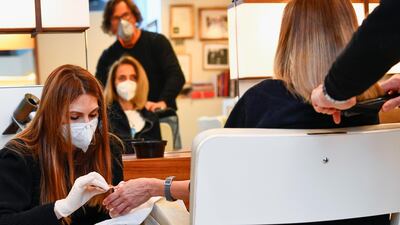
A hairdresser serves a customer after Lombardy was downgraded from a red to an orange zone, loosening Covid-19 restrictions in Milan, Italy. Reuters -

Medical personnel vaccinate a driver in his car in the first drive-through Covid-19 vaccination centre in France, dubbed a 'Vaccidrive', near Montpellier. EPA -
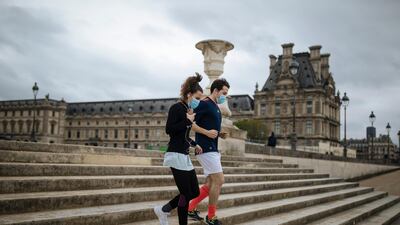
A masked couple run down the steps of the Tuileries Garden, in Paris, France. AP Photo


"The first, most important issue is these events are extremely rare, but if you get Covid you will have a very much higher risk of getting a clotting problem. The clotting problem is trivial compared with the risks of getting Covid," the academic said.
"Different countries have to do what they have to do. Denmark has 15 per cent of its population vaccinated but AstraZeneca is the only one they have widely available."
Meanwhile, researchers at the University of Oxford on Thursday reported that the risk of rare blood clotting after Covid-19 infection was about 100 times greater than normal, several times higher than post-vaccination or after influenza.
The study authors, led by Prof Paul Harrison and Dr Maxime Taquet from the University of Oxford's department of psychiatry and the NIHR Oxford Health Biomedical Research Centre, counted the cases of clotting, or cerebral venous thrombosis, in the two weeks after diagnosis of Covid-19, or after the first dose of a vaccine. They compared these with calculated incidences of CVT after influenza, and the background level in the general population.
The rare clotting was found to be more common after coronavirus infection, with 30 per cent of these cases occurring in under 30s. Compared with the Covid-19 vaccines in use, this risk is between eight and 10 times higher, and about 100 times higher when measure against the baseline.
Paul Harrison, professor of psychiatry and head of the Translational Neurobiology Group at the University of Oxford, said: "There are concerns about possible associations between vaccines, and CVT, causing governments and regulators to restrict the use of certain vaccines. Yet, one key question remained unknown: ‘What is the risk of CVT following a diagnosis of Covid-19?’.
"We’ve reached two important conclusions. First, Covid-19 markedly increases the risk of CVT, adding to the list of blood-clotting problems this infection causes. Second, the Covid-19 risk is higher than seen with the current vaccines, even for those under 30; something that should be taken into account when considering the balances between risks and benefits for vaccination."
Dr Maxime Taquet, also from the Translational Neurobiology Group, said it was important to note that the data should be interpreted cautiously.
"However, the signals that Covid-19 is linked to CVT, as well as portal vein thrombosis – a clotting disorder of the liver – is clear, and one we should take note of," she said.
Prof Bell, who is a member of the UK government's coronavirus task force, said he thought that a mix-and-match approach to vaccination was promising, but more research was required to test the theory that combining different drugs offered better protection.
"This is a really interesting strategy, probably more interesting in terms of dealing with variants," he said. "We believe if you mix the vaccines you will get a different type and a wider and stronger immune response.
"That would mean we are better able to deal with the South African variant and dozens of others popping up all over the world.
"As you start to mix and match, you will start to get an enhanced and more durable response. I think it is a really positive step forward."
He said the approach could lead to a vaccination programme that did not need a booster dose weeks or months down the line.

