
The cheers of the crowd gathered in Zagreb’s Ban Jelacic Square on Monday were those reserved for winners. “Champions! Champions!” overjoyed supporters shouted as the national team approached the plaza.
The Croatian players, although failing in their bid to win the World Cup after losing 4-2 to France on Sunday, were treated to a scene usually expected for the tournament’s real winners.
Croatia were the underdogs of the World Cup final, up against a talented and youthful French side, and subsequently won fans all over the world for their gutsy performances in the tournament's knockout stages.
The meme “France might have won the World Cup, but the Croatians won our hearts”, became an instant hit on the social media.
The Croatian football jerseys, a red and white checkerboard, have become the best known symbol the country has ever had. Some half a million people – in a country of just four million – donned the same red and white colours to welcome the Vatreni (‘The Blazers’, team’s nickname) in the capital.
Supporters of all ages and from all parts of Croatia rushed to Zagreb. The national railway company cut their return ticket prices by 50 per cent for supporters wanting to “cheer for their heroes”.
Such a sentiment of unity and the feeling of euphoria does not come as a surprise in a country whose largest achievement in the World Cup goes twenty years back, when they secured third place at the World Cup in France.
Yet, just a couple of weeks before, at the beginning of the championship, the popularity of several of the Croatian heroes was waning back home.
-
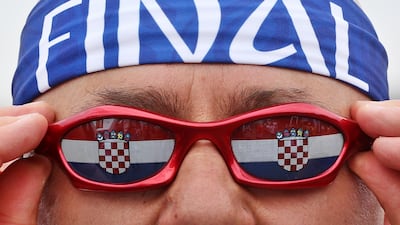
A supporter of Croatia arrives to the stadium for the World Cup 2018 final between France and Croatia in Moscow, Russia. EPA -
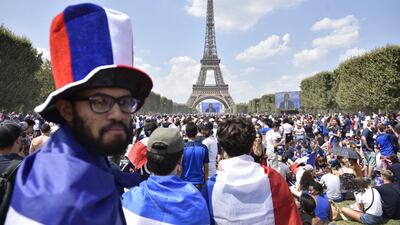
French supporters gather at the Eiffel Tower fan zone in Paris, France. EPA -

A Croatia's supporter poses at the Luzhniki Stadium in Moscow. AFP -

A France's supporter waves his national flag at the Luzhniki Stadium in Moscow. AFP -

Supporters of Croatia gather in the center of Zagreb in Croatia. EPA -
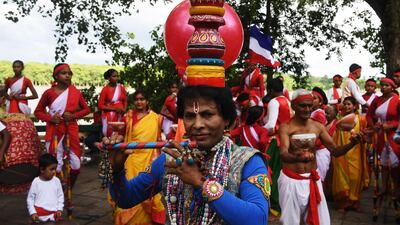
Indian traditional folk dancers perform to show their support to the French football team in Chandannagar, India. AFP -

Supporters of Croatia's national football team wave from a window in downtown Zagreb. AFP -
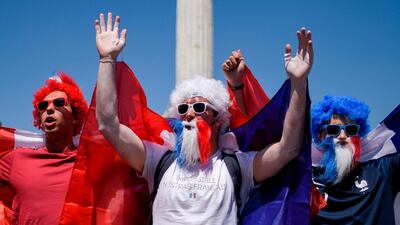
People wait infront of a giant screen at a fan zone in central Nantes. AFP -
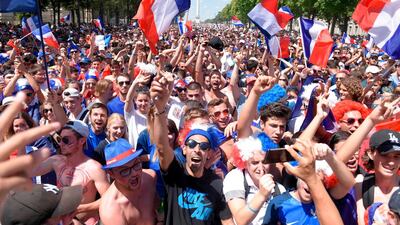
Supporters wave French flags as they wait in front of a giant screen in central Nantes. AFP -

A statue monument of the 19th-century rebel nobleman Ban Jelacic is covered with Croatian national colours in Zagreb. Getty Images -

Supporters hold a huge Croatian flag in Zagreb. AFP -
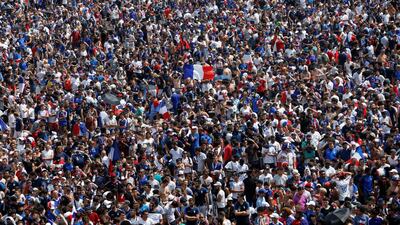
Supporters wave French flags as they gather on the fan zone on the Champ de Mars in Paris. AFP


Luka Modric, the Croatia midfielder and winner of the tournament’s Golden Ball award reserved for its best player, is involved in a court case that has threatened to mar his and the country’s summer.
The Real Madrid star is suspected of providing a false testimony to a criminal court about his financial deals with Zdravko Mamic, a businessman and former Dinamo Zagreb director, in what is a multimillion dollar corruption case. Mr Mamic is one of the most powerful people in Croatian football, a figure who holds significant political influence as well.
Modric testified as a witness at the tax fraud trial of Dinamo officials standing on charges of tax evasion and the siphoning of 116 million kuna (Dh67m) from player transfers at the club. He is suspected of changing his testimony in support of Mr Mamic. Modric’s teammate Dejan Lovren is also suspected of perjury.
________________
Read more:
Report: France win the World Cup with 4-2 victory over Croatia
WATCH: Paris landmarks celebrate France World Cup win
2018 World Cup team of the tournament: France players dominate
________________
Among the officials implicated were Al Ain manager Zoran Mamic; Zdravko Mamic, his brother; and Damir Vrbanovic, a senior official in the Croatian Football Federation (HNS). While Al Ain’s Mr Mamic said he would appeal the prison sentence, his brother Zdravko was sentenced to six-and-a-half years in prison and fled to neighbouring Bosnia and Herzegovina.
In his first testimony, Modric confirmed signing an annex to his contract that allowed him to take a cut of his transfer fee to Tottenham Hotspur. But he is believed to have changed some of his initial statements, saying “I don’t remember” when asked about the contract clause.
This sentence became viral in Croatia. The walls of his native Zadar were covered with scolding graffiti messages: "Luka, you'll remember one day", or "Modric, you’re Mamic’s w****".
When he missed his penalty against Denmark earlier in the World Cup, a photo of Modric with the inscription "I do not remember how to score a goal" quickly did the rounds on social media.
"I was afraid that these trials and everything that people were telling about them would influence their game," Miroslav Blazevic, former national team coach tells The National. "Luckily, Modric played better than ever. Now people might stop talking about it."
After the team’s success, supporters and the press seem to have nothing but praise for the best player in Croatia’s short 26-year history.
“Before the World Cup, I predicted that his legal troubles would have a negative impact on the team’s game,” says Drazen Lalic, a specialist in the sociology of sports.
“I thought people were more concerned about corruption than the success of our team at the World Cup. Today, I admit I might have been wrong. Considering the general atmosphere, I have a feeling that no judge would pronounce a harsh sentence,” he continues.
But others who follow the beautiful game in the country beg to differ.
"It is impossible for me to think that the Croatian laws should be different for someone just because they played well in the national football team,” says Croatian football journalist Aleksandar Holiga. “For me, it doesn’t make sense to associate Modric, the football player, and Modric, the man suspected of perjury.”
In a World Cup tournament, everyone becomes hooked on football to the point that it seems that the sport is the only thing that matters in society, the journalist continues.
Yet true fans, those who follow football all year round, will not be able to forget such a act, he says.
But could this historical result in the most important international competition have a beneficial impact on Croatian football and restore the nation’s faith in it?
“It is a question I don’t have an answer to,” says Mr Holiga. “But I hope it might have a positive influence.”

