
Sweden’s controversial herd immunity approach to tackling Covid-19 appears at last to be paying off, despite doom-mongers predicting catastrophe for the country.
The Scandinavian country has averaged only one death a day for the last 10, despite not going into lockdown.
Sweden has so far has recorded 5,843 coronavirus deaths, making it the fifth-highest per capita death rate in Europe, but the number of new infections has been declining steadily since the peak in late June.
Overall, it has recorded more than 86,000 infections in its population of about 10 million, but it had only 13 patients in intensive care on Wednesday.
That same day, it recorded 204 new infections and no additional deaths.
This is a stark contrast to other countries in Europe that went into lockdowns, such as Britain, France and Spain, where new cases are soaring and their workers and economies in hibernation.
The UK recorded 2,659 new infections and registered another eight deaths on Wednesday. France, meanwhile, recorded 8,577 cases and 30 more deaths. The last available figures for Spain from Friday last week were 10,476 more infections and 184 deaths.

At the end of May, Sweden's state epidemiologist, Anders Tegnell, received death threats over his handling of the coronavirus pandemic. But less than four months later, there is now a sense of vindication.
Unlike any other country in the world, Sweden shunned a strict lockdown.
During its first wave of the virus, the Scandinavian state kept restaurants, cafes and bars open. Instead of confining people to their homes, the government issued several guidelines to help people through the pandemic such as staying home if they were ill, washing hands and social distancing. The state did, however, ban gatherings of more than 50 people.
The herd immunity theory says that if at least 60 per cent of a population get the virus, the whole population develops immunity to it, slowing down its transmission. Although other countries including Britain and the Netherlands had considered the same strategy, both ended up abandoning it, due to pressure from health officials and the public.
By the end of May, Sweden had become the country with the highest number of coronavirus deaths per capita, but it stubbornly kept bars, restaurants and businesses open.
The picture looked more upbeat on Wednesday, when Johan Carlson, an epidemiologist and the director of the Swedish public health agency, said that Swedes were now benefitting from the herd immunity strategy.
“Our strategy was consistent and sustainable,” Prof Carlson, a leading figure behind the herd immunity policy, said. “We probably have a lower risk of [the virus] spreading than other countries.”

“The purpose of our approach is for people themselves to understand the need to follow the recommendations and guidelines that exist,” he said.
“There are no other tricks before there are available medical measures, primarily vaccines.
“The Swedish population has taken this to heart.”
Rates of infection are also increasing in Norway and Denmark, neighbours of Sweden which both enforced lockdowns.
On Wednesday, for the first time since the spring, higher rates of infection were registered in Norway than in Sweden. Denmark has 2.1 new cases per 100,000 people, Norway has 1.5 and Sweden 1.1, the TT news agency reported.
In response, Norway will stop easing coronavirus lockdown and could end up bringing back tougher measures, Prime Minister Erna Solberg said on Thursday.
Norway originally went into lockdown in March but eased measures in May after a dramatic drop in new cases.
-

An employee wears a Continental-branded protective face mask at the Continental AG factory in Hanover, Germany. Bloomberg -
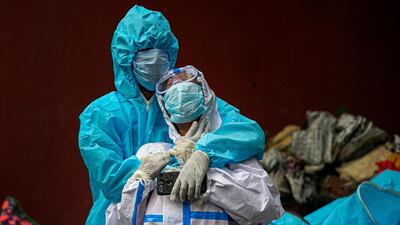
An Indian woman mourns after taking a glimpse of her husband's body, a victim of Covid-19, at a cremation ground in Gauhati, India. AP Photo -

Workers place signs with portraits of health workers who died from Covid-19 at the Venezuelan Medical Federation in Caracas, Venezuela. AFP -

A Covid-19 test that came out positive is seen on a chair during a doctor's visit in Ate, on the eastern outskirts of Lima, in Peru. AFP -

Men wait in a distanced line to get tested for Covid-19 aboard a trajinera, one of the colorful wooden boats popular with tourists and revelers, in the Xochimilco district of Mexico City. AP Photo -

A nurse prepares to inoculate volunteer Ilya Dubrovin, 36, with Russia's new coronavirus vaccine in a post-registration trials at a clinic in Moscow. AFP -

Netherland's King Willem-Alexander looks on as he visits a coronavirus (Covid-19) test site in Leiderdorp, The Netherlands. AFP -

Workers check disinfection tunnels at the Capital University of Science and Technology in Islamabad, Pakistan. AFP -
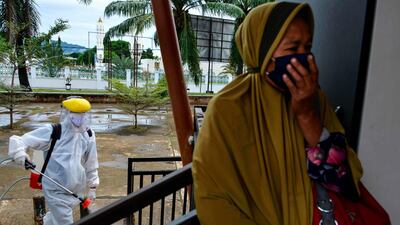
A worker disinfects a bus stop in Banda Aceh, Indonesia. AFP -

A boy shares his breakfast with the birds of the central park after begging with his father, in Tegucigalpa, Honduras. EPA -

Migrants from different nationalities rest on board the Spanish NGO Open Arms vessel after being rescued in international waters, in the Central Mediterranean sea. AP Photo -

A child sits down during his first on-site day at Albino Nunez school after months of lockdown in Ourense, Spain. EPA -

New Zealand Prime Minister Jacinda Ardern visits inMusic in Auckland, New Zealand. Getty Images -

Johnny Lopez makes his way past a mural on the side of Hideaway Pizza on Rockford Ave. while walking home from work in Tulsa, Oklahoma, USA. Tulsa World via AP


“We can’t open up any more at this time…In case of a rise in the number of infections without a known source, or local outbreaks that are not contained, we will consider righter restrictions, locally, regionally or nationally,” she said.
Following Sweden’s perceived success with herd immunity, reports have suggested that the United States, the country hit hardest by the virus, was considering copying its strategy.
But on Wednesday White House Coronavirus Task Force Co-ordinator Dr Deborah Birx rejected the reports, saying she didn’t want to endanger American lives.
Dr Birx told reporters at St Mary Mercy Hospital in Livonia, Michigan, that American lives were non-negotiable for the sake of herd immunity.
“Neither I, nor anybody in the administration, is willing to sacrifice American lives for herd immunity. We’ll get to herd immunity through a vaccine and that’s the right way to do it.”

