


Early Europeans suffered extinction due to an extreme cooling event on the continent about 1.1 million years ago, a study has suggested.
The ocean surface temperatures off Lisbon dropped below 6°C due to abrupt climate changes that created conditions that would have made it hard for archaic humans to survive, according to the researchers.
The findings of the University College London scientists, published in the journal Science, challenge the widely held belief that, after arriving from South-West Αsia about 1.4 million years ago, these humans were able to survive several climate cycles and adapt to increasingly harsh conditions.
“Our discovery of an extreme glacial cooling event around 1.1 million years ago challenges the idea of continuous early human occupation of Europe,” senior author Chronis Tzedakis, of UCL Geography, said.
Along with UCL, paleoclimate scientists from the University of Cambridge and CSIC Barcelona analysed the chemical composition of marine micro-organisms and examined the pollen content in a deep-sea sediment core recovered off the coast of Portugal.
Cores such as these can give a glimpse of the Earth’s past geology and climate.
“To our surprise, we found that this cooling at 1.1 million years ago was comparable to some of the most severe events of recent ice ages,” lead author Vasiliki Margari, of UCL Geography, said.
Co-author Nick Ashton of the British Museum said: “A cooling of this magnitude would have placed small hunter-gatherer bands under considerable stress, especially since early humans may have lacked adaptations such as sufficient fat insulation and also the means to make fire, effective clothing or shelters.”
The experts then ran a climate simulation to capture the extreme conditions during this time.
Climate change around the world – in pictures
-

Engineers carry solar panels on to the roof of a property in Barcelona in September 2022. Spain and other Mediterranean countries have generated record amounts of power from wind and solar farms. Bloomberg -
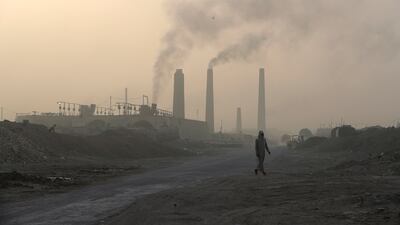
Smoke rises from brick factory stacks in Nahrawan, Baghdad. Tackling emissions from heavy industry is crucial to tackling global warming. Reuters -
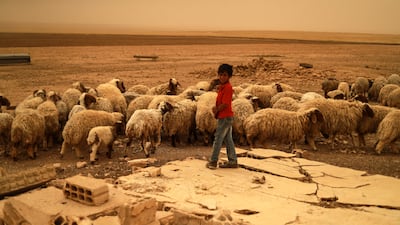
A boy stands near a flock of sheep as a sandstorm approaches in the Syrian countryside of Tabqa. Syria is among the countries most vulnerable and poorly prepared for climate change, which is expected to worsen. AFP -
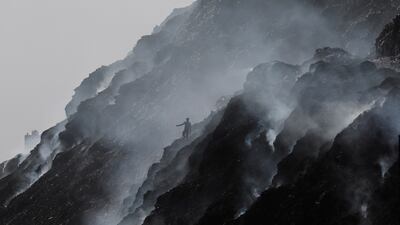
Mountains of smouldering rubbish at the Bhalswa landfill in New Delhi, India. Reuters -

Greenpeace activists take part in a climate change protest in front of the Brandenburg Gate in Berlin in May. AP -
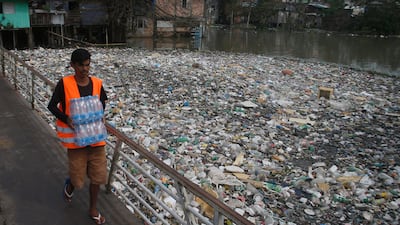
A man carries water bottles across the heavily polluted Negro River in Manaus, Brazil. About 35 tonnes of rubbish are removed daily from the river. AP -
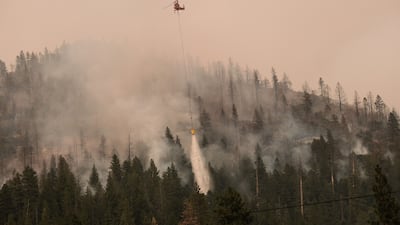
A helicopter drops water on a brush fire in California. Bloomberg -

UN climate chief Patricia Espinosa speaks on the opening day of the Bonn climate change conference in Germany. Getty -

Activists take part in a demonstration to raise awareness of global warming, during an event to mark World Environment Day in Kolkata. AFP -
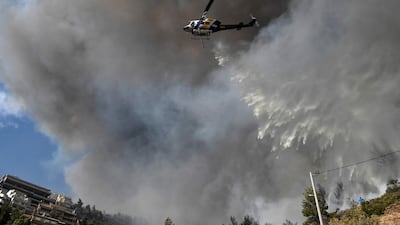
A helicopter drops water on a bushfire near a residential district in Athens. The fire forced residents to flee. AFP -
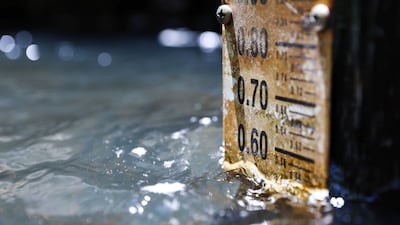
A gauge measures water levels in the Rio Nambe river, in New Mexico. Ninety per cent of the state is experiencing extreme drought. Getty -

Afghan refugees search for recyclable material from heaps of rubbish in Karachi, Pakistan. AP -

A climate activist ties herself to the net during the semi-final tennis match between Croatia's Marin Cilic and Norway's Casper Ruud at the French Open in Roland Garros in Paris. AP -
A dance group performs at a climate summit in Stockholm, Sweden. Getty -

US climate envoy John Kerry talks to a delegate at the Stockholm 50 climate summit. Getty -
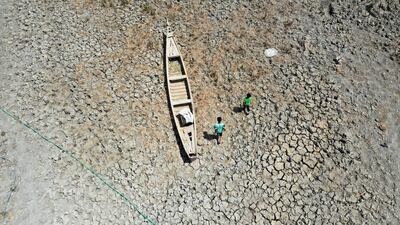
A boat is stranded during low tide at the Chebayesh marsh in Dhi Qar province, Iraq. Reuters -
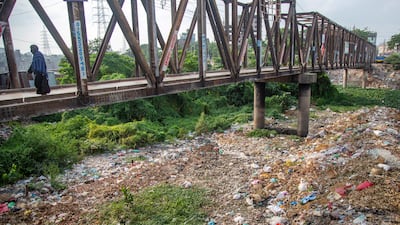
A woman crosses a polluted river in Dhaka, Bangladesh. EPA -
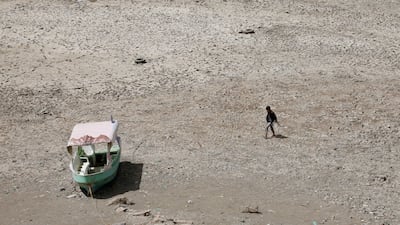
A man walks past an abandoned boat in the bed of a drought-affected reservoir on the outskirts of Sana'a, Yemen. EPA


“The results showed that 1.1 million years ago climate around the Mediterranean became too hostile for archaic humans,” study co-author Axel Timmermann, of the IBS Centre for Climate Physics at Pusan National University in South Korea, said.
Combined results suggest that Iberia, and more generally southern Europe, became devoid of humans and remained so for the next 200,000 years.
“According to this scenario, Europe may have been recolonised around 900,000 years ago by more resilient humans with evolutionary or behavioural changes that allowed survival in the increasing intensity of glacial conditions,” study co-author Chris Stringer, of the Natural History Museum in London, said.
Meanwhile, another study, also published in the journal Science, suggests climate change may have enabled interbreeding between two groups of ancient human relatives: Denisovans and Neanderthals.
Back in 2018, scientists found evidence of a woman, nicknamed Denny, who lived 90,000 years ago and had a Denisovan father and a Neanderthal mother.
Simulations paleo-biologists from South Korea and Italy showed Neanderthals and Denisovans had different environmental preferences, with Denisovans more adapted to cold environments, such as boreal forests and tundra, while their Neanderthal cousins preferred temperate forests and grassland.
But in warm interglacial periods, when Earth’s orbit around the Sun was more elliptic and the Northern Hemisphere's summer occurred closer to the Sun, simulations suggest their habitats may have begun to overlap geographically.
“When Neanderthals and Denisovans shared a common habitat, there were more encounters and interactions among the groups, which would have increased the chance of interbreeding,” Mr Timmermann said.

