


Since last summer, Russia's army has suffered a series of battlefield reverses with heavy territorial and troop losses.
Meanwhile, Ukraine is receiving increasingly sophisticated western equipment, such as Sunday’s announcement of British heavy tanks, and appears to be on the cusp of a major offensive.
Russia’s position in Ukraine looks tenuous with its army potentially on the point of collapse.
But the respected Institute for the Study of War (ISW) has given warning that the West should not assume victory to be within Kyiv’s grasp.
Far from it. With little fanfare, Russia has begun taking steps to remedy its failings. Mobilised troops have been kept in reserve, training for combat rather than thrown into unwinnable battles.
Russia’s military industrial base is undergoing an upheaval and the Kremlin’s propaganda arm is preparing the people for a long war.
There could also be a “major offensive” by Russia in spring or summer, although that may not be the deciding factor, the Washington think tank said. President Vladimir Putin is in the fight for the long term, retaining his maximalist goal of taking all of Ukraine.
In effect, the ISW's offensive campaign assessment states that the idea of Russia being the cusp of defeat is wishful thinking, and both inaccurate and dangerous.
There is also a lesson in history. When Russia was invaded in the Second World War, it suffered many defeats, with the Germans at the gates of Moscow by the end of 1941.

But brutal lessons were learnt, the Red Army reformed and four years later it was Soviet troops that bulldozed their way into the German capital.
Those reforms could well be in train again. Here is the ISW's assessment of what could happen:
Major conventional war
The Kremlin is “belatedly” addressing the key issues that have undermined its war effort that includes mobilisation of troops, reorganising its forces and priming industry for military production.
It is now taking steps to fight “a major conventional war”, signalled by Mr Putin pledging last month that Russia will improve upon its mistakes in the initial campaign, suggesting the war will be a “lengthy process”.
He will also centralise the Kremlin’s hold over information and propaganda, as well as reinstating the Defence Ministry’s authority, largely undermined by apparent successes of the Wagner Group of mercenaries.
“There is emerging evidence that Putin is changing fundamental aspects of Russia’s approach to the war by undertaking several new lines of effort,” the report said.
All this points to “a decisive strategic action” later this year “intended to end Ukraine’s string of operational successes and regain the initiative”.
Force generation
Suffering an estimated 100,000 casualties in the first 11 months of the war, including more than 25,000 killed, rebuilding the army is key to any future success.
The Kremlin has announced plans to drastically expand the conventional Russian military by forming new divisions and increasing conscription age.
This demonstrates an intent to “conduct large-scale conventional warfighting” with Ukrainian intelligence suggesting Russia wants to increase its armed forces to two million under arms, up from 1.35 million.

Western intelligence officials are also reporting that “serious preparations” are under way to introduce a second wave of mobilisation this month.
While Wagner and other auxiliaries appear to be carrying out the bulk of the current frontline fighting, the Kremlin may well be conserving its recently mobilised troops and conscripts for a decisive operation.
In Russia as well as Belarus, it is taking time to train and equip them for that campaign.
War industry
Key to Russia’s long-term aim is the modernisation of its industrial defence base, with Mr Putin recently holding several high-level meetings with management.
He has emphasised much greater focus on building reconnaissance drones, as well as ordering ministers to rapidly issue defence contracts for new kit.
In another echo of the Soviet period, there is speculation that the Kremlin might go on to a full industrial war-footing by considering the nationalisation of certain industries.
War chiefs
By appointing the Chief of the General Staff, Valery Gerasimov, as theatre commander for Ukraine last week, Mr Putin has signalled he intends a much more centralised approach.
After a round of sackings following the early war failings, experienced staff planners are understood to have been reappointed.

There is no magic bullet to winning the war, Mr Putin appears to have understood, after he hoped the appointment of Gen “Armageddon” Sergey Surovikin might grant him new victories.
But Gen Surovikin has been retained as one of three deputies to Gen Gerasimov to help prepare Russia for a “protracted war and take command of a major effort in 2023”, the report said.
Info wars
Keeping the Russian people onside is crucial if the military is going to send hundreds of thousands of men into battle.
The war has also produced the phenomenon of “milbloggers”, experienced military analysts, some of whom have fought in Ukraine, whose online musings are being closely followed inside and outside Russia.
Mr Putin has developed a strong relationship with key milbloggers, giving him a powerful propaganda arm.
Kremlin officials are also reframing the war as a national act of self-defence, justifying the sacrifices with the “false narrative that the existence of an independent Ukraine threatens Russian sovereignty and culture”.
Kursk repeat
As reported in The National, Russia might attempt to repeat the thinking behind the Battle of Kursk in 1943, in which they drew the German armour into their defensive lines, defeated them then attacked with a massive counter-punch.
The ISW report agrees. “Russian forces may seek to successfully defeat a Ukrainian counteroffensive and deprive Ukraine of the initiative by destroying a significant proportion of mechanised Ukrainian forces,” it said.

“Such a successful Russian decisive action could then enable Russian forces to develop a counteroffensive to exploit disorganised and exhausted Ukrainian forces.”
The most likely place for the major offensive is the Luhansk Oblast which remains an official war goal and is Moscow’s “most achievable though still highly challenging” objective, with its proximity to Russia making logistics support easier.
Dangerous bear
Ultimately, the report concludes, Russia forces “remain dangerous” which means Ukraine needs sustained western support which its allies must provide "quickly”.
“The Russian military, as the saying goes, retains a vote on the course of the war, despite its weaknesses and is actively setting conditions for major operations as the war enters its second year,” it concluded.
Russia and Ukraine conflict latest - in pictures
-
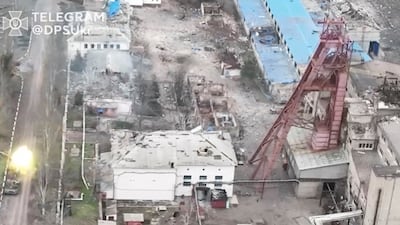
A tank, seen left, fires a round in Soledar, a town in the Donetsk region of eastern Ukraine. Reuters -
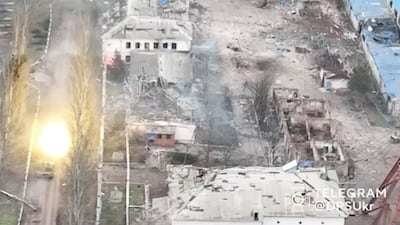
Tank fire in Soledar, Donetsk. Reuters -
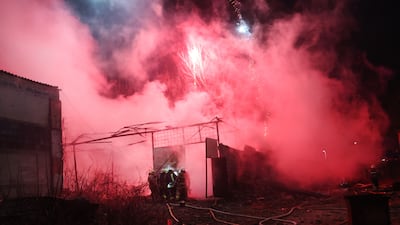
Firefighters work to put out a blaze at a Kharkiv fireworks storage site after it was struck by a Russian missile. Getty -
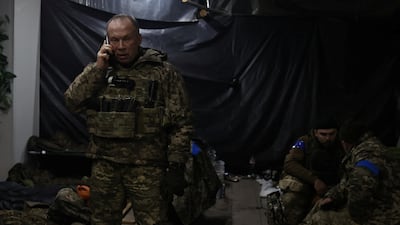
Col Gen Oleksandr Syrskyi, commander of Ukraine's ground forces, visits his troops on the frontline in Soledar, Donetsk. Reuters -
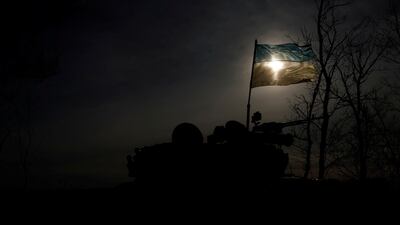
A Ukrainian flag attached to a tank flutters in the wind in Bakhmut. Reuters -
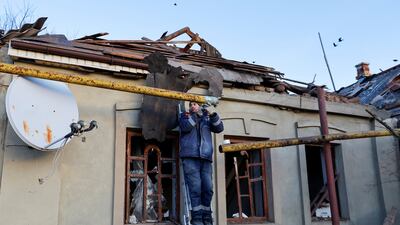
A specialist from an emergency crew works on a residential building in Donetsk that was damaged in recent shelling. Reuters -
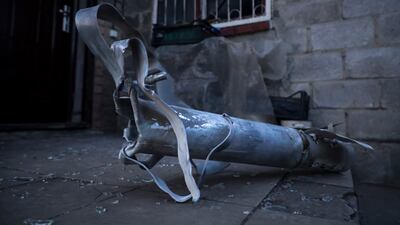
A missile fragment left by shelling in Russian-controlled Donetsk. AP -
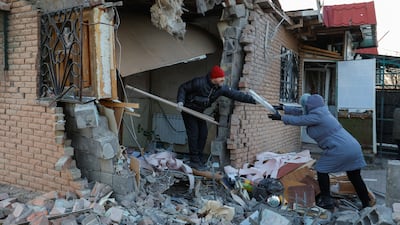
Residents remove debris and carry their belongings out of a building destroyed by recent shelling in Donetsk, Russian-controlled Ukraine. Reuters -
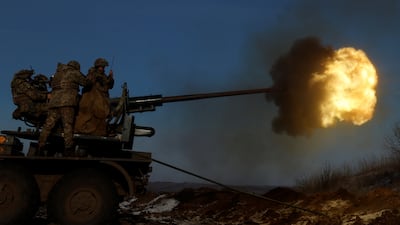
Ukrainian forces fire an anti-aircraft weapon as Russia's attack on the frontline city of Bakhmut continues. Reuters -
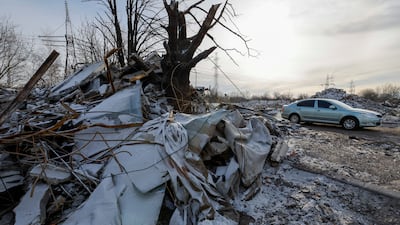
A car drives past a destroyed building purported to have been used as temporary accommodation for Russian soldiers, dozens of whom were killed in a Ukrainian missile strike in Makiivka, Russian-controlled Ukraine. Reuters -
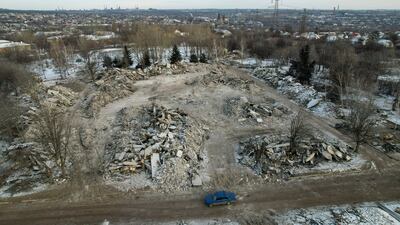
The site of a temporary barracks for Russian soldiers in Makiivka, which was destroyed in a Ukrainian missile attack. Reuters -
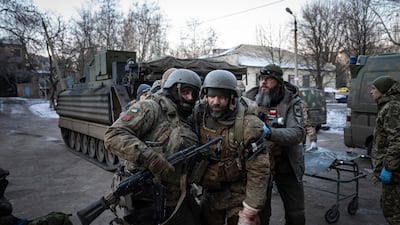
A Ukrainian serviceman carries his injured comrade from the battlefield to a hospital in the Donetsk region. AP -
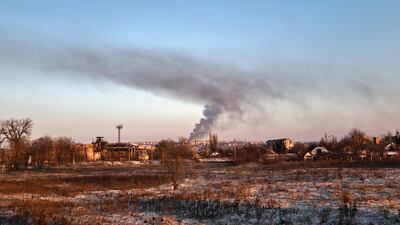
Smoke rises after shelling in Soledar, the site of heavy battles with Russian forces in the Donetsk region. AP



