

Russia has exhausted its stockpile of Iran-supplied kamikaze drones after Ukraine’s “creativity” defeated them, western officials have said.
It is understood that Russia ran through its Shahed 136 unmanned aerial vehicles two weeks ago after firing an estimated arsenal of 400 drones.
The kamikaze aircraft led to a new bombing campaign on Kyiv and other Ukrainian cities when the Tehran-supplied UAVs were unleashed in October, flying over urban areas before nosediving and detonating their 40kg warheads.
At the time Ukrainian President Volodymyr Zelenskyy denounced Tehran’s supply to Moscow as “a collaboration with evil”.

But now that collaboration is in doubt after officials confirmed that Iran had temporarily halted exporting the drones following production issues and the need to keep them for its own operations.
“We have been told that they have run out but the Russians anticipate a resupply,” the official said. “It is something that concerns us and something we are monitoring very closely.”
The Shahed 136 is a long-range unmanned aerial vehicle that can strike targets more than 2,000km away. It is propeller driven — giving it a low speed of about 185 kph — and its guidance is by GPS, making it accurate.
But it is thought both of those features also make it vulnerable to ground fire and electronic jamming. Footage shot by Ukrainian forces has shown German-supplied Gepard anti-aircraft tanks taking out what appear to be drones using one-second bursts from their twin 35mm cannons.
Asked by The National how effective the Shaheds had been, the official praised Ukraine’s ability to adapt their air defences.
“In terms of effectiveness, while the drones obviously created a new dimension and gave the Russians additional capability we don't think they've been terribly effective,” he said. “The Ukrainians have been quite creative about how they've organised themselves to defeat them.”

He added that Iranian production issues are “a consideration” in the shortage, and that the regime would “want to think carefully about what it's committing.”
“There'll also be a deeper conversation about what arrangement the Iranians and Russians are coming to. How far Iran is prepared to go into its own production capabilities and stockpiles will depend on what they think they are getting out of their partnership with Russia,” he said. “We'll have to watch that unfold.”
The Shahed — “martyr” in Persian — is not stealthy and the Ukrainians have nicknamed them “flying mopeds”, but at $20,000 each they are cheap to make and when used in swarms they can overwhelm defences.
-
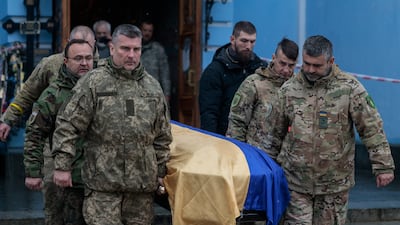
The coffin of Valeriy Krasnyan is brought out of St. Michael's Golden-Domed Monastery in Kyiv. Getty Images -
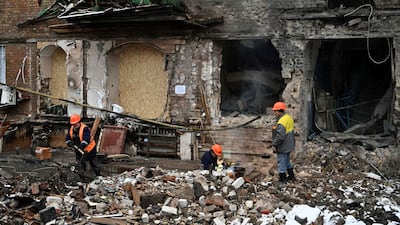
Repairmen work near a residential building damaged following a missile attack in Vyshgorod, outside of Kyiv. AFP -
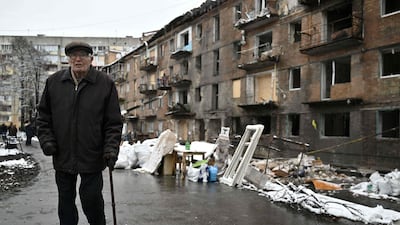
An elderly man walks in front of a residential building damaged following a missile attack in Vyshgorod. AFP -

A boy kisses a dog while he charges his phone at the heating tent dubbed a Point of Invincibly in Bucha, Ukraine. AP -

A couple uses a laptop in the heating tent. AP -
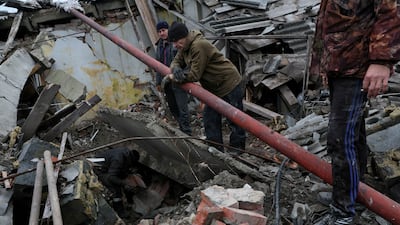
Workers dig out a tire from the rubble of a destroyed storage building at a grain processing center so they can use it for repairs in Siversk, Donetsk region. Reuters -
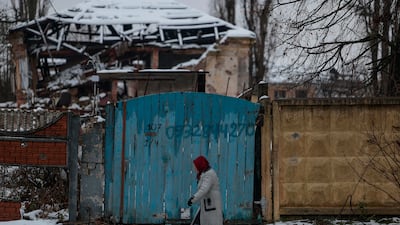
The Chernihiv region found itself on the frontline of Russia's invasion in February, when Moscow's forces were attempting to quickly seize Kyiv. Getty -
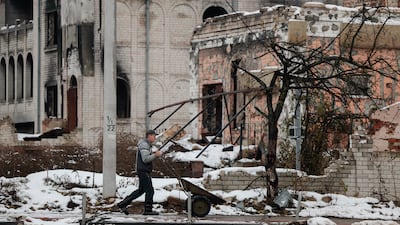
Russia ultimately retreated from northern Ukraine to focus its attack on the east and south. Getty -
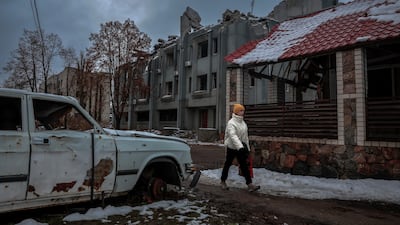
The city of Chernihiv on November 28, 2022 in Chernihiv, Ukraine. Getty -
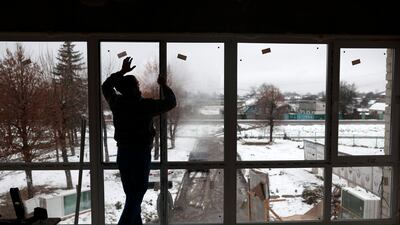
A worker fits in new windows of a building in Chernihiv. Getty -

People receive food from AFAT - Disaster and Emergency Management Presidency in Chernihiv. Getty -
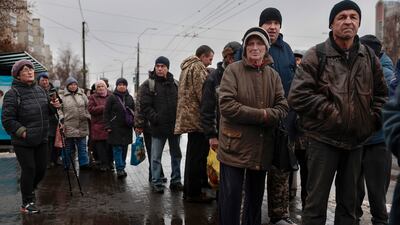
The people Chernihiv queue up for hot food. Getty -
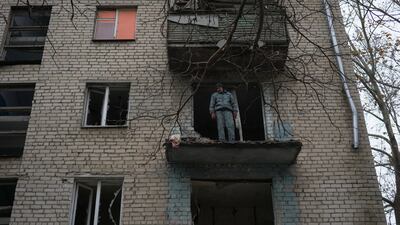
Oleksandr Antonenko stands on a balcony of his apartment damaged by a recent Russian military strike in Kherson. Reuters -
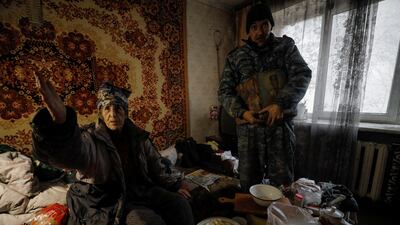
Mr Antonenko and his mother Liudmyla inside their apartment recently damaged by a Russian military strike in Kherson. Reuters -

A woman walks in an underpass in Kyiv, on November 26, 2022. AFP -
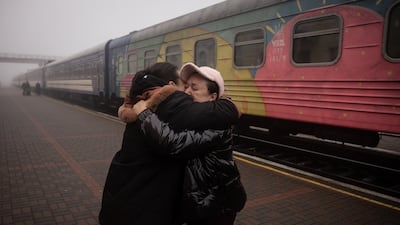
Friends hug after the arrival of a train in the southern city of Kherson. Getty -
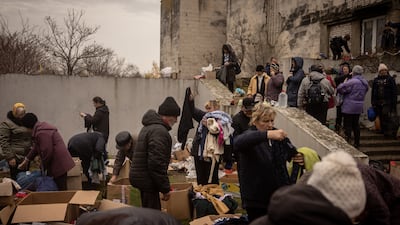
Residents sort through donated clothing at an aid centre in Kherson. Getty -
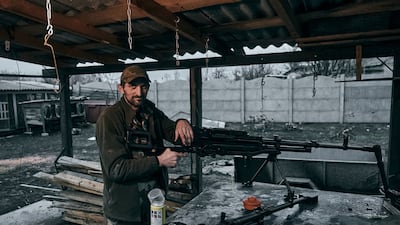
A Ukrainian soldier stands with a machinegun near Liman in the Donetsk region. AP -
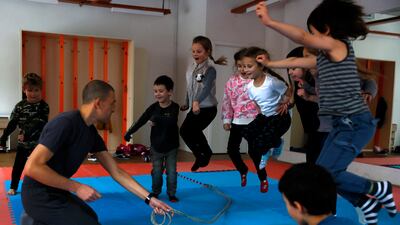
Children attend a physical education class at Spilno School in Kyiv. Getty -
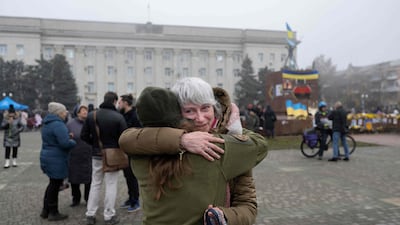
A woman embraces her friend, a soldier in the Ukrainian army, in Kherson. AFP -
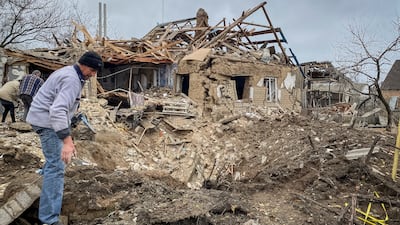
Residents inspect a crater left by a Russian military strike in the village of Komyshuvakha in the Zaporizhzhia region. Reuters -
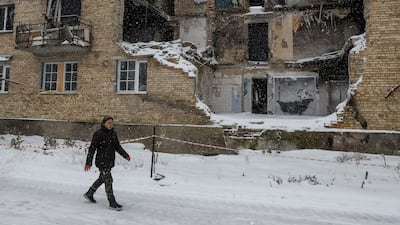
Resident Tetiana Reznychenko walks past a work by world-renowned graffiti artist Banksy, on the wall of a destroyed building in the Ukrainian village of Horenka. Reuters -
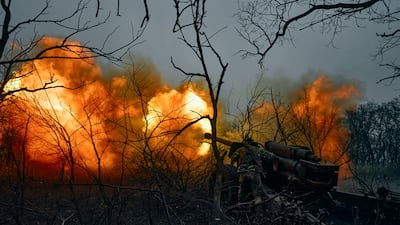
Ukrainian soldiers fire artillery at Russian positions near Bakhmut in the Donetsk region. AP -

A fisherman sails his boat on the Dnipro as black smoke rises from an oil reserve in Kherson. AFP


It is estimated that Ukraine shot down more than 75 per cent of the kamikaze attacks. But when they struck targets they proved destructive and were potentially responsible for taking out 30 per cent of Ukraine’s electricity supplies.
But Ukraine has now used its own drones to attack bomber bases deep inside Russia adapting Soviet-era Tu-141s on Monday, in an assault that could have a “psychologically powerful” impact on Moscow’s thinking.
“This is where the Russians keep their strategic long-range bombers,” the official said. “They will have to think about how they distribute those assets and keep them safe. It may have the effect of pushing those bombers into dispersed locations. It certainly makes the Russians less confident that anywhere is safe.”

