


European leaders left open on Friday the possibility of capping the price of gas this winter, as a summit laid bare divisions over how to navigate the energy crisis.
After three hours of talks in Prague aimed at bridging the divide, leaders gave the European Commission the task of drawing up concrete proposals before the next summit in two weeks’ time.
Supporters of an EU-wide price cap said it would ease Europe’s economic woes by freeing individual countries from having to fund expensive bailouts.
“We could not just leave people coping with the cold weather,” said Belgian Prime Minister Alexander De Croo.
But sceptics were concerned that paying below the market rate could limit Europe’s ability to buy extra gas this winter.
“We cannot set the price so that no one would sell gas into Europe,” said Latvia’s Prime Minister Krisjanis Karins.
The bickering over energy came a day after EU members joined forces with 17 other European states in a historic show of unity against Russia.
On the second day of talks, the EU heard a fresh appeal from Ukrainian President Volodymyr Zelenskyy — his second address to European leaders in two days — to increase support for his country.
He told the closed-door meeting that pressing for peace talks would be futile because Russia “does not want any real negotiations”.
“Russia just wants to save time. Wants to regroup forces. And accumulate resources. To strike again. We have to stop it from doing that,” he said.

Mr Zelenskyy came away with a promise that the EU would maintain its support for Ukraine and a signal that it would move ahead with a planned European training mission for Ukrainian troops.
As leaders arrived in Prague, protesters wrapped in Ukrainian flags held up a banner demanding: “Western tanks for Ukraine.”
They cheered Lithuanian President Gitanas Nauseda after he personally promised them his support.
“More weapons for Ukraine. Absolutely agree. This is our main task,” Mr Nauseda said.
French President Emmanuel Macron said France would set up a fund worth €100 million ($98m) dedicated to Ukrainian arms purchases.
He said talks were ongoing to send more French Caesar cannons to Ukraine on top of the 18 that have already been donated.
But there was less unity once the talks turned to the energy crisis after lunch, with the price cap only one of the issues causing divisions among EU members.
“The word cap means different things for different member states,” said European Parliament President Roberta Metsola.
Countries including Germany, Latvia, Slovakia and Luxembourg expressed concern that setting a maximum price would reduce Europe's ability to buy gas on the world market.
Austrian Chancellor Karl Nehammer set out another misgiving, that a price cap would effectively mean sanctions on Russian gas “by the back door”, when the EU has not agreed on such a measure and countries including Austria oppose it.
Commission President Ursula von der Leyen had floated the idea of a cap in a letter to the EU’s 27 leaders before the summit in Prague.
Her suggestion was that gas prices could be capped to lower the cost of producing electricity, with broader measures planned next year to sever the link between the two.
Although senior EU officials said there was a consensus that prices should be brought down, they had no clear breakthrough to announce after the summit.
“We’re all aware of the problems posed by energy prices in various member states. We’re aware of the fact that winter is drawing near. What’s positive is that member states want European solutions,” Czech Prime Minister Petr Fiala said.
European Commission officials and the Czech EU presidency are responsible for drawing up concrete proposals by the time of the next meeting in Brussels on October 20 and 21.
“There is a common will for a common European approach,” said European Council President Charles Michel at a press conference after the talks.
European summit in Prague — in pictures
-
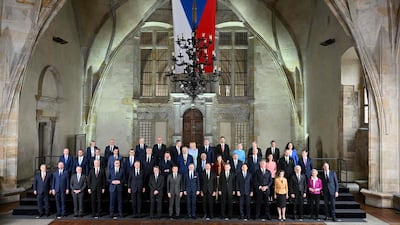
Leaders from more than 40 countries pose for a 'family photo' as they attend the European Political Community summit in Prague. AFP -
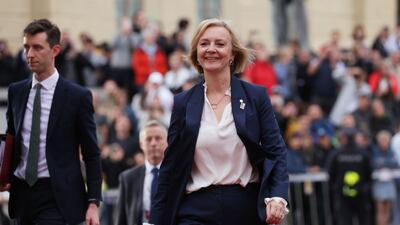
British Prime Minister Liz Truss arrives for the first day of the inaugural gathering in the Czech capital. Getty Images -
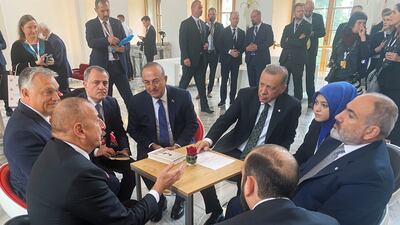
Turkish President Recep Tayyip Erdogan speaks to Azerbaijan's President Ilham Aliyev, Armenia's Prime Minister Nikol Pashinyan and Hungarian Prime Minister Viktor Orban. Reuters -
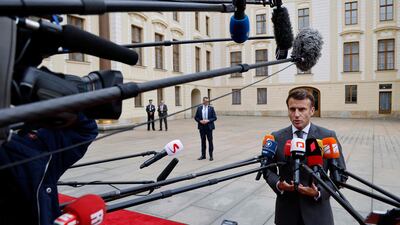
French President Emmanuel Macron speaks to media as he arrives at Prague Castle. AFP -
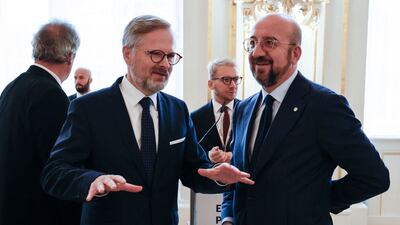
Czech Prime Minister Petr Fiala speaks to President of the European Council Charles Michel. AFP -
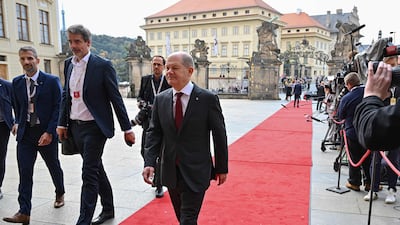
Germany's Chancellor Olaf Scholz arrives at the summit. AFP -
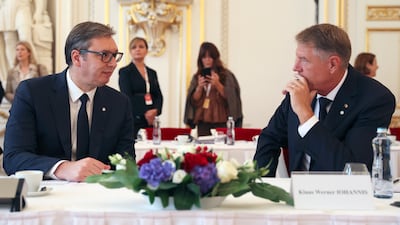
Serbian President Aleksandar Vucic deep in discussion with Romania's President Klaus Werner Iohannis. EPA -
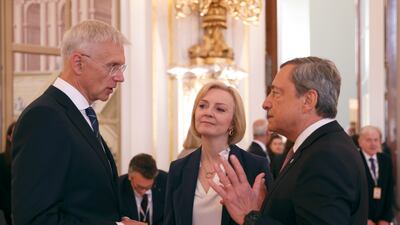
Latvian Prime Minister Arturs Krisjanis Karins, Liz Truss and Italian Prime Minister Mario Draghi. EPA -
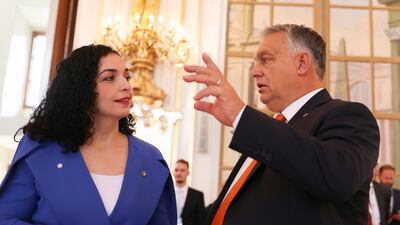
Kosovo President Vjosa Osmani Sadriu speaks to Viktor Orban. EPA -
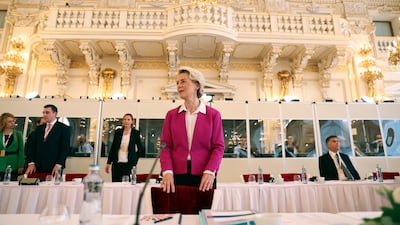
European Commission President Ursula von der Leyen takes a seat. EPA -
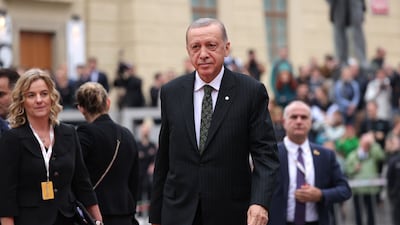
Recep Tayyip Erdogan arrives. Getty Images


Aside from a price cap, another planned endeavour is to use the EU’s market power to jointly negotiate lower prices with suppliers such as the US and Norway.
Talks are already under way between the EU and Norwegian companies on taming the price explosion, said Ms von der Leyen.
Mr Michel said the EU also wanted to see energy consumption reduced further, going beyond the voluntary 15 per cent target for cutting gas use that was agreed to over the summer.
The call for joint action came after Germany's plan to spend up to €200 billion ($195.97bn) to subsidise energy prices caused some disquiet among EU countries who lack the same fiscal firepower.
Chancellor Olaf Scholz defended the package on Friday by saying France, Italy, Spain and the Netherlands had introduced similar measures.
He said his talks at the informal summit had “contributed to clearing up misunderstandings” about the package.
There are also differences of opinion on Europe's gas pipelines. Germany and Spain support a new pipeline across the Pyrenees to link up the Iberian Peninsula — somewhat isolated in energy terms — to the rest of Europe.
However, Mr Macron is sceptical of the proposal and said the focus should instead be on electricity interconnections. He said he would hold talks with Spain and Portugal in the coming days.
Mr Macron and several other leaders called for Europe-wide discussions on how to protect infrastructure such as cables and satellites from being sabotaged like the Nord Stream gas pipelines.
“We have to watch our infrastructure very closely, especially the pipeline from Norway because right now, it’s an important source, especially when Norway is increasing capacity,” Slovak Prime Minister Eduard Heger told The National.
Some countries may be able to guard their pipelines with their own security forces, but “if not, then we should help”, he said.
Nord Stream 1 and 2, the largest pipelines from Russia to Europe, were not supplying gas even before they were hit by apparent blasts.
The EU’s top diplomat Josep Borrell said of the gas leaks: “We don't know exactly who has done it, but someone did it.”
EU states discussed energy co-operation with non-members including Britain and Norway at the inaugural European Political Community summit on Thursday.
Leaders agreed that the next pan-European meeting would take place in Moldova in spring 2023. Subsequent talks are scheduled in Spain and the UK.

