

The UK recording its hottest temperature yet may not be commonplace, but it is likely to become frequent in years to come and that is a problem — because the country is ill-equipped to deal with potentially deadly heat.
Admittedly the 42.2°C registered on Tuesday at London Heathrow is hot but it is also fairly run of the mill when it comes to soaring temperatures across Europe. Scientists operate a second gauge of temperatures, the minimum mortality temperature or the trigger temperature at which the fewest people die, calculated from an average of 10 different regions. On this the UK ranks low at 17°C, while it rises to almost 22°C in Italy and 31°C in Kuwait.
Changing temperatures are a big challenge for Europeans, even though severe temperatures have long been predicted, a leading climate scientist told The National.
In recent days, the region has been grappling with a fearsome heatwave, which has precipitated a premature wildfire season. Tens of thousands of western Europeans have been forced to leave their homes and flee from the conflagrations, while more than 1,100 people in Portugal and Spain have died from heat-related causes.
Much of Europe simply isn't heat-proofed, with both old and new buildings designed with more moderate temperatures in mind and infrastructure is inadequately equipped to cope with the heat.
"[They] are consistent with projections that have been made for decades by climate models," said Manoj Joshi, Professor of Climate Dynamics at the University of East Anglia.
"As the world warms, we'll get heatwaves that will be hotter and more intense compared to what happened before."
The latest Copernicus fire forecast showed the risk of blazes this week, and unsurprisingly the UK and France are currently in greatest jeopardy.

What has caused Europe's current heatwave
While the ferocity of Europe's current heatwave marks a climatic step change, its cause is no different to past heatwaves.
"It's a plume of warm air from Europe, which is both very warm and very dry," said Prof Joshi.
"In a warmer world, these plumes of air will simply be warmer: the sea surface temperature is warmer, the land is warmer — and so the anomalies you get become proportionately warmer."
Like humans, no heatwave is absolutely identical. The current incarnation has been triggered by a region of upper level low-pressure air that has effectively split from the mid-latitude jet stream and moved in a northwards direction up through France and into the UK, taking the Mediterranean's warm air with it.

It's not just at ground level where the searing temperatures are being felt; temperatures at mid-levels (one to two kilometres in altitude) in Europe are also at record highs.
This doesn't surprise Prof Joshi given it represents a straightforward meteorological correspondence.
"When air mass moves, it moves across to the whole depth or what we call the troposphere, the bit of the atmosphere where the weather happens which is about 10 kilometres deep," he said.
"If you have very warm temperatures on the ground, you are going to get very warm temperatures above too."
Locations in Europe approaching or surpassing unofficial daily temperature records
Temperatures on the ground were certainly intense across Europe as of 3pm UK time on Tuesday.
The red circles denote a city marking a daily record, the magenta a station tying or exceeding a monthly record, while the black circles with an "x" inside show places where an all-time record has been set. From the heavy concentration of these latter symbols in England, it is clear than almost all of the country had temperatures at previously unseen levels.

The fact England was so disproportionately affected by Europe's heatwave on Tuesday was ascribed to the quirks of the weather.
"[The UK] just happens to be where this particular heat dome is," said Prof Joshi.
"Its random chance essentially determines where these different high pressure systems may sit at any given point in time.
"This one I believe, has sat over the UK and is moving east. So different places are going to get these heatwaves [at different] times."
A fiery future awaits
The Portuguese can attest to the heatwave's fluidity. Last week, the epicentre of the heatwave fell four-square over Portugal where temperatures reached a national high of 47°C.
With such highs come the attendant natural disasters. The EU earlier this month said Europe would have to become used to both droughts and large fires. Meanwhile, the UN has warned the trend of hotter heatwaves is likely to continue until the 2060s at the earliest, regardless of climate mitigation efforts.
"They are becoming more frequent and this negative trend will continue... at least until the 2060s, independent of our success in climate mitigation efforts," World Meteorological Organisation chief Petteri Taalas told a press conference in Geneva on Tuesday.
"Thanks to climate change we have started breaking records... In the future these kinds of heatwaves are going to be normal, and we will see even stronger extremes."
Wildfires have certainly proliferated across the region since this heatwave struck.

London fires — in pictures
-

A residential area after a large fire in Wennington, Greater London. Several fires broke out across England as the UK experienced a record-breaking heatwave. Getty Images -

Residents look at buildings destroyed by fire in Wennington. Getty -

Firefighters tackle a grass fire during the heatwave in Mow Cop, Staffordshire. Reuters -
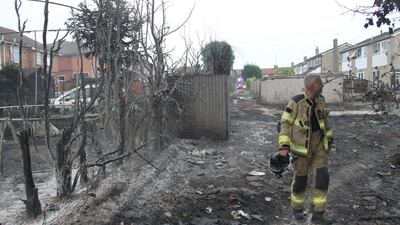
Firefighters in Maltby, after a fire started on scrubland before spreading to outbuildings, fences and homes in South Yorkshire. PA -
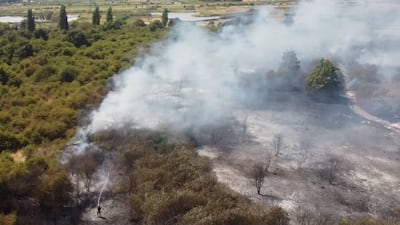
The scene after a fire at Dartford Marshes. PA -
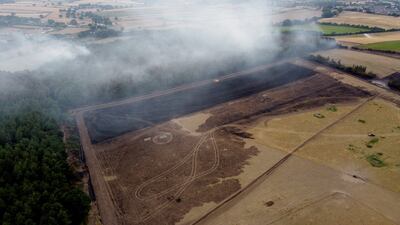
Burnt woodland is seen as smoke rises from the trees following a fire in Blidworth. Getty Images -
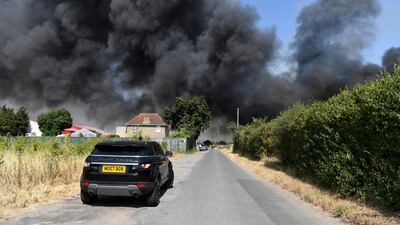
A car drives towards a fire in East London. Reuters -
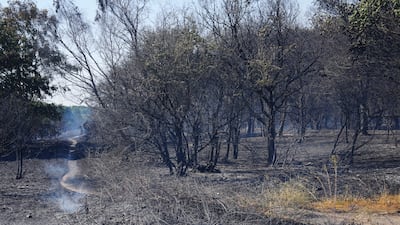
Burnt woodland in Dartford Heath, England, after a fire on Tuesday. Getty -
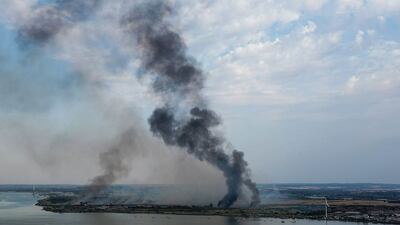
Smoke columns rise from Dartford, Kent, where a fire erupted earlier in the day. AFP -
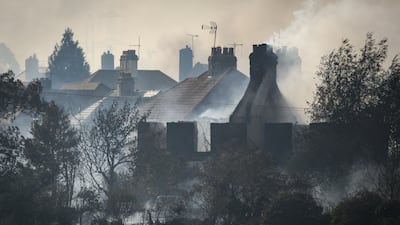
Smoke rises from Wennington neighbourhood fires in England on Tuesday. Getty -
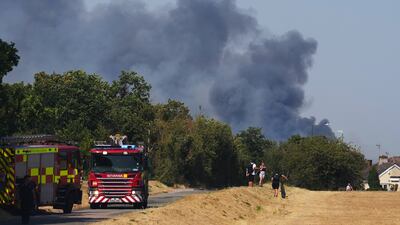
Emergency services tackle a fire on Dartford Heath. Grass fires broke out around the country during an intense heatwave. Getty -
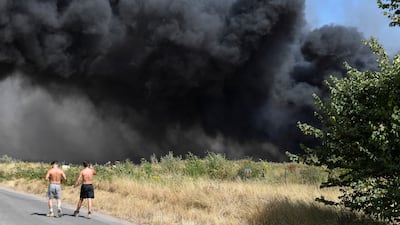
People look on as a fire burns in East London. Reuters -
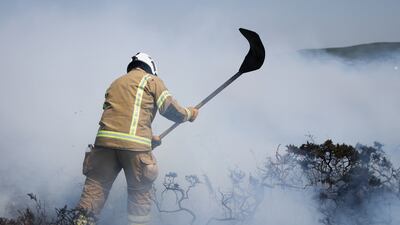
A firefighter attends a gorse bush fire during a heatwave near Zennor, Cornwall. Reuters -

Smoke pours from a blaze in the village of Wennington, east London. PA -
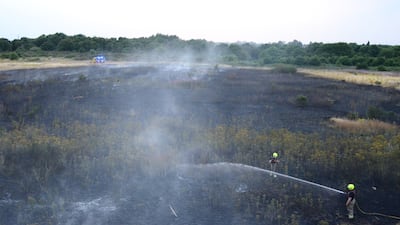
Firefighters hose down a grass fire in Ravenswood in Suffolk. PA -
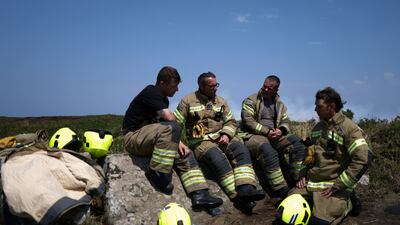
Firefighters rest after attending a gorse bush fire near Zennor in Cornwall. Reuters -
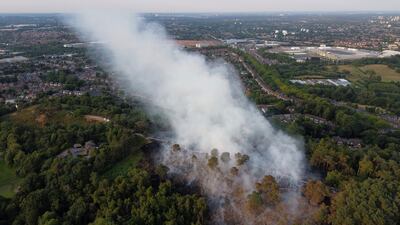
A large wildfire in woodland at Lickey Hills Country Park on the edge of Birmingham. AP -
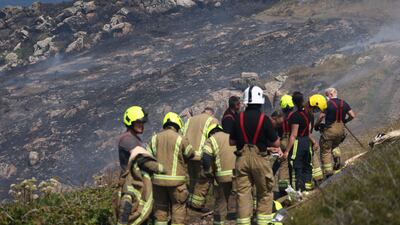
Smoke from the fire near Zennor, Cornwall. Reuters -
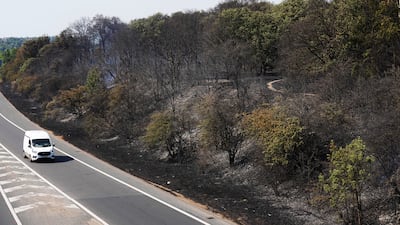
Burnt woodland alongside a motorway near Dartford Heath. Getty -
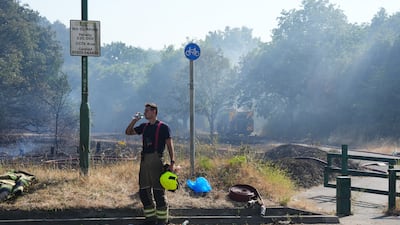
A firefighter has a drink of water after the major blaze on Dartford Heath. Getty


Prof Joshi believes the blazes portend the UK's fiery future.
"We don't really think of forest fires here in the UK as being a thing, but they might soon be," he said.
He feels one of the reasons the UK heatwave hadn't been deemed as severe as that in France, is that it hasn't been accompanied by the sort of raging infernos seen by the French and in other parts of Europe — but once that happens and people's lives are alloyed by the heat, this will change.
"Global warming is as much about temperature as it is about water," he said.
Prof Joshi also stressed that global temperature shouldn't be treated as a uniform concept.
"The global temperature is something like one 1.2°C above pre-industrial levels but the world doesn't warm uniformly.
"The Arctic warms more than the equator, the land warms more than the ocean so you can get changes in weather, changes in circulation.
"And that's important to note thinking about how heatwaves may change in future. So it's not just 'think of the weather a few decades back and add a degree to it'. It's far more complex than that."
Keeping net zero pledges is key
What the weather will look like in a few decades time significantly depends on how diligent countries are in sticking to their net-zero targets.
"I don't agree with some of the apocalyptic forecasts that we have, but I personally think we'll get to something like 2°C-2.5°C above pre-industrial levels," said Prof Joshi.
He cited China which, has a net-zero target and where emissions are starting to slow, and said that "even India's talking about a net-zero target".
However, he doesn't think progress is quick enough to prevent the world from going over 1.5°C above pre-industrial levels. Yet he remain sanguine, and thinks much of Europe will just have to evolve and adapt.
"I wouldn't say the future is hopeless but I do think we're going to have to adapt to these high temperatures in [the UK].
"That's something that will both cost money and require much political will."
UK's hottest ever day — in pictures
-
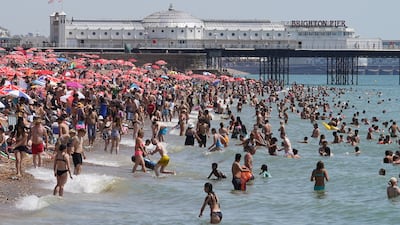
People basking in the sun on a crowded Brighton beach. The temperature in Britain smashed through the 40ºC barrier for the first time in recorded history. PA -
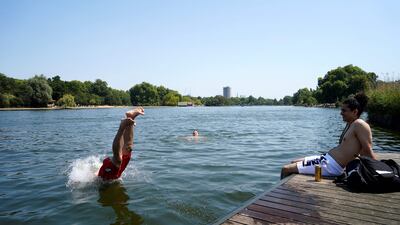
A man dives into the Serpentine Lake to cool off in Hyde Park, west London. AFP -
Firefighters rest as they attend a gorse bush fire, near Zennor, Cornwall. Reuters -
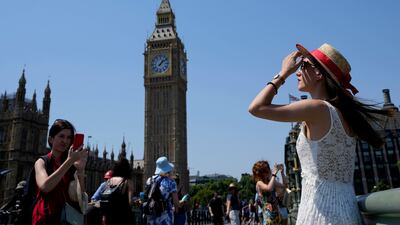
A tourist wears a hat to shield herself from the sun on Westminster Bridge in central London. AP -
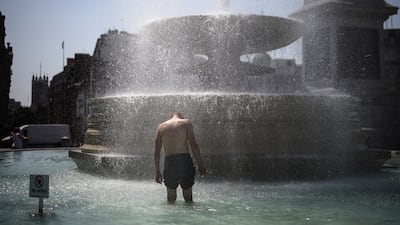
A man cools off at Trafalgar Square, central London. Reuters -
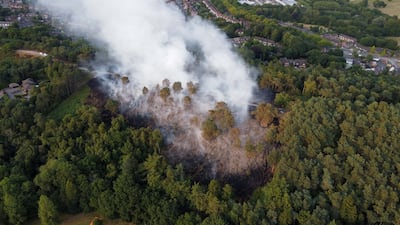
Firefighters respond to a large wildfire in woodland at Lickey Hills Country Park on the edge of Birmingham. PA -
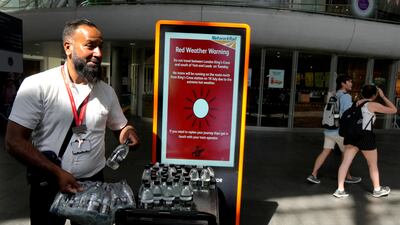
A railway worker hands out bottles of water to passengers at London's King's Cross, where there are train cancellations due to the heat. AP -
Firefighters control a grass fire in Ravenswood, Suffolk. PA -

Train tracks are painted white to help with the heat at Alexandra Palace train station in London. PA -
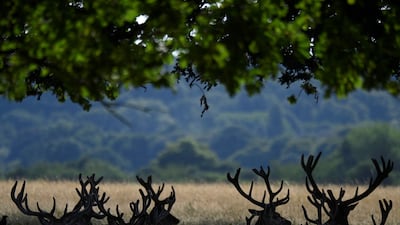
Deer rest in the shade at London's Richmond Park. Reuters -

An empty freezer section at Sainsbury's Nine Elms in London. PA -

Chippy the chimpanzee enjoys an ice treat at Blair Drummond Safari and Adventure Park, near Stirling. AP -

A student dips her head into the fountain at Trafalgar Square, London. Getty Images -
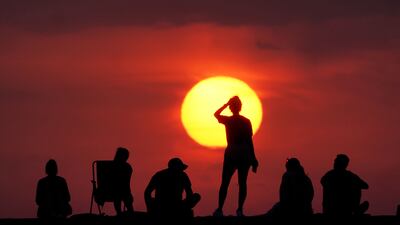
People turn out to watch the sunrise on Tuesday morning at Cullercoats Bay, North Tyneside. PA -

A digital thermometer displaying a temperature of 39°C on a London Underground train. PA -

A fan finds a way to keep cool while watching the Women's Euro 2022 football match between Italy and Belgium at Manchester City Academy Stadium. AP -

An aerial view shows swimmers at Hathersage Swimming Pool, west of Sheffield in northern England. AFP -
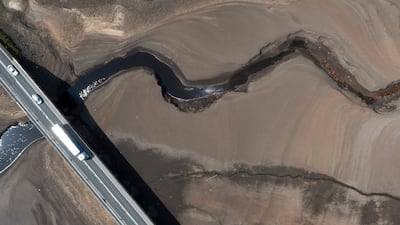
Traffic crosses a bridge at Woodhead Resevoir in West Yorkshire as water levels dip dangerously low. AP -

A man leaps from the top of a tree into the River Cam, in Cambridge. Getty Images -
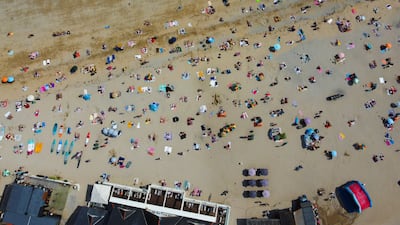
A packed Gyllyngvase beach in Falmouth. Getty Images -

A police officer gives water to a sentry in heavy ceremonial uniform, outside Buckingham Palace in central London. AP -
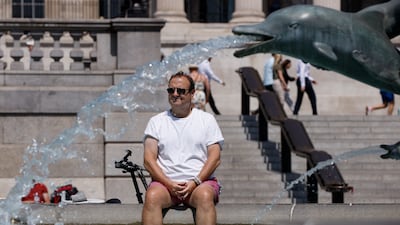
A man cools off in a fountain in London. Reuters -

A man sunbathes at the harbour in Mousehole, Cornwall. AP -
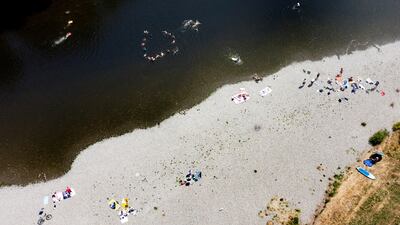
People swim in the River Wye. Reuters -
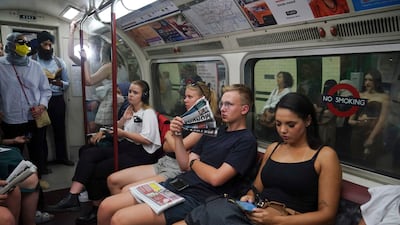
Passengers feel the heat on the London Underground. The operator advised its customers not to use the metro during the worst of the heatwave. AP -

Palm House supervisor Will Spolestra waters the plants at the Royal Botanical Gardens Kew, west London, where temperatures inside the greenhouses are cooler than outside during the heatwave. PA -

Dry grass at Greenwich Park, south-east London. AP -

A swimmer takes an early morning dip in the cool water of Jesus Green Lido in Cambridge, eastern England. Getty Images -

Assistant horticulturalist Katie Martyr checks the temperature at the Cambridge University Botanic Garden. Forecasts are for record temperatures exceeding 40°C. Getty Images -
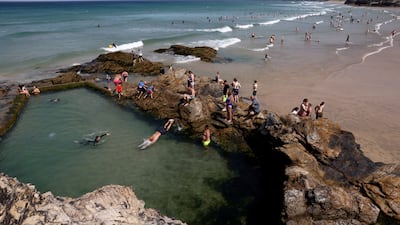
Bathers keep cool in a tidal pool at Perranporth Beach in Cornwall, south-west England. Reuters -
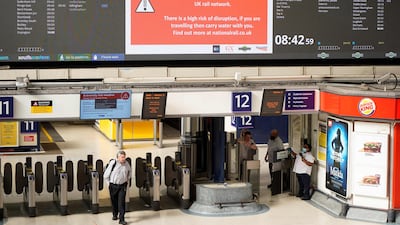
Message boards at London's Victoria Station warn passengers of potential disruption to train services due to the extreme heat. AFP -
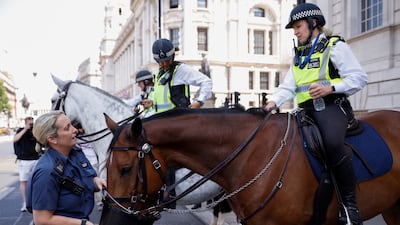
Zorro the police horse drinks water from a bucket to cool down during hot weather, on Whitehall in London. Reuters -
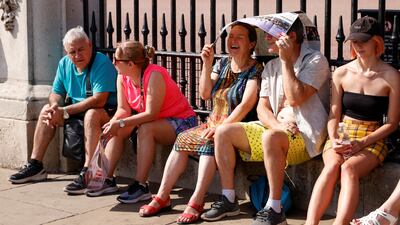
People use a map to shelter from the sun outside Buckingham Palace in London. Reuters -
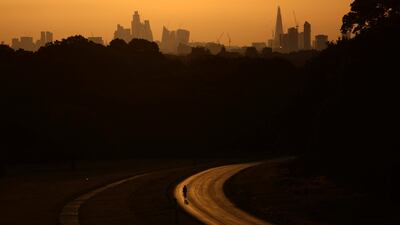
A cyclist rides through Richmond Park in south-west London at sunrise on Monday. Reuters -
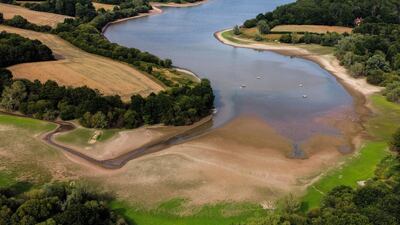
The reduced water level at Weir Wood reservoir, near Crawley, south-east England. The UK's Met Office has issued its first 'red warning' for exceptional heat. AFP -
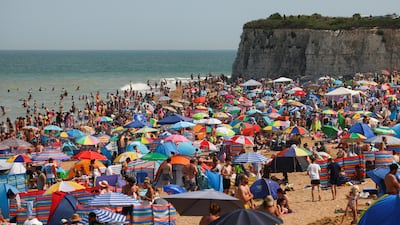
A crowded beach at Joss Bay in Broadstairs, south-east England. Reuters -
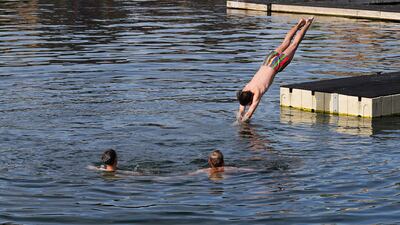
Swimmers take the plunge to escape the heat in east London. Reuters -
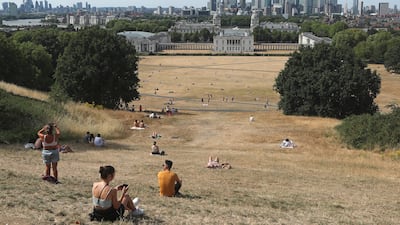
Sunbathers on the parched grass in Greenwich Park, south-east London. AP -
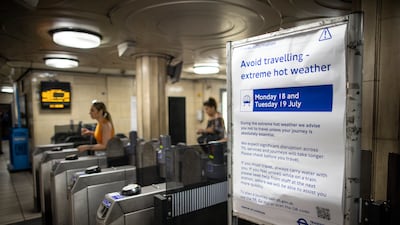
A sign advises people not to travel on the London Underground during the heatwave. EPA



