


Germany’s pet project at the G7 summit, forming an international “climate club” of countries with green ambitions, has drawn a mixed response from activists and businesses amid concerns it will fail to drive global action.
Environmentalists have been lukewarm on Chancellor Olaf Scholz’s proposal, seeing it as well-meaning but lacking detail, and in danger of becoming a talking shop that does nothing to force down emissions.
For any club to be credible, it will “likely need teeth”, said Domien Vangenechten, a policy adviser at think tank E3G – potentially meaning that countries are shut out if they do not meet its standards.
At the same time, “in order for the idea to fly, it will need to secure broad initial membership and be deemed legitimate,” he told The National.
Businesses also have concerns over whether the club will succeed in cajoling countries beyond the G7 to meet higher environmental standards, ensuring western steel and chemicals manufacturers do not lose out by going green.
“The initiative cannot hide the fact that the levels of ambition among potential club members are going to remain massively different for some time,” said Hans Juergen Kerkhoff, a German steel industry representative.
Even officials involved in the talks say some questions are likely to remain unanswered after the G7 summit in Germany, where they are expected to endorse the principle of a climate club.
Although Germany wants the club to talk about carbon pricing, the US and Japan are sceptical about the idea and it is unclear whether consensus can be found on that point.

Asked on Monday whether disagreement on carbon pricing could sink the project before it has launched, Mr Scholz told broadcasters that there were different ways for potential club members to reach carbon neutrality.
“The climate club is about states working closely together who are ready to become carbon neutral very quickly, by the middle of this century,” he said.
“If some countries like Germany use carbon prices and others choose different ways, the aim has to be the same.”
A group of businesses advising the G7 said in pre-summit recommendations that it welcomed Mr Scholz’s idea but that the nature of the club was not yet clearly defined.
It said the G7 must work closely together with the G20 – a body that includes Russia and which Mr Scholz hopes to circumvent by setting up the climate club – and ensure that the club is open to all.
Activists have said much would depend on the membership of Mr Scholz's club. Mr Vangenechten said countries could be tempted to join with preferential access to the club’s markets or the offer of financial support or green technology.
He said setting up such an “industrial club” to drive decarbonisation could be a precursor to a wider climate club, and would have the advantage of not weighing in on the debate about carbon pricing.
However, Mr Kerkhoff said that only a robust carbon pricing system, more likely to come via the European Union, would ensure that the German steel industry could cut carbon without losing customers.
-
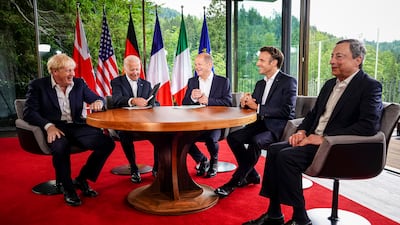
Britain's Prime Minister Boris Johnson, US President Joe Biden, German Chancellor Olaf Scholz, France's President Emmanuel Macron and Italian Prime Minister Mario Draghi chat before their meeting at Elmau Castle on Tuesday morning. Getty Images -
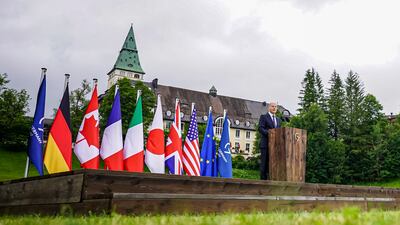
Olaf Scholz speaks at a press conference at Elmau Castle. EPA -
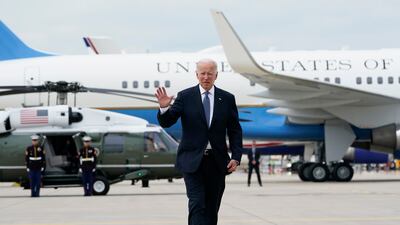
Joe Biden waves as he crosses the tarmac next to Air Force One at Munich International Airport. The US president is leaving Germany on his way to Spain to attend a Nato summit. AP -
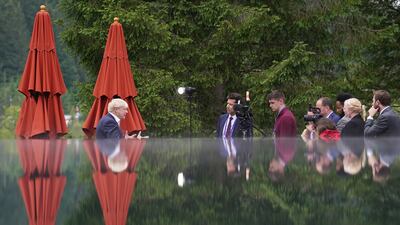
Boris Johnson speaks to press at the G7 summit. PA -

Emmanuel Macron holds a press conference at Elmau Castle. AFP -
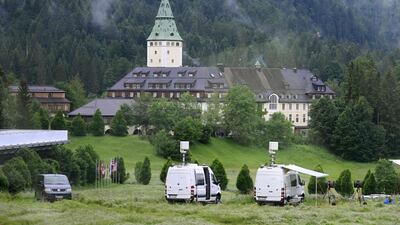
Vans equipped with electronic detection devices are stationed in front of Elmau Castle, where the G7 summit is taking place. AFP -
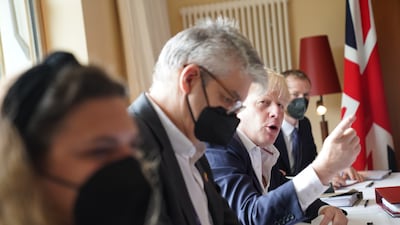
Boris Johnson makes a point during a meeting with the Prime Minister of Japan Fumio Kishida. PA -
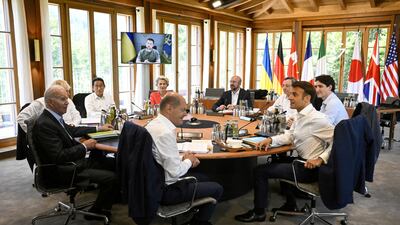
Clockwise from centre: Olaf Scholz; Joe Biden; Boris Johnson; Fumio Kishida; European Commission President Ursula von der Leyen, European Council President Charles Michel; Mario Draghi; Canada's Prime Minister Justin Trudeau, and Emmanuel Macron listen to an online address by Ukraine's President Volodymyr Zelenskyy at the G7 summit in Bavaria. Reuters -
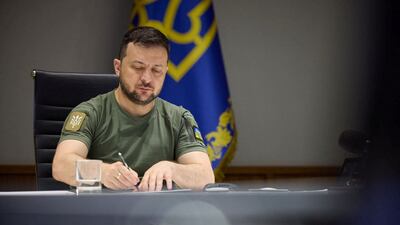
Volodymyr Zelenskyy attends a working session of G7 leaders via video link from Kyiv, Ukraine. Reuters -
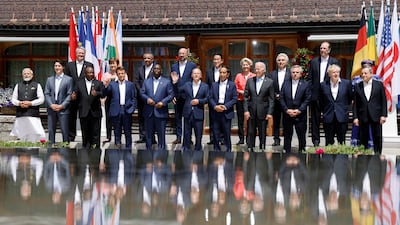
Olaf Scholz waves alongside G7 leaders and participants of the outreach programme as they pose for a 'family photo' at the Bavarian resort of Schloss Elmau. Reuters -
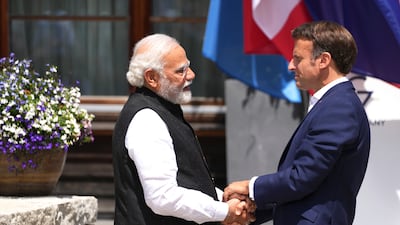
Emmanuel Macron greets India's Prime Minister Narendra Modi during the official welcome ceremony of G7 leaders. AP -
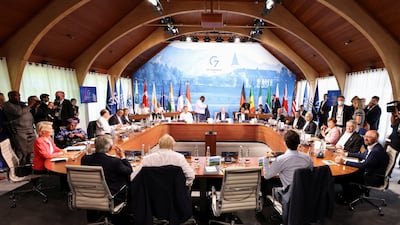
G7 leaders meet outreach guests at the summit. Reuters -
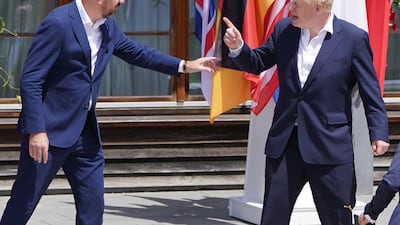
Boris Johnson speaks to Charles Michel. PA -
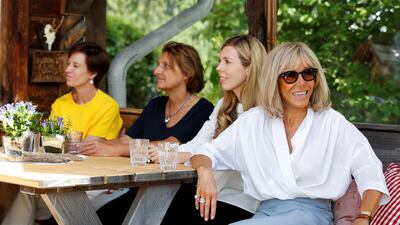
Amelie Derbaudrenghien, Britta Ernst, Carrie Johnson and Brigitte Macron at Elmauer Alm Mountain Restaurant. Reuters -
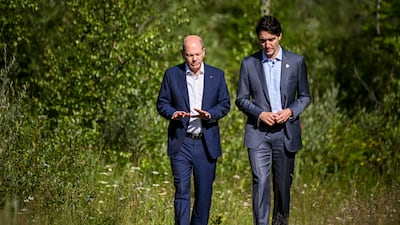
G7 leaders Olaf Scholz and Justin Trudeau talk a walk at Elmau Castle in Bavaria. EPA -
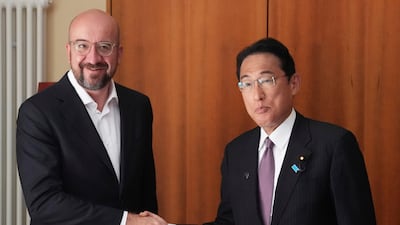
European Council President Charles Michel greets Japanese Prime Minister Fumio Kishida on the sidelines of the G7 summit at Castle Elmau in Bavaria. AP -
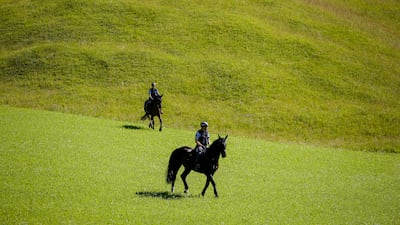
Horseback police patrol at Elmau Castle in Bavaria. EPA -
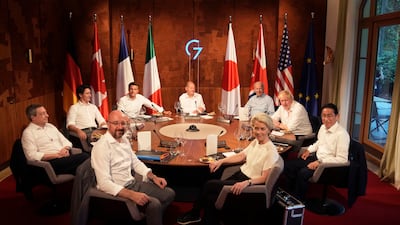
G7 leaders have dinner at Elmau Castle in Kruen, Germany. Clockwise from front left, European Council President Charles Michel, Italy's Prime Minister Mario Draghi, Canada's Prime Minister Justin Trudeau, French President Emmanuel Macron, German Chancellor Olaf Scholz, US President Joe Biden, British Prime Minister Boris Johnson, Japan's Prime Minister Fumio Kishida and European Commission President Ursula von der Leyen. AP -

From left, Mr Draghi, Ms von der Leyen, Mr Biden, Mr Scholz, Mr Johnson, Mr Trudeau, Mr Kishida, Mr Macron and Mr Michel. AFP -
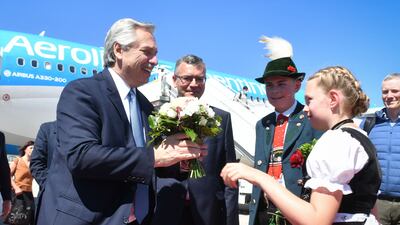
Flowers for President Alberto Fernandez of Argentina at Munich Airport as he arrives to take part in the G7 summit in Bavaria. AFP -
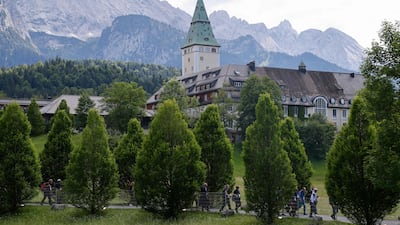
Elmau Castle in southern Germany, the venue for the G7 summit. AFP -
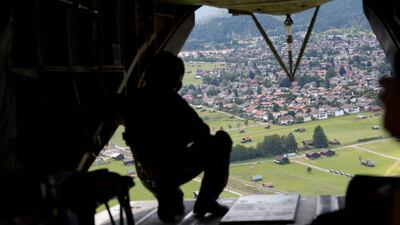
The view from a German armed forces helicopter on its way to the G7 summit at Elmau Castle. AFP -
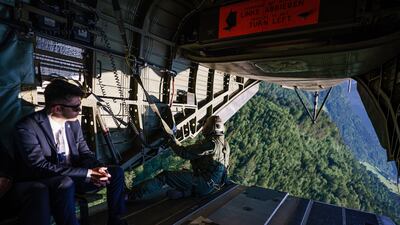
Gazing out from the helicopter. AFP -
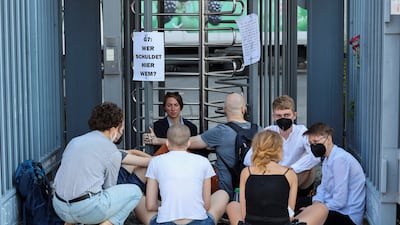
In Berlin, campaigners sit near a sign reading 'G7: Who owes who?' at the Ministry of Finance building to demand debt relief for countries of the global south. Reuters -
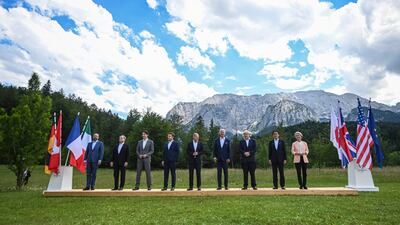
From left, Mr Michel, Mr Draghi, Mr Trudeau, Mr Macron, Mr Scholz, Mr Biden, Mr Johnson, Mr Kishida and Ms von der Leyen at the summit at Elmau Castle. EPA -
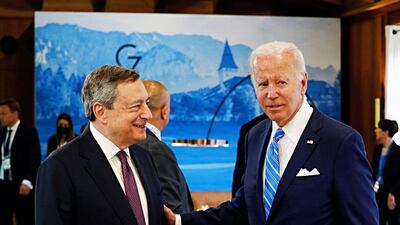
Mr Draghi talks with Mr Biden. EPA -
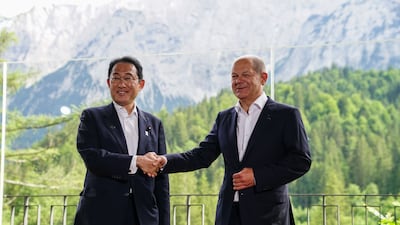
Mr Scholz shakes hands with Mr Kishida. EPA -
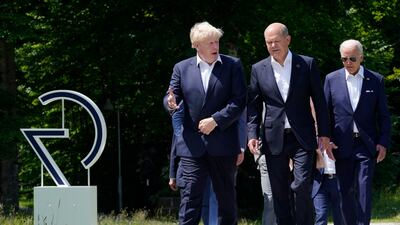
Mr Johnson, Mr Scholz and Mr Biden. AFP -
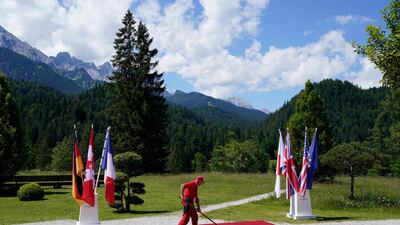
A worker cleans the red carpet at Elmau Castle in the Bavarian mountains. AFP -

Mr Kishida leads the Japanese delegation. AFP -

The G7 logo at Elmau Castle. AFP -
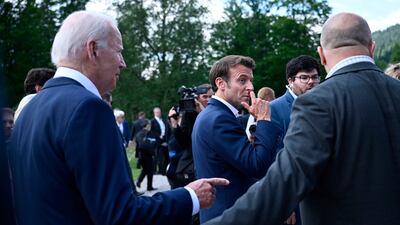
Mr Biden and Mr Macron. AP -
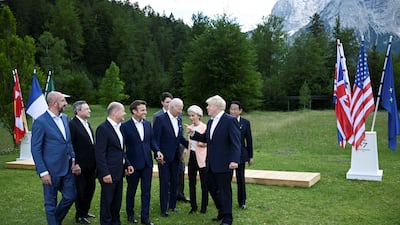
The leaders at a photocall. Reuters -
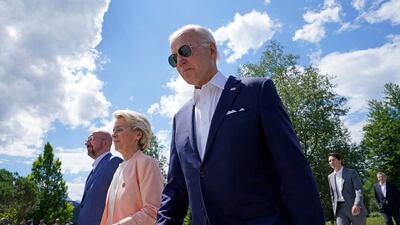
Mr Biden walks with Ms von der Leyen and Mr Michel. Reuters -
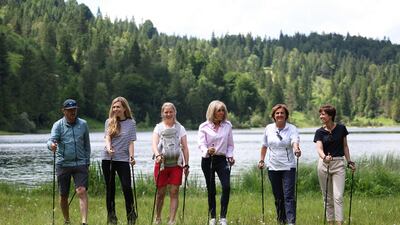
Former German alpine ski racer Christian Neureuther, British Prime Minister's wife Carrie Johnson, former German biathlete Miriam Neureuther, French President's wife Brigitte Macron, German Chancellor's wife Britta Ernst and European Council President's wife Amelie Derbaudrenghien take part in a Nordic Walk as part of the spouses' programme. Reuters -

Mr Macron, Mr Biden, Ms von der Leyen and Mr Trudeau. AP -
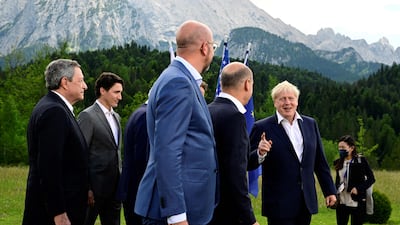
Mr Draghi, Mr Trudeau, Mr Michel, Mr Scholz and Mr Johnson. AFP -

Ms von der Leyen chats with Mr Trudeau. AFP -
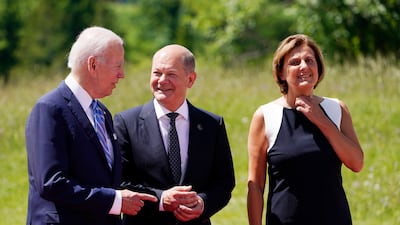
Mr Biden is welcomed by Mr Scholz and his wife Britta Ernst. AP -
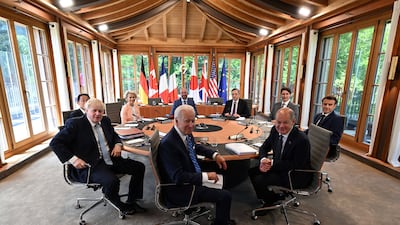
The leaders get down to business. AP -
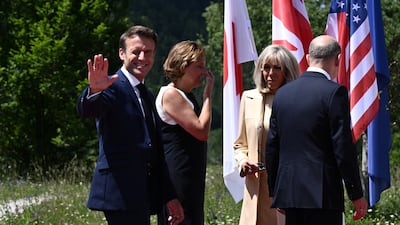
Mr Scholz and Ms Ernst welcome the Macrons. Reuters -
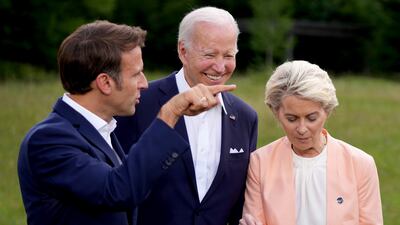
Mr Macron, Mr Biden and Ms von der Leyen. AP -
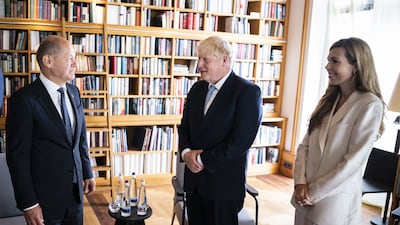
Mr Scholz greets Mr and Mrs Johnson. PA -

Mr Scholz and Ms Ernst welcome Ms von der Leyen to Elmau Castle. AFP -
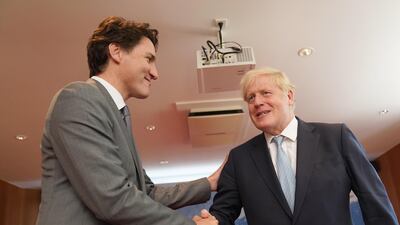
Mr Johnson meets Mr Trudeau. PA -
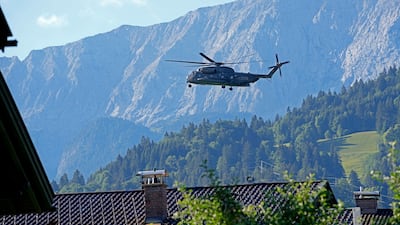
A helicopter flies over the G7 venue. AP Photo


Activists are also concerned that the G7 will water down its commitments on fossil fuels, as gas shortages linked to the war in Ukraine spur them into firing up condemned coal plants.
Germany last week announced what Vice Chancellor Robert Habeck said was the painful decision to turn back to coal despite a commitment by Mr Scholz’s government to phase it out by 2030.
Friederike Meister of advocacy group Global Citizen said it was doubtful whether an end to overseas fossil fuel financing by the end of 2022, negotiated by G7 energy ministers last month, would survive the leaders’ summit.
The Fridays for Future movement said a climate club would be "just for show" if Mr Scholz's government keeps buying more natural gas and equivocating on banning petrol cars.
But Mr Vangenechten said the wider trend was still a “hard shift” away from coal and that the G7’s ability to claim global leadership rested more on whether it would cough up finance for developing countries.
A promise of $100 billion of annual climate funding for poorer countries – first made in 2009 – has yet to be delivered, to the growing frustration of the global south.
“G7 members need to find ways to scale up finance for mitigation, adaptation and clean infrastructure from billions to trillions,” Mr Vangenechten said.

