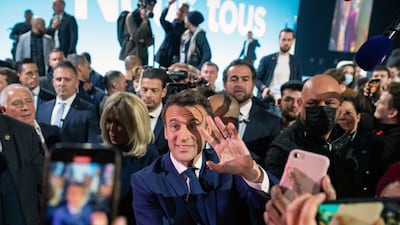
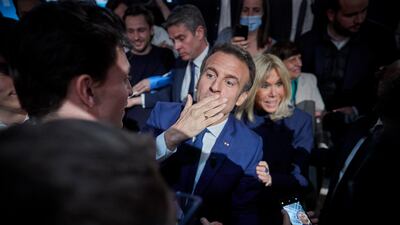
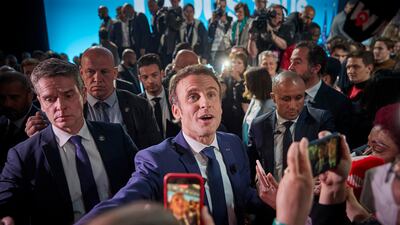
French President Emmanuel Macron, centre, in Carvin, northern France, on April 11. EPA

Macron woos left-wing voters with hint at delaying pension reforms


Tim Stickings
  • English
  • Arabic

French President Emmanuel Macron has hinted at watering down a controversial pension reform in what his election rival Marine Le Pen described as a ploy to win coveted votes from the left.

It came as former president Nicolas Sarkozy became one of the most high-profile figures to urge voters to put aside party differences and back the centrist Mr Macron over the far-right Ms Le Pen.

The two final-round opponents have begun a two-week sprint to gather votes from the 17 million people who backed other candidates in the first round, with 7.7 million of those supporting hardline left-winger Jean-Luc Melenchon.

Ms Le Pen’s camp wants to seduce those voters by opposing the president’s plans to raise the state pension age from 62 to 65 to increase productivity and cut the cost of France’s expensive welfare state.

The president has been promising pension reform since his first campaign in 2017, but his proposals sparked protests from the Yellow Vest movement and were eventually shelved during the coronavirus pandemic.

Although the move to 65 is in Mr Macron’s manifesto for the next five years, he said on his first day of campaigning for the April 24 second round he was willing to push it back until 2030 if “people are too anxious” to do it sooner.

Lowering the threshold to 64 is not out of the question because 65 “is not a dogma”, he said as he answered questions in one of Ms Le Pen’s northern heartlands.

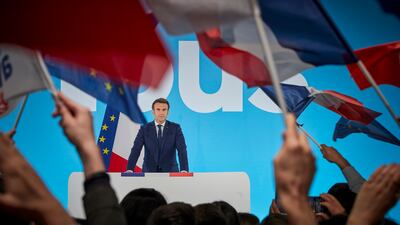
  • Emmanuel Macron, the president of France, at an election night event after voting in the first round of the French presidential election, in Paris. Bloomberg
    Emmanuel Macron, the president of France, at an election night event after voting in the first round of the French presidential election, in Paris. Bloomberg
  • Emmanuel Macron at a rally in Paris after the first round of voting in the French presidential election as early exit polls suggested victory. Getty Images
    Emmanuel Macron at a rally in Paris after the first round of voting in the French presidential election as early exit polls suggested victory. Getty Images
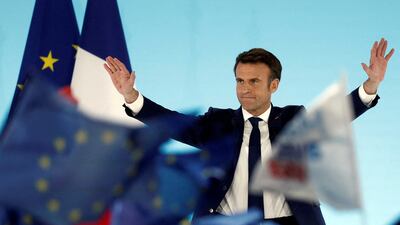
  • Mr Macron after partial results were declared in the first round of the 2022 French presidential election. Reuters
    Mr Macron after partial results were declared in the first round of the 2022 French presidential election. Reuters
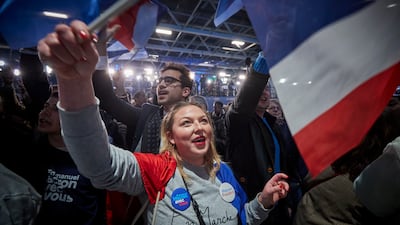
  • Supporters in Paris cheer Mr Macron at a rally after the first-round vote. Getty Images
    Supporters in Paris cheer Mr Macron at a rally after the first-round vote. Getty Images
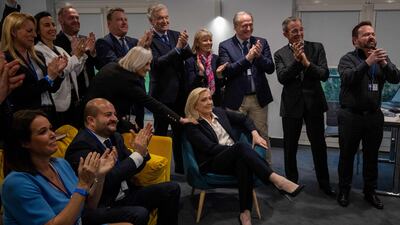
  • Marine Le Pen, centre, of the French far-right party Rassemblement National, and supporters after the first round of voting. AFP
    Marine Le Pen, centre, of the French far-right party Rassemblement National, and supporters after the first round of voting. AFP
  • Supporters cheer in Paris as exit polls indicated Mr Macron would win the election. Getty Images
    Supporters cheer in Paris as exit polls indicated Mr Macron would win the election. Getty Images
  • The French leader acknowledges his supporters at a rally in Paris. Getty Images
    The French leader acknowledges his supporters at a rally in Paris. Getty Images
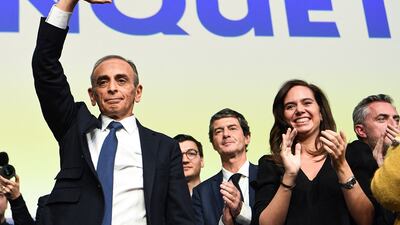
  • Eric Zemmour, candidate of the far-right Reconquete! party, waves to supporters after voting ended in the first round of the French presidential election. AFP
    Eric Zemmour, candidate of the far-right Reconquete! party, waves to supporters after voting ended in the first round of the French presidential election. AFP
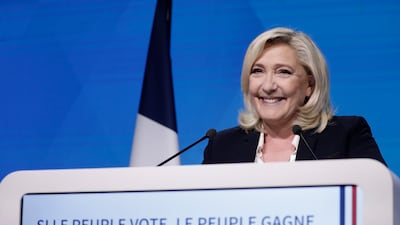
  • Far-right candidate Marine Le Pen delivers a speech at her election day headquarters in Paris. AP
    Far-right candidate Marine Le Pen delivers a speech at her election day headquarters in Paris. AP
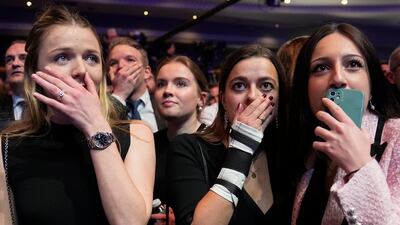
  • Supporters of Mr Zemmour as preliminary results of the first round of the presidential election were announced in Paris. AP
    Supporters of Mr Zemmour as preliminary results of the first round of the presidential election were announced in Paris. AP
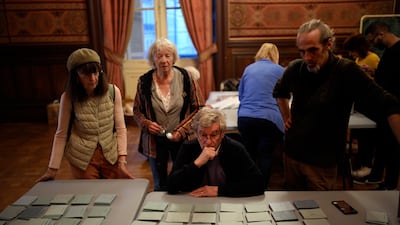
  • Ballots for the first round of the presidential election are counted in Marseille, southern France. AP
    Ballots for the first round of the presidential election are counted in Marseille, southern France. AP
  • French President Emmanuel Macron, who was seeking re-election, accompanied by his wife Brigitte, greets people at a polling station in Le Touquet-Paris, France. EPA
    French President Emmanuel Macron, who was seeking re-election, accompanied by his wife Brigitte, greets people at a polling station in Le Touquet-Paris, France. EPA
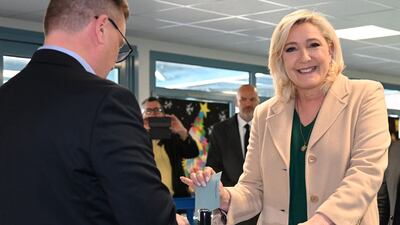
  • Far-right presidential candidate Marine Le Pen casts her ballot at a polling station in Henin-Beaumont, northern France. AFP
    Far-right presidential candidate Marine Le Pen casts her ballot at a polling station in Henin-Beaumont, northern France. AFP
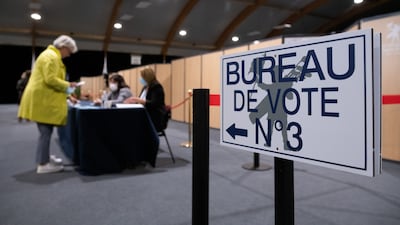
  • A sign indicates where to vote at a polling station, in Le Touquet-Paris. Bloomberg
    A sign indicates where to vote at a polling station, in Le Touquet-Paris. Bloomberg
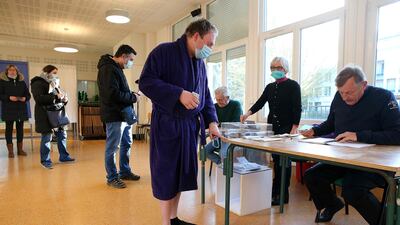
  • A voter wearing a robe and slippers arrives to cast his ballot at a polling station in Reims, north-eastern France. AFP
    A voter wearing a robe and slippers arrives to cast his ballot at a polling station in Reims, north-eastern France. AFP
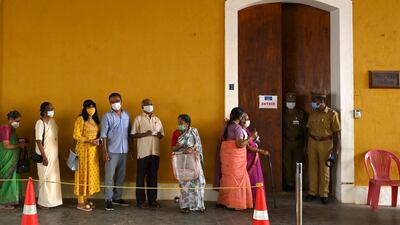
  • French citizens living in India arrive to cast their votes at France's consulate general, in the region of Pondicherry. AFP
    French citizens living in India arrive to cast their votes at France's consulate general, in the region of Pondicherry. AFP
  • A man votes in Saint-Denis, outside Paris. AP
    A man votes in Saint-Denis, outside Paris. AP
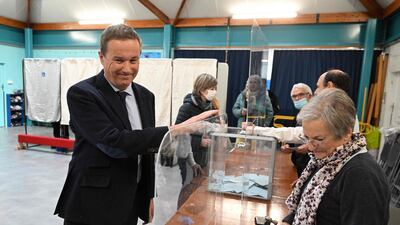
  • Presidential candidate of the far-right DLF party, Nicolas Dupont-Aignan, casts his ballot in Yerres, south-east of Paris. AFP
    Presidential candidate of the far-right DLF party, Nicolas Dupont-Aignan, casts his ballot in Yerres, south-east of Paris. AFP
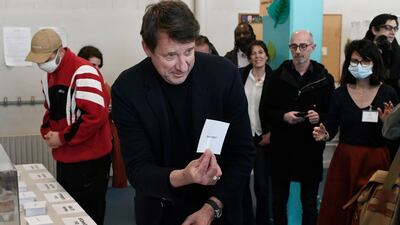
  • The French ecologist party EELV's presidential candidate, Yannick Jadot, takes ballots before voting at a polling station in Paris. AFP
    The French ecologist party EELV's presidential candidate, Yannick Jadot, takes ballots before voting at a polling station in Paris. AFP
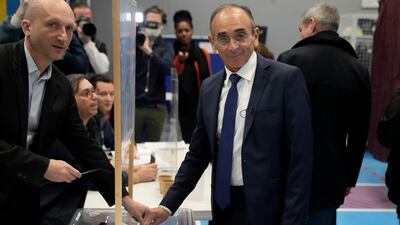
  • Far-right candidate Eric Zemmour votes in Paris. AP
    Far-right candidate Eric Zemmour votes in Paris. AP
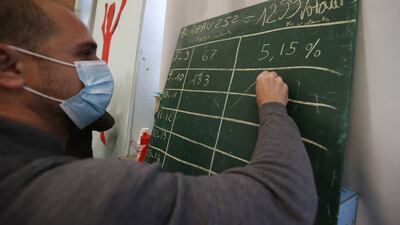
  • A polling station worker checks voters turnout by hour at a polling station in Marseille. EPA
    A polling station worker checks voters turnout by hour at a polling station in Marseille. EPA
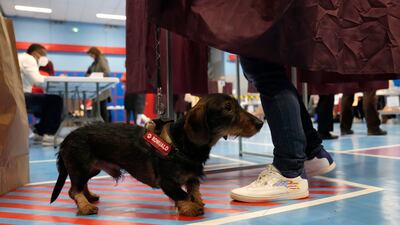
  • A voter inside a voting booth in Paris. AP
    A voter inside a voting booth in Paris. AP
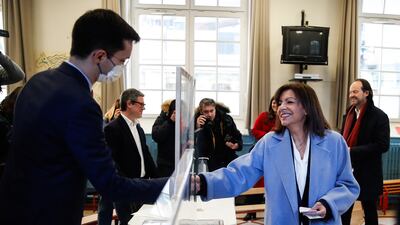
  • Mayor of Paris and presidential candidate Anne Hidalgo votes at a polling station in the French capital. EPA
    Mayor of Paris and presidential candidate Anne Hidalgo votes at a polling station in the French capital. EPA
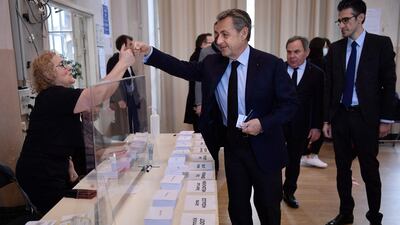
  • Former French president Nicolas Sarkozy, centre, greets an electoral officer at a polling station in Paris. AFP
    Former French president Nicolas Sarkozy, centre, greets an electoral officer at a polling station in Paris. AFP
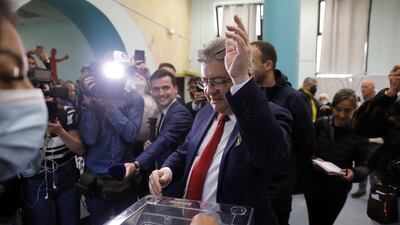
  • The presidential candidate of the LFI party, Jean-Luc Melenchon, casts his ballot at a polling station in Marseille. EPA
    The presidential candidate of the LFI party, Jean-Luc Melenchon, casts his ballot at a polling station in Marseille. EPA

Finance Minister Bruno Le Maire, a supporter of Mr Macron, separately said the move to 65 would not be scrapped but “there will be options for discussing details”.

The softer line was taken by rival camps as an attempt to persuade left-wing voters to go the polls, after Mr Melenchon told his supporters not to give “one single vote” to the far right but stopped short of endorsing Mr Macron.

“It's a manoeuvre by Emmanuel Macron to try to win over, or at least to mitigate the opposition of the left-leaning voters,” Ms Le Pen told France Inter radio on Tuesday.

Manuel Bompard, the head of the Melenchon campaign, suggested a referendum on pensions as he voiced dissatisfaction with both remaining candidates’ stances on the issue.

Mr Melenchon supports reducing the pension age to 60, an idea Ms Le Pen once supported but which she has largely backed away from in favour of keeping it at 62.

“I tell Macron this: If he really wants to appeal to our voters... he has to make a clear commitment,” said Mr Bompard.

The president’s camp has sought to turn public attention to Ms Le Pen’s hard-line views and a record of Kremlin-friendly statements that have come back into the limelight since Russia invaded Ukraine.

Former president Nicolas Sarkozy said on Tuesday he would support Mr Macron in the final round. AFP

Sarkozy support

Mr Sarkozy, the president from 2007 to 2012 whose centre-right Republicans were eliminated in Sunday’s first round, cited the war in Ukraine as part of his reasoning for supporting Mr Macron this time.

“I believe he has the necessary experience faced with a grave international crisis… and his commitment to Europe is clear and unambiguous,” said Mr Sarkozy.

He urged voters to show “republican values” by uniting against Ms Le Pen as they have done in the past, amid concerns that this habitual dam-building against the far right is no longer a certainty.

Mr Macron won 28 per cent of votes in the first round. Ms Le Pen won 23 per cent, with Mr Melenchon scoring a higher-than-expected 22 per cent.

Although nearly all second-round polls have shown Mr Macron in the lead, some have him only a few points ahead and all suggest a far narrower race than when the same two candidates faced off in 2017.

Mr Macron won by a landslide that year after his new centrist party upended French politics, leaving the mainstream left and right struggling for survival.

Valerie Pecresse, the defeated candidate from Mr Sarkozy’s party, on Monday issued an appeal for donations after failing to reach the 5 per cent threshold necessary for campaign debts to be reimbursed by the state.


'Champions'

Director: Manuel Calvo
Stars: Yassir Al Saggaf and Fatima Al Banawi
Rating: 2/5
 

The specs: 2018 Nissan Patrol Nismo

Price: base / as tested: Dh382,000

Engine: 5.6-litre V8

Gearbox: Seven-speed automatic

Power: 428hp @ 5,800rpm

Torque: 560Nm @ 3,600rpm

Fuel economy, combined: 12.7L / 100km

Kat Wightman's tips on how to create zones in large spaces


  • Area carpets or rugs are the easiest way to segregate spaces while also unifying them.
  • Lighting can help define areas. Try pendant lighting over dining tables, and side and floor lamps in living areas.
  • Keep the colour palette the same in a room, but combine different tones and textures in different zone. A common accent colour dotted throughout the space brings it together.
  • Don’t be afraid to use furniture to break up the space. For example, if you have a sofa placed in the middle of the room, a console unit behind it will give good punctuation.
  • Use a considered collection of prints and artworks that work together to form a cohesive journey.
Three trading apps to try

Sharad Nair recommends three investment apps for UAE residents:

  • For beginners or people who want to start investing with limited capital, Mr Nair suggests eToro. “The low fees and low minimum balance requirements make the platform more accessible,” he says. “The user interface is straightforward to understand and operate, while its social element may help ease beginners into the idea of investing money by looking to a virtual community.”
  • If you’re an experienced investor, and have $10,000 or more to invest, consider Saxo Bank. “Saxo Bank offers a more comprehensive trading platform with advanced features and insight for more experienced users. It offers a more personalised approach to opening and operating an account on their platform,” he says.
  • Finally, StashAway could work for those who want a hands-off approach to their investing. “It removes one of the biggest challenges for novice traders: picking the securities in their portfolio,” Mr Nair says. “A goal-based approach or view towards investing can help motivate residents who may usually shy away from investment platforms.”
What is a robo-adviser?

Robo-advisers use an online sign-up process to gauge an investor’s risk tolerance by feeding information such as their age, income, saving goals and investment history into an algorithm, which then assigns them an investment portfolio, ranging from more conservative to higher risk ones.

These portfolios are made up of exchange traded funds (ETFs) with exposure to indices such as US and global equities, fixed-income products like bonds, though exposure to real estate, commodity ETFs or gold is also possible.

Investing in ETFs allows robo-advisers to offer fees far lower than traditional investments, such as actively managed mutual funds bought through a bank or broker. Investors can buy ETFs directly via a brokerage, but with robo-advisers they benefit from investment portfolios matched to their risk tolerance as well as being user friendly.

Many robo-advisers charge what are called wrap fees, meaning there are no additional fees such as subscription or withdrawal fees, success fees or fees for rebalancing.

Updated: April 12, 2022, 9:43 AM