



Live updates: follow the latest news on Russia-Ukraine
The number of refugees leaving Ukraine is soaring towards one million as fighting intensifies and spreads.
As of Wednesday, 874,026 refugees had left Ukraine with more heading for its borders, the UNHCR refugee agency said.
Poland alone took in more than half of them – 453,982 – as the rate of refugees escaping notched higher.
The new figure is a marked leap from the estimated 677,000 announced on Tuesday afternoon and the 520,000 from Monday.
“We are looking at what could become Europe's largest refugee crisis this century,” UNHCR chief Filippo Grandi said.

The first wave of people fleeing Ukraine is likely to be those with cars, resources and some connections in other European countries, he said.
If Russia's military offensive continues and more urban centres are hit, people who are “more vulnerable in every respect” could start to flee, he said.
UNHCR figures show about 116,000 fleeing to Hungary; 67,000 to Slovakia; 79,315 to Moldova; 42,900 to Russia; 44,540 to Romania; and 341 to Belarus.
About 96,000 crossed into Russia from the separatist Donetsk and Luhansk regions between February 18 and 23, the UNHCR noted.
Meanwhile, 69,600 have moved on to other European countries.
The EU has been trying to push an open-door policy for Ukraine refugees but data from individual nations is not yet readily available.

In Germany, 5,309 people have been registered as entering Germany from Ukraine, according to the federal police, but the number could be much higher.
“There are no border controls, at least no regular border controls, only random checks. That's why it is very possible that significantly more people have already reached Germany,” an interior ministry representative said.
In Ireland, 134 refugees have arrived and Irish Foreign Affairs Minster Simon Coveney said up to 20,000 may eventually arrive.
Prime Minister Boris Johnson has indicated that the UK, no longer a member of the EU, could take in about 200,000 Ukrainian refugees and has encouraged requests from those with relatives already in the country.
The UNHCR projects that more than four million Ukrainian refugees may eventually need protection and assistance in neighbouring countries.
-

The Empire State Building in New York lights up with the colours of Ukraine in a show of solidarity. Photo: Empire State Building -
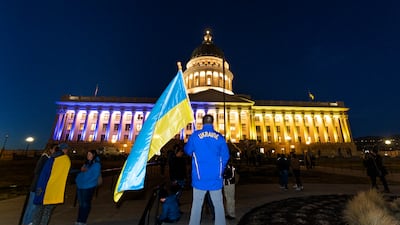
Zac Haycock stands in front of the Utah State Capitol, which is lit in blue and yellow in support of Ukraine. AP -

The I-35W Bridge glows blue and yellow in support of the people of Ukraine in Minneapolis, Minnesota. EPA -
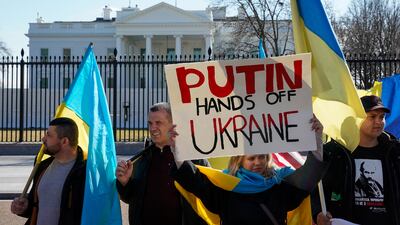
Demonstrators hold flags and a sign during a 'Stand with Ukraine' rally in front of the White House in Washington. Reuters -

Protesters gather at Town Square in Jackson, Wyoming, to show solidarity with Ukraine amid the Russian invasion. Several of the protesters were native Ukrainians with family in the country. AP -
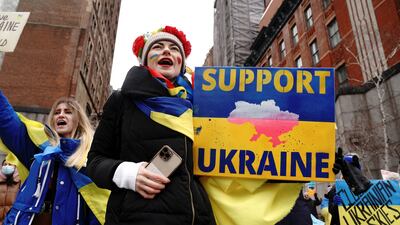
People protest outside the UN in New York against Russia's invasion of Ukraine. Reuters -

US first lady Jill Biden wears a mask with a sunflower, the national flower of Ukraine. AFP -
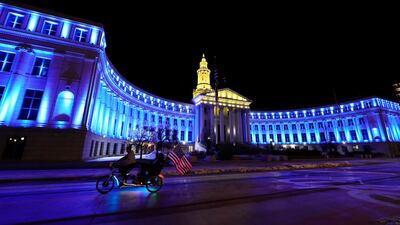
An American flag unfurls off a pedicab as it glides past the Denver City/County Building, which is illuminated in yellow and blue in support of Ukraine. AP -
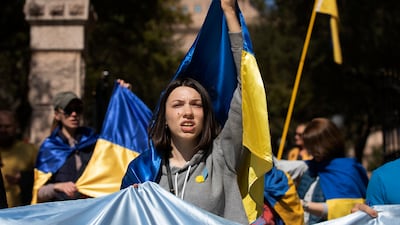
Kristina Ulyanenko protests the Russian attack on Ukraine at the state capitol in Austin, Texas. AP -
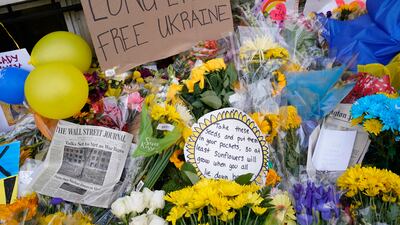
Flowers and messages are piled together outside the Ukrainian embassy in Washington. AP -
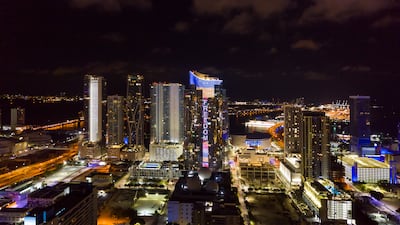
The Paramount Miami Worldcentre skyscraper in Florida lights up blue and yellow. Paramount Miami Worldcentre via AP -
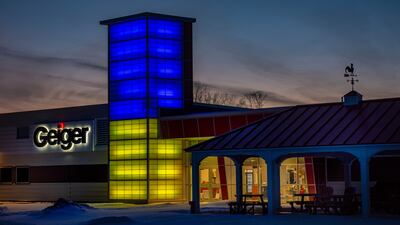
A store in Lewiston, Maine, programmed its 11-metre light tower to dance through a series of blinking yellow and blue lights that eventually come together to form the colors of the flag of Ukraine. AP -
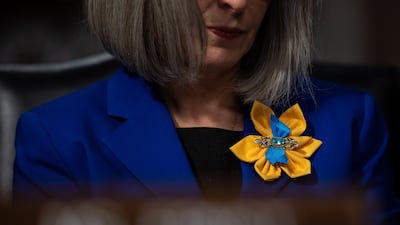
Joni Ernst, a Republican senator from Iowa, wears a brooch in the colours of Ukraine during a Senate Armed Services Committee hearing at the US Capitol. EPA -
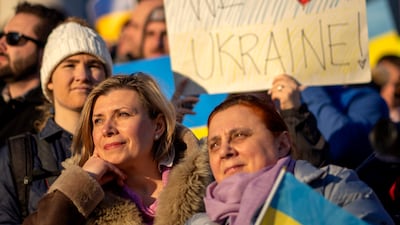
Protesters listen to speakers as they gather for a rally in support of Ukraine at the Utah Capitol in Salt Lake City. AP -
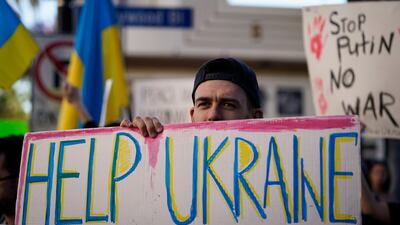
Dmytro Stasyshen of Ukraine holds a sign to protest the Russian invasion during a rally in the Hollywood area of Los Angeles. AP -

Evergy Plaza in Topeka, Kansas, will be lit in blue and yellow lights. AP -
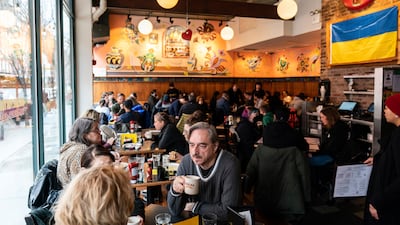
People dine inside Veselka restaurant where a Ukrainian flag hangs in the East Village in New York. AP


“The military offensive in Ukraine has caused destruction of civilian infrastructure and civilian casualties and has driven many thousands of people from their homes seeking safety, protection and assistance,” it said.
“There is a clear indication that many more people are on the move. They are in need of protection and support.”
The UN on Tuesday launched an emergency appeal for $1.7 billion to provide urgent humanitarian aid to those caught up in the Russian invasion of Ukraine and for the refugees fleeing the violence.
Mr Grandi said $550.6 million of that was needed to help refugees across the region, with the aim to provide shelter, emergency relief items, cash assistance and psycho-social support.
The Polish rail company PKP Intercity said on Saturday it would carry Ukrainian citizens free of charge from the border. Deutsche Bahn is giving Ukrainian passport or ID-card holders free travel on its long-distance trains from Poland to Germany.
Eurostar is offering Ukrainians travelling with valid visas free rides to the UK from its stations in France, Belgium and the Netherlands.
More than a dozen telecom providers are providing free international calls to Ukraine or are scrapping roaming charges there.
Airbnb is working with its hosts to house up to 100,000 Ukrainian refugees free of charge. Polish hospitality chain Arche Hotels has lodged 1,000 refugees and is preparing to admit 5,000.

