

Travellers to Ireland over Christmas will need to show negative coronavirus tests before departure as new restrictions are set to be enacted to tackle the threat posed by the Omicron variant.
This week, the Irish government agreed to new rules on travel in which all people entering Ireland will be required to show a negative result on a professionally administered antigen test 48 hours before arrival or on a PCR test 72 hours before arrival.
The government said that travel operators would be required to carry out pre-boarding checks to ensure all passengers were following the new rules.
The new measures would initially apply for two weeks, with the government hoping to be able to remove them “as soon as possible”.
The measures would also apply to travellers from Britain. Children aged 11 and under would be exempt from the requirements.
The government would also introduce new legislation to re-establish mandatory hotel quarantine.
On Friday, Taoiseach Micheal Martin outlined new restrictions on socialising over the festive period, including new limits on household gatherings and hospitality.
The restrictions will be in place from December 7 to January 9, he said.
In a national address, Mr Martin said: “The risks associated with proceeding into the Christmas period without some restrictions to reduce the volume of social contacts is just too high.”

Among the measures taking effect from next Tuesday include strict social distancing requirements for bars and restaurants.
The rules will mean the hospitality sector will largely revert to the situation preceding October 22, with a maximum of six adults per table and no multiple table bookings.
Mr Martin also said there will now be a maximum of 50 per cent capacity at entertainment, cultural, community and sporting events, with all those attending needing to be fully seated.
Use of the Covid-19 pass will also be extended to gyms, leisure centres, hotel bars and restaurants.
Visits to private homes, he said, should be limited to people from a maximum of three households, although he acknowledged the need for “flexibility”.
“My message this evening is a difficult one,” he said.
“I understand and I share the disappointment and frustration this will cause for many of you.”
-
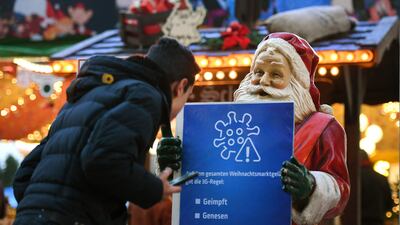
A Father Christmas figure holds Covid-19-related hygiene instructions for visiting the Christmas market in Hagen, western Germany. AFP -
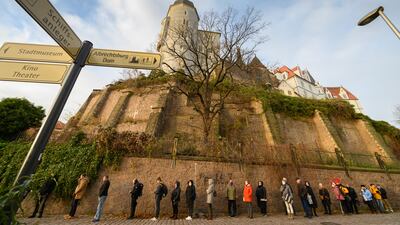
People wait to be vaccinated below Albrechtsburg castle and the cathedral in Meissen, Germany. AP -
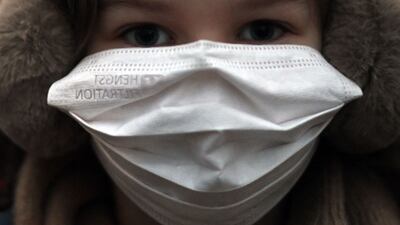
A pupil at the Petri primary school in Dortmund, western Germany. AFP -
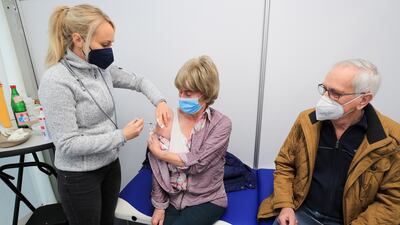
A drive-in vaccination centre at Lanxess Arena in Cologne, Germany. Reuters -
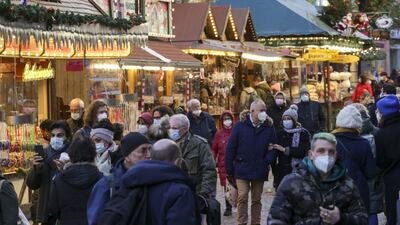
Shoppers in face masks at a Christmas market in Frankfurt, Germany. Bloomberg -
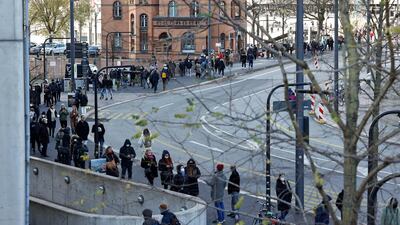
People in a queue reported to be 700 metres long wait to be vaccinated at the Philharmonic Hall in the northern German city of Hamburg. AFP -
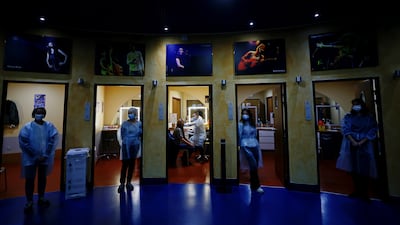
A medical worker administers a vaccine to a patient in a dressing room at the Theatre de Verdure vaccination centre in Nice, France. Reuters -
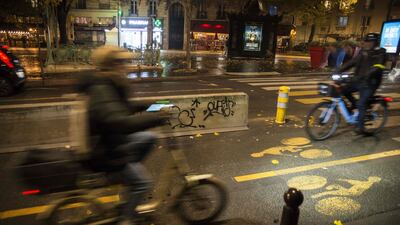
Cyclists on a 'coronapiste', a temporary cycle path created during the pandemic in Paris, France. Mayor of Paris Anne Hidalgo set up about 60 kilometres of new cycling roads to take pressure off public transport during the pandemic. AFP -
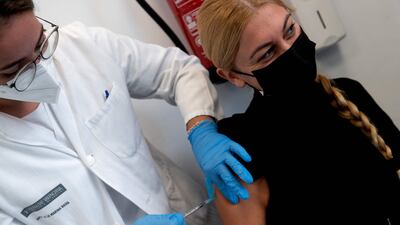
A healthcare worker administers a vaccine during a vaccination campaign for foreign tourists in Benidorm, Spain. AFP -
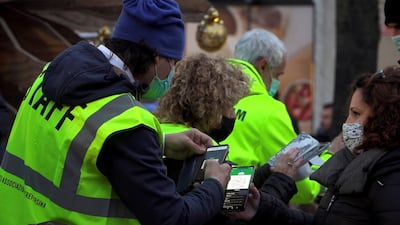
Visitors have their Covid-19 health passes checked at the Christmas market in Trento, Italy, on its opening weekend. Reuters -

Health workers administer booster shots at San Giovanni Addolorata Hospital in Rome, Italy. EPA -
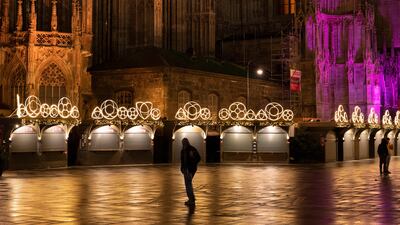
The closed Christmas market next to Stephen's Cathedral, which would normally be packed with crowds of people, in Vienna, Austria. The country is under a nationwide lockdown. AFP -
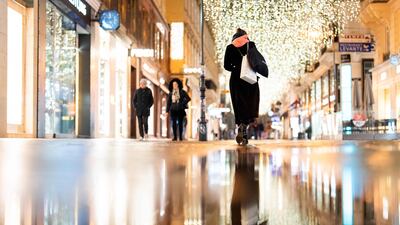
An unusually quiet street decorated with Christmas lights in Vienna, Austria. AFP -
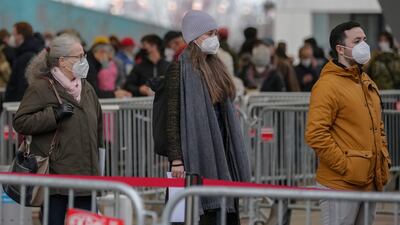
People queue to receive a vaccine in Vienna, Austria. AP -

Police patrol the centre of the northern city of Zwolle, where an emergency order is in force after three nights of unrest in the Netherlands over new Covid-19 measures. AFP


Mr Martin said that the appearance of the new Omicron variant as the holiday season approaches is a major cause for concern.
But he said: “This is not about going back to the days of lockdowns.
“Across the country, very many people in the hospitality and entertainment industries will be bitterly disappointed by this news.
“Many of them will be fearing for their livelihoods.
“I want to reassure them that, just as we have done since the beginning of the pandemic, the government will stand by them and ensure that they have the financial supports necessary to weather this latest storm and to stay intact until we are out of it.”
Earlier, the government was said that the number of Covid-19 cases could surge to 15,000 a day after Christmas if the Omicron variant becomes dominant.
The National Public Health Emergency Team (Nphet) said that the new variant could drive up cases during increased social activity over the Christmas period.
In a letter to the government, Nphet said that greater socialising combined with the impact of Omicron could pose a “very real but as yet unquantifiable risk” to the management of Covid-19 over the coming weeks.
Health officials said this presents “serious challenges” for the weeks ahead and that it is “impossible” to quantify the level of risk and its impact.
In the letter, chief medical officer Dr Tony Holohan said that if social contact can be maintained at current levels or marginally decreased, the level of infections per day will remain below 5,000.
However, if social contact increases to levels seen in December last year, cases could surge to between 6,000 and 8,000 cases per day in early January.
If infection-induced immunity is low or evaded by the new variant, a “very large surge is possible”, with a peak of about 8,000 to 15,000 cases per day, Nphet added.
In a pessimistic but “plausible scenario”, Nphet said that between 750 to 1,300 people could need hospital care and up to 400 people would require critical care.
Ireland has so far confirmed one case of the new Omicron variant.

