


French President Emmanuel Macron's efforts to placate the gilets jaunes protesters with minor concessions and assurances that he understood their grievances demonstrate a failure to appreciate the depth of hurt inflicted by the crackdown on the movement for change.
Mr Macron’s ratings slumped at the height of the protests but have subsequently recovered. The figures have not matched those that won him a comfortable victory in 2017. One of those at the heart of the movement believes a backlash against the president will play out before the election in April.
Autopsy on the Gilets Jaunes Movement, written from within the ranks of protesters by two committed activists, Khider Mesloub and Robert Bibeau, provides an explanation of why the president could yet be derailed by the well-spring of anger simmering across France.
Mr Mesloub, the son of a veteran of Algeria’s war of independence, contrasts the French media’s concentration on violence by demonstrators with the view taken by many ordinary people.
“Media focus on the alleged violence of the gilets jaunes, summed up in a few broken windows or burnt cars, aimed to obscure the real state violence perpetrated by the thousands of police officers mobilised against the demonstrators,” he told The National.
“The French population did not fall into the trap of propaganda distilled by the commercial French media, describing the yellow vests as a horde of thugs.”
Among many intriguing features of the gilets jaunes protest movement was the high level of public support it attracted even when demonstrators became violent, attacked property and disrupted daily life.
Opinion polls consistently showed two thirds or more of those questioned to be in favour of the protests, an approval rating that at one point rose above 80 per cent.
-

Protesters take part in a yellow vest demonstration in February 2019, in Paris. The start of the gilets jaunes movement in 2017 was triggered by anger at soaring energy prices. All photos: Getty Images -

People wear yellow jackets in a protest against rising prices of fuel and oil in November 2018 in Avignon, France. -
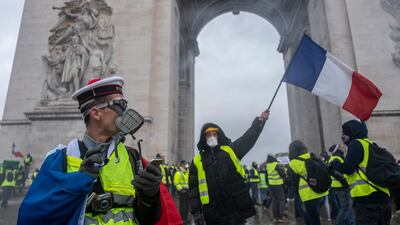
Tear gas surrounds protesters as they clash with riot police during a yellow vest demonstration near the Arc de Triomphe in December 2018 in Paris. -
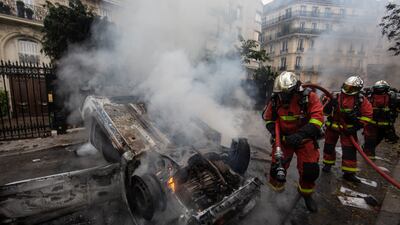
Firefighters work to put out cars set alight on a road near the Arc de Triomphe in December 2018 after yellow vest demonstrations. -
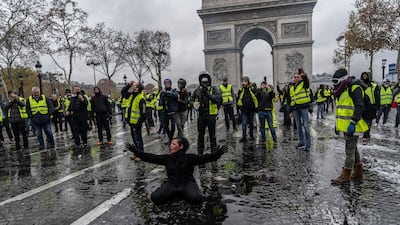
Yellow vest protesters clash with riot police near the Arc de Triomphe in December 2018. -

Yellow vest protesters chant slogans against President Macron and his government in front of Sacre Coeur in Paris in March 2019. -
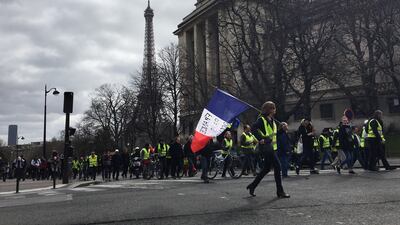
Yellow vest protesters walk past the Eiffel Tower in March 2019. -

Yellow vest protesters demonstrate in front of the Palais de Justice in Paris in March 2019. -
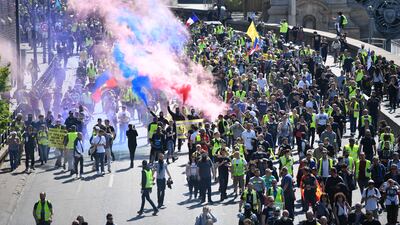
Yellow vest demonstrators gather in the Bercy neighbourhood of Paris to protest for a 23rd week in April 2019. -
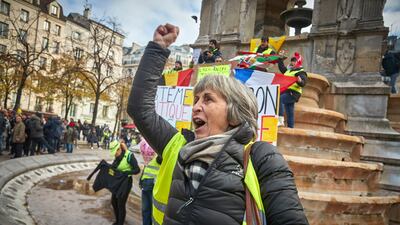
Yellow vest protesters chant against President Macron at the Fontaine des Innocents in Paris during the second day of protests to mark the first anniversary of the movement, in November 2019. -
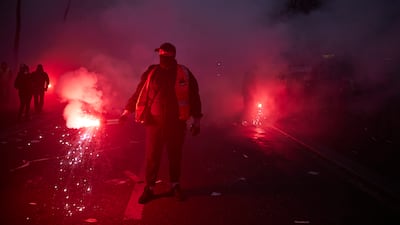
Yellow vests and railway workers walk towards French riot police holding flares amid violent clashes between officers and protesters during a rally near Place de Republique, in support of a national strike in France in December 2019. -

A yellow vest protester stands defiantly in front of French riot police during Bastille Day anti-government demonstrations at Place de la Bastille in July 2020. -
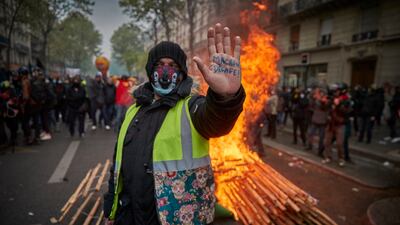
A yellow vest protester stands in front of a burning barricade as May Day protests turn violent near Place de la Republique in May 2021.


Support survived the effects of shocking images of destruction, including a mob attack on the Arc de Triomphe in Paris,
that
led foreign governments to advise against travel to France.
The authors say they detected the “revolutionary potential” of a spontaneous protest movement that refused to be constrained by conventional political organisations or taken over by any party or trade union.
Anger at Mr Macron’s proposal, later abandoned, to impose a “green tax” on fuel provided the trigger, Mr Mesloub says, but the movement escalated into a broader struggle to defend living and working conditions.
Mr Mesloub believes that heavy-handed police action rather than Mr Macron's “anti-social policies or arrogance” brought the president unpopularity.
He rejects the idea of the movement being dominated by far-right and far-left elements, portraying it instead as an “anti-system political paradigm, in an anti-government dynamic that broke with classic institutional political categories”.
A wide range of studies of the movement reveals general acceptance that several factors contributed to the striking level of public endorsement of the revolt and, until the protests faded, disapproval of the president.
There was a widespread feeling that, for all the violence of some protesters, harsh police counter-measures – endorsed by a tough-talking Interior Minister, Christophe Castaner – were excessive.
This sentiment was deepened by the large number of injuries inflicted at demonstrations, where police responded to attacks by using rubber bullets, stun grenades and tear gas.
Many in France also identified with the concerns that drove the gilets jaunes on to the streets: plummeting living standards as wages or benefits failed to keep pace with rising prices of essential goods and services, and disenchantment with the political establishment.
Fuel prices were a particular issue in small towns and rural areas where public transport is limited and people rely heavily on their own cars.
As a relic of the French Revolution that overthrew royalty in the late 18th century, France likes to think of itself as a country of rebellion, forcing change through protest.
“Just look at our history,” says a retired bank worker and natural centre-right voter in north-western France. “You see that many, maybe most, important social advances have been won by militants.”

The analysis by Mr Mesloub will seem fanciful to some, who may also dispute his emphasis on police violence – “hundreds of officers dressed as RoboCop, over-armed, equipped with deadly technology” – though he also denounces “gratuitous violence perpetrated by thugs”.
He has been heartened, since first speaking to The National last month, by the resurgence of the movement in response to further rises in fuel and energy prices, and diminishing purchasing power. The protests have been modest so far but Mr Mesloub foresees them growing and even spreading.
“After 18 months of sanitary conditioning, big business is once again threatening us, in France and around the world, with drastic increases in energy prices,” he said.
“Will these price increases for energy materials lead to the reiteration of the yellow vests movement but on an international scale? We think so. All the objective conditions are in place to trigger a radical worldwide protest movement.”

