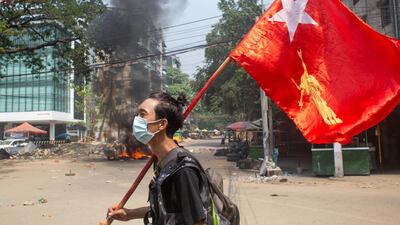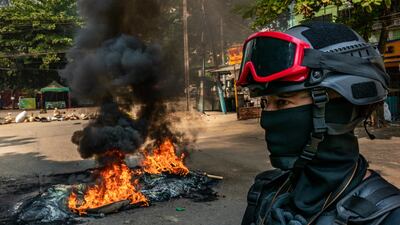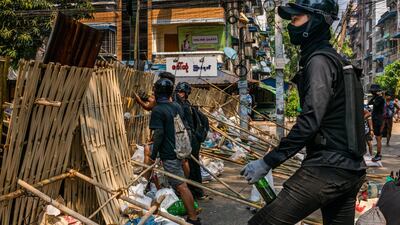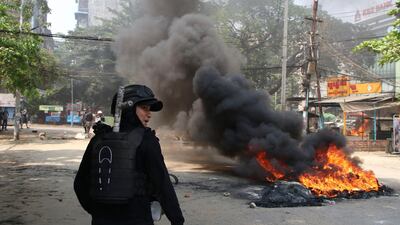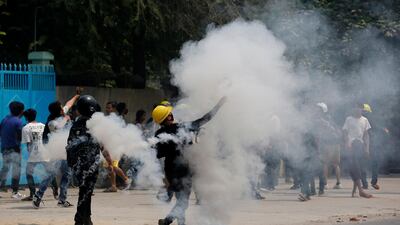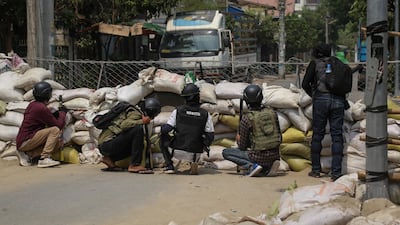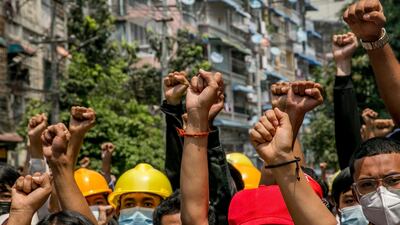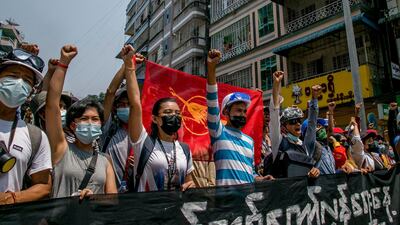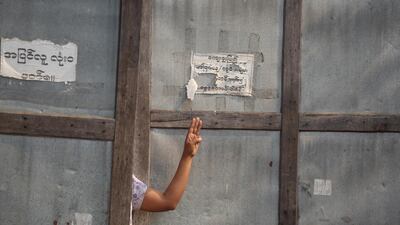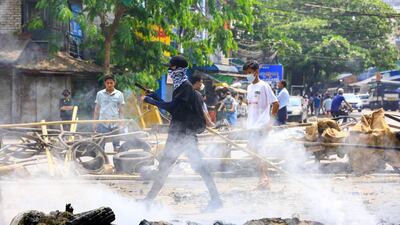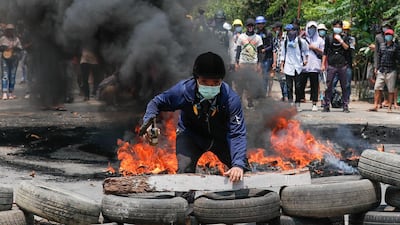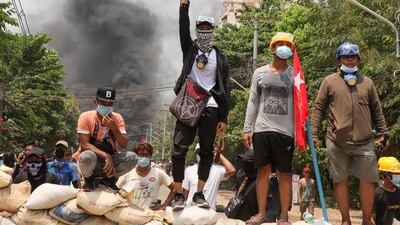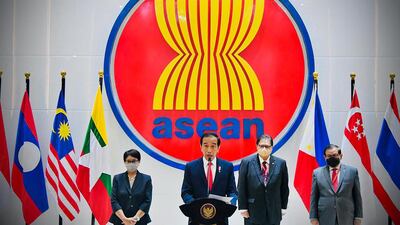
The UN Security Council called on Friday for an immediate end to violence in Myanmar as stated in an Asean plan.
Unanimous approval was given for a joint statement which had been modified for compromise with China and Russia.
The plan, which also calls for the naming of an envoy from the Association of Southeast Asian Nations to address the crisis triggered by the February 1 military coup, should be applied "without delay," the council statement says.
It was approved after a closed-door meeting of the council and forced Western countries to make concessions to China – Myanmar's main backer – and Russia to win passage.
At their request the council eliminated clauses that said it "once again strongly condemned violence against peaceful protestors" and "reiterated their call on the military to exercise utmost restraint."
A diplomat speaking on condition of anonymity explained the changes saying "what we must avoid is losing council unity to the point of making it irrelevant."
Since the coup in Myanmar, the council has approved four statements on the crisis including this latest one of Friday.
Friday's session was convened by Vietnam to present the conclusions of a recent Asean summit in Indonesia.
The statement that was ultimately passed calls for the UN Special Envoy to Myanmar, Christine Schraner Burgener, who is currently touring the region, to be able to visit Myanmar "as soon as possible."
Ms Schraner Burgener gave a report on her long meeting with Myanmar junta leader General Min Aung Hlaing, held on the sidelines of the Asean meeting last weekend.
Diplomats said the envoy, who is currently based in Bangkok, once again had her request for a visit to Myanmar denied.
During the meeting, Brunei, which currently holds the presidency of Asean, floated the idea of a joint visit to Myanmar by the UN envoy and her future Asean counterpart.
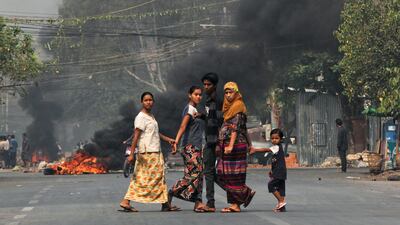
"We estimate around 20,000 internal displacements and almost 10,000 fleeing to neighboring countries since February. The regional implications require urgent action," Ms Schraner Burgener told the council, according to the text of her speech, which was seen by AFP.
"The common aspiration for democracy has united the people of Myanmar across religious, ethnic and communal divides like never before. Such strong unity has created unexpected difficulties for the military in consolidating power and stabilising the coup," she added.
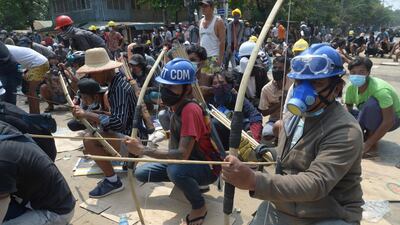
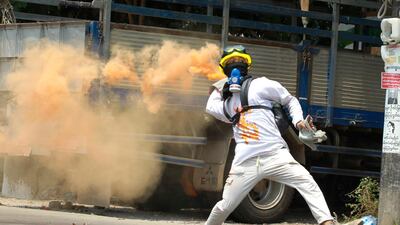
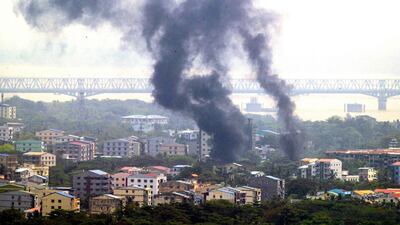
Nearly 760 civilians have been killed by police and soldiers in the past three months, according to the Assistance Association for Political Prisoners (AAPP).
The junta puts the death toll at 258 dead by April 15, calling the demonstrators "rioters" who engaged in "acts of terrorism".

Farage on Muslim Brotherhood
Nigel Farage told Reform's annual conference that the party will proscribe the Muslim Brotherhood if he becomes Prime Minister.
"We will stop dangerous organisations with links to terrorism operating in our country," he said. "Quite why we've been so gutless about this – both Labour and Conservative – I don't know.
“All across the Middle East, countries have banned and proscribed the Muslim Brotherhood as a dangerous organisation. We will do the very same.”
It is 10 years since a ground-breaking report into the Muslim Brotherhood by Sir John Jenkins.
Among the former diplomat's findings was an assessment that “the use of extreme violence in the pursuit of the perfect Islamic society” has “never been institutionally disowned” by the movement.
The prime minister at the time, David Cameron, who commissioned the report, said membership or association with the Muslim Brotherhood was a "possible indicator of extremism" but it would not be banned.
A Cat, A Man, and Two Women
Junichiro Tamizaki
Translated by Paul McCarthy
Daunt Books
Who's who in Yemen conflict
Houthis: Iran-backed rebels who occupy Sanaa and run unrecognised government
Yemeni government: Exiled government in Aden led by eight-member Presidential Leadership Council
Southern Transitional Council: Faction in Yemeni government that seeks autonomy for the south
Habrish 'rebels': Tribal-backed forces feuding with STC over control of oil in government territory
The National Archives, Abu Dhabi
Founded over 50 years ago, the National Archives collects valuable historical material relating to the UAE, and is the oldest and richest archive relating to the Arabian Gulf.
Much of the material can be viewed on line at the Arabian Gulf Digital Archive - https://www.agda.ae/en
Kandahar%20
%3Cp%3E%3Cstrong%3EDirector%3A%3C%2Fstrong%3E%20Ric%20Roman%20Waugh%3C%2Fp%3E%0A%3Cp%3E%3Cstrong%3EStars%3A%C2%A0%3C%2Fstrong%3EGerard%20Butler%2C%20Navid%20Negahban%2C%20Ali%20Fazal%3C%2Fp%3E%0A%3Cp%3E%3Cstrong%3ERating%3A%3C%2Fstrong%3E%202.5%2F5%3C%2Fp%3E%0A
UAE currency: the story behind the money in your pockets
The alternatives
• Founded in 2014, Telr is a payment aggregator and gateway with an office in Silicon Oasis. It’s e-commerce entry plan costs Dh349 monthly (plus VAT). QR codes direct customers to an online payment page and merchants can generate payments through messaging apps.
• Business Bay’s Pallapay claims 40,000-plus active merchants who can invoice customers and receive payment by card. Fees range from 1.99 per cent plus Dh1 per transaction depending on payment method and location, such as online or via UAE mobile.
• Tap started in May 2013 in Kuwait, allowing Middle East businesses to bill, accept, receive and make payments online “easier, faster and smoother” via goSell and goCollect. It supports more than 10,000 merchants. Monthly fees range from US$65-100, plus card charges of 2.75-3.75 per cent and Dh1.2 per sale.
• 2checkout’s “all-in-one payment gateway and merchant account” accepts payments in 200-plus markets for 2.4-3.9 per cent, plus a Dh1.2-Dh1.8 currency conversion charge. The US provider processes online shop and mobile transactions and has 17,000-plus active digital commerce users.
• PayPal is probably the best-known online goods payment method - usually used for eBay purchases - but can be used to receive funds, providing everyone’s signed up. Costs from 2.9 per cent plus Dh1.2 per transaction.
Mercer, the investment consulting arm of US services company Marsh & McLennan, expects its wealth division to at least double its assets under management (AUM) in the Middle East as wealth in the region continues to grow despite economic headwinds, a company official said.
Mercer Wealth, which globally has $160 billion in AUM, plans to boost its AUM in the region to $2-$3bn in the next 2-3 years from the present $1bn, said Yasir AbuShaban, a Dubai-based principal with Mercer Wealth.
“Within the next two to three years, we are looking at reaching $2 to $3 billion as a conservative estimate and we do see an opportunity to do so,” said Mr AbuShaban.
Mercer does not directly make investments, but allocates clients’ money they have discretion to, to professional asset managers. They also provide advice to clients.
“We have buying power. We can negotiate on their (client’s) behalf with asset managers to provide them lower fees than they otherwise would have to get on their own,” he added.
Mercer Wealth’s clients include sovereign wealth funds, family offices, and insurance companies among others.
From its office in Dubai, Mercer also looks after Africa, India and Turkey, where they also see opportunity for growth.
Wealth creation in Middle East and Africa (MEA) grew 8.5 per cent to $8.1 trillion last year from $7.5tn in 2015, higher than last year’s global average of 6 per cent and the second-highest growth in a region after Asia-Pacific which grew 9.9 per cent, according to consultancy Boston Consulting Group (BCG). In the region, where wealth grew just 1.9 per cent in 2015 compared with 2014, a pickup in oil prices has helped in wealth generation.
BCG is forecasting MEA wealth will rise to $12tn by 2021, growing at an annual average of 8 per cent.
Drivers of wealth generation in the region will be split evenly between new wealth creation and growth of performance of existing assets, according to BCG.
Another general trend in the region is clients’ looking for a comprehensive approach to investing, according to Mr AbuShaban.
“Institutional investors or some of the families are seeing a slowdown in the available capital they have to invest and in that sense they are looking at optimizing the way they manage their portfolios and making sure they are not investing haphazardly and different parts of their investment are working together,” said Mr AbuShaban.
Some clients also have a higher appetite for risk, given the low interest-rate environment that does not provide enough yield for some institutional investors. These clients are keen to invest in illiquid assets, such as private equity and infrastructure.
“What we have seen is a desire for higher returns in what has been a low-return environment specifically in various fixed income or bonds,” he said.
“In this environment, we have seen a de facto increase in the risk that clients are taking in things like illiquid investments, private equity investments, infrastructure and private debt, those kind of investments were higher illiquidity results in incrementally higher returns.”
The Abu Dhabi Investment Authority, one of the largest sovereign wealth funds, said in its 2016 report that has gradually increased its exposure in direct private equity and private credit transactions, mainly in Asian markets and especially in China and India. The authority’s private equity department focused on structured equities owing to “their defensive characteristics.”
Results:
Women:
1. Rhiannan Iffland (AUS) 322.95 points
2. Lysanne Richard (CAN) 285.75
3. Ellie Smart (USA) 277.70
Men:
1. Gary Hunt (GBR) 431.55
2. Constantin Popovici (ROU) 424.65
3. Oleksiy Prygorov (UKR) 392.30
Our legal consultant
Name: Dr Hassan Mohsen Elhais
Position: legal consultant with Al Rowaad Advocates and Legal Consultants.
Sly%20Cooper%20and%20the%20Thievius%20Raccoonus
%3Cp%3E%3Cstrong%3EDeveloper%3A%3C%2Fstrong%3E%20Sucker%20Punch%20Productions%3Cbr%3E%3Cstrong%3EPublisher%3A%3C%2Fstrong%3E%20Sony%20Computer%20Entertainment%3Cbr%3E%3Cstrong%3EConsole%3A%3C%2Fstrong%3E%20PlayStation%202%20to%205%3Cbr%3E%3Cstrong%3ERating%3A%3C%2Fstrong%3E%205%2F5%3C%2Fp%3E%0A
The specs
Engine: 2.0-litre 4cyl turbo
Power: 261hp at 5,500rpm
Torque: 405Nm at 1,750-3,500rpm
Transmission: 9-speed auto
Fuel consumption: 6.9L/100km
On sale: Now
Price: From Dh117,059
Islamophobia definition
A widely accepted definition was made by the All Party Parliamentary Group on British Muslims in 2019: “Islamophobia is rooted in racism and is a type of racism that targets expressions of Muslimness or perceived Muslimness.” It further defines it as “inciting hatred or violence against Muslims”.
Conservative MPs who have publicly revealed sending letters of no confidence
- Steve Baker
- Peter Bone
- Ben Bradley
- Andrew Bridgen
- Maria Caulfield
- Simon Clarke
- Philip Davies
- Nadine Dorries
- James Duddridge
- Mark Francois
- Chris Green
- Adam Holloway
- Andrea Jenkyns
- Anne-Marie Morris
- Sheryll Murray
- Jacob Rees-Mogg
- Laurence Robertson
- Lee Rowley
- Henry Smith
- Martin Vickers
- John Whittingdale
Dubai Bling season three
Cast: Loujain Adada, Zeina Khoury, Farhana Bodi, Ebraheem Al Samadi, Mona Kattan, and couples Safa & Fahad Siddiqui and DJ Bliss & Danya Mohammed
Rating: 1/5
POSSIBLE ENGLAND EURO 2020 SQUAD
Goalkeepers: Jordan Pickford, Nick Pope, Dean Henderson.
Defenders: Trent Alexander-Arnold, Kieran Trippier, Joe Gomez, John Stones, Harry Maguire, Tyrone Mings, Ben Chilwell, Fabian Delph.
Midfielders: Declan Rice, Harry Winks, Jordan Henderson, Ross Barkley, Mason Mount, Alex Oxlade-Chamberlain.
Forwards: Harry Kane, Raheem Sterling, Marcus Rashford, Jadon Sancho, Tammy Abraham, Callum Hudson-Odoi.
The specs
Engine: 2.0-litre 4-cyl turbo
Power: 247hp at 6,500rpm
Torque: 370Nm from 1,500-3,500rpm
Transmission: 10-speed auto
Fuel consumption: 7.8L/100km
Price: from Dh94,900
On sale: now