Myanmar's Commander-in-Chief, Senior General Min Aung Hlaing, bottom right, and Asean leaders convene during their meeting in Jakarta this week. AP Photo
The credibility of the Association of South-East Asian Nations (Asean) was at stake in the run-up to what was widely billed as an emergency summit on Myanmar over the weekend. The international community reacted with condemnation and sanctions to the military coup that displaced the country's democratically elected government in February, but thus far nothing has even stalled the junta's jailing of critics and campaign of repression and killing.
If Asean "centrality" – the notion that Asean should be the driving force or at least pivotal to any discussions or actions in the region – was to mean anything at all, the 10-member group Myanmar has been part of since 1997, had to take some kind of stand. With the coup leader, Senior General Min Aung Hlaing, present at talks in Jakarta, would Asean pass the test? Or would it reveal itself to be truly "Nato" – no action, talk only – toothless in the face of a member state potentially descending into civil war or even on the way to becoming a failed state?
In the event, a “Five-Point Consensus” was reached and issued in the name of the current Asean chairman, the Sultan of Brunei. It called for an immediate cessation of violence with all parties exercising utmost restraint; constructive dialogue among all parties to seek a peaceful solution; a special envoy of the Asean Chair to mediate the dialogue process, with the assistance of the Secretary General of Asean; Asean to provide humanitarian assistance; and the special envoy and delegation to visit Myanmar to meet all parties concerned.
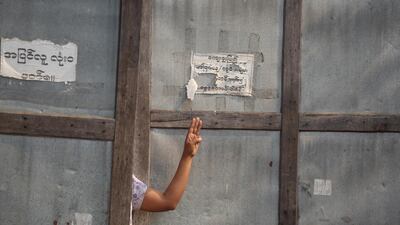
Demonstrators flash three-fingers salutes as they march during an anti-military coup protest in Yangon. EPA
By Asean's standards, this was pretty forceful. And it was greeted with approval by the ousted parliamentarians of Aung San Suu Kyi's National League for Democracy and other forces opposed to the junta in Myanmar. The consensus was "encouraging", said Dr Sasa, the international co-operation minister of the parallel National Unity Government. "We look forward to firm action by Asean to follow up its decisions and to restore our democracy and freedom."
If this was an achievement, it was a very Asean-esque achievement: a step forward that still allowed all parties to maintain face. To start with, it was not an “Asean summit”, which are official gatherings held twice a year by the chair country. No, this was a less high-level “Leaders’ Meeting”. Neither was it initiated to address the crisis in Myanmar, or not nominally so according to the chair’s statement. That said, the meeting “was convened with the view to advance Asean Community building, hasten recovery from the Coronavirus Disease 2019 [Covid-19] pandemic, strengthen Asean’s external relations and address pressing issues of common interest to all Asean Member States". The situation in Myanmar was only recognised near the end of the 1,000-word statement.
Nor did Mr Min Aung Hlaing – or MAH, an abbreviation increasingly being used – formally agree with the Five-Point Consensus. He just didn’t disagree. He “did not reject what was put forward by me and many other colleagues", was how Malaysian Prime Minister Muhyiddin Yassin put it. MAH spoke last at the meeting, after all the other participants, and “said he heard us, he would take the point in, which he considered helpful", as Singapore Prime Minister Lee Hsien Loong characterised the military leader’s response.
I'm told the meeting was expected to last two to three hours but went on longer, not least as the continental mainland countries present – Thailand, Vietnam, Laos and Cambodia – were "deeply ambivalent" about its purpose. None of the latter three are functioning democracies. In the case of Thailand, MAH not only has a close friend in its leader Prayuth Chan-ocha, a former general who first came to power as a result of a coup in 2014, but MAH was also "adopted" in 2012 as a kind of godson by possibly the most influential man in the country after the king, the late Prem Tinsulanonda, a former premier, army chief and president of the Privy Council.
No wonder the word is that MAH felt no need to be defensive. Nevertheless, he will have understood the point made by Malaysia's Mr Muhyiddin, who said: “Many around the world want an explanation, and we are finding it increasingly tough to explain. The international community expects Asean to act and address what is happening in our very own backyard.”
Indonesian President Joko Widodo speaks during the Asean meeting in Jakarta at the weekend. AFP
With the force of this statement, the meeting was able to accept the five points, which I understand Brunei and Indonesia (where the Asean Secretariat is headquartered) played a key role in formulating after consultation with the member states.
There was a last-minute change to the consensus – a demand for all political prisoners to be freed was removed, and turned up instead in the chairman’s statement as “we also heard calls for the release of all political prisoners including foreigners".
While Singapore’s Mr Lee warned at the meeting of a “humanitarian disaster” unfolding in Myanmar, MAH will have been pleased to hear him say: “Any solution that returns Myanmar to the path of democratic transition must involve both the Tatmadaw [the armed forces], which has always been a key institution in Myanmar's body politic, and also the National League for Democracy, which commands popular support.”
That will infuriate implacable opponents of the armed forces such as the activist Dr Maung Zarni, who considers the Tatmadaw to be an “existential threat” to the country, but Mr Lee was echoing a view deemed to be unpalatable but realistic almost universally in the region.
Likewise most will concur with Malaysia’s Mr Muhyiddin when he told a news conference on Saturday: “We have succeeded. It’s beyond our expectation in getting the outcome from today’s meeting.” Given Asean’s composition and its stress on “non-interference” in each others’ affairs, the group really did as much as could reasonably be expected.
Euan Graham, a Singapore-based analyst, recently wrote that “Asean centrality is the hole in the doughnut. Integral to the design, but not the most filling part". But if Asean wastes no time in acting on its statements after the Jakarta meeting, with the swift appointment of a special envoy and concrete moves on the ground, it will have proved that its “centrality” is not just a void, as per Mr Graham’s amusing description, but something tangible and consequential. Asean passes the test. For now.
Sholto Byrnes is an East Asian affairs columnist for The National
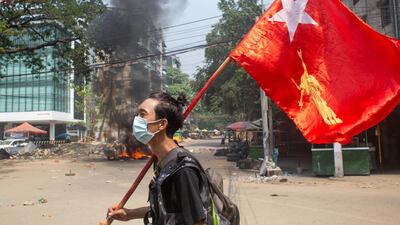
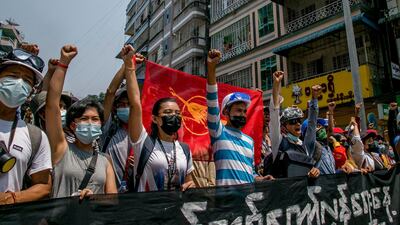
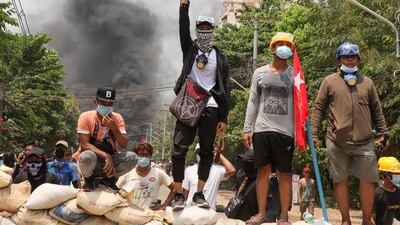
A man holds a National League for Democracy flag during a protest against the military coup in Yangon, Myanmar. Reuters
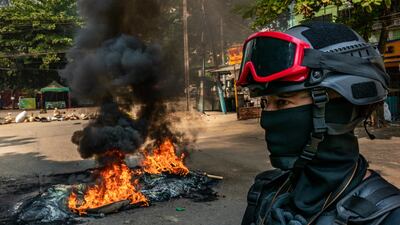
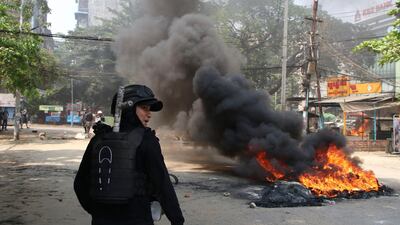
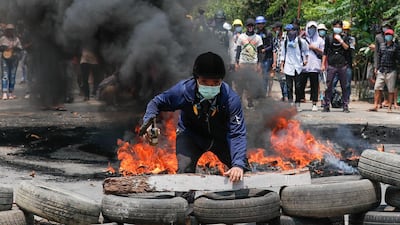
Protesters set fire to tyres on a road to slow the progress of security forces in Yangon. Getty Images
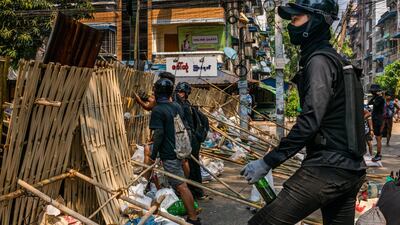
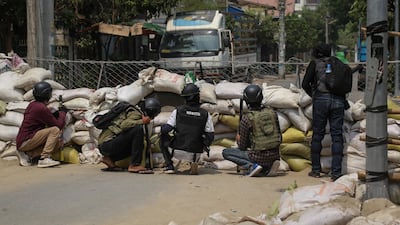
Protesters stand behind a barricade while waiting for security forces to approach in Yangon. Getty Images
A protester stands near a fire during a demonstration in Dala township, Yangon. AP Photo
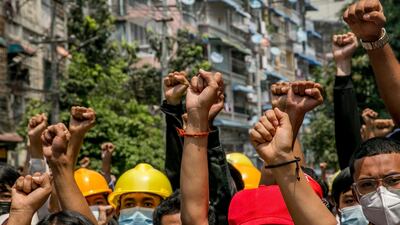
Protesters gesture with a three-finger salute in Thaketa township Yangon. AP Photo
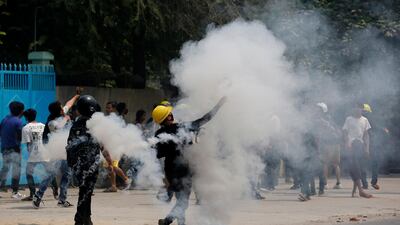
Protesters hurl back tear gas canisters towards police in Mandalay. AP Photo
Protesters take cover during a protest against the military coup in Mandalay. EPA
Protesters take part in a demonstration against the military coup in Yangon's Tamwe township. AFP
A resident flashes the three-finger salute as demonstrators march during a protest against the military coup in Mandalay. EPA
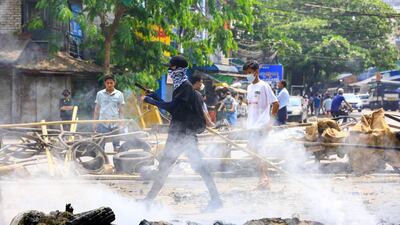
A protester walks past makeshift barricades set up to deter security forces in Yangon's Hlaing township. AFP
A man stands behind a barricade during a protest against the military coup in Yangon. Reuters
People stand on a barricade during a protest against the military coup in Yangon. Reuters
Protesters extinguish fires during a protest in Thaketa township Yangon. AP Photo
A man holds a makeshift gun in Yangon. Reuters
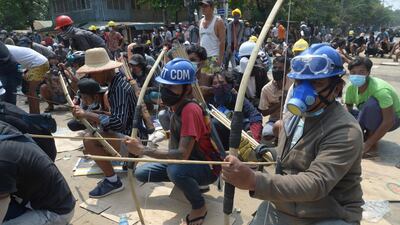
Protesters prepare makeshift bow and arrows to confront police in Thaketa township Yangon. AP Photo
Family members cry in front of a man after he was shot dead during an anti-coup protesters crackdown in Yangon. Reuters
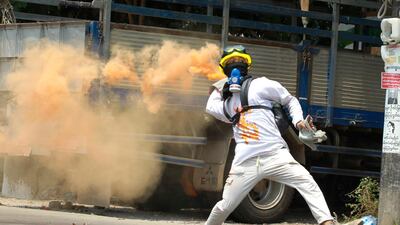
A protester throws a smoke bomb in Thaketa township Yangon. AP Photo
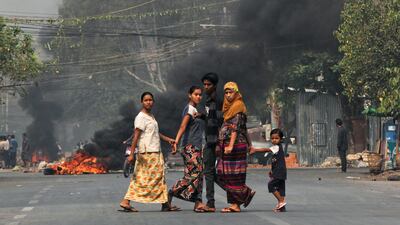
People walk on a street as barricades burn behind them in Mandalay. reuters
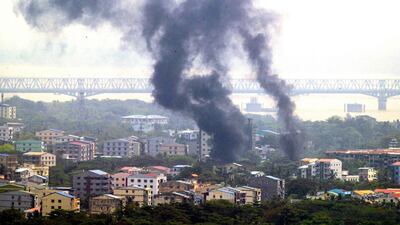
Smoke rises over Thaketa township in Yangon as security forces continue their crackdown on protests against the military coup. AFP
Who's who in Yemen conflict
Houthis: Iran-backed rebels who occupy Sanaa and run unrecognised government
Yemeni government: Exiled government in Aden led by eight-member Presidential Leadership Council
Southern Transitional Council: Faction in Yemeni government that seeks autonomy for the south
Habrish 'rebels': Tribal-backed forces feuding with STC over control of oil in government territory
Mercer, the investment consulting arm of US services company Marsh & McLennan, expects its wealth division to at least double its assets under management (AUM) in the Middle East as wealth in the region continues to grow despite economic headwinds, a company official said.
Mercer Wealth, which globally has $160 billion in AUM, plans to boost its AUM in the region to $2-$3bn in the next 2-3 years from the present $1bn, said Yasir AbuShaban, a Dubai-based principal with Mercer Wealth.
“Within the next two to three years, we are looking at reaching $2 to $3 billion as a conservative estimate and we do see an opportunity to do so,” said Mr AbuShaban.
Mercer does not directly make investments, but allocates clients’ money they have discretion to, to professional asset managers. They also provide advice to clients.
“We have buying power. We can negotiate on their (client’s) behalf with asset managers to provide them lower fees than they otherwise would have to get on their own,” he added.
Mercer Wealth’s clients include sovereign wealth funds, family offices, and insurance companies among others.
From its office in Dubai, Mercer also looks after Africa, India and Turkey, where they also see opportunity for growth.
Wealth creation in Middle East and Africa (MEA) grew 8.5 per cent to $8.1 trillion last year from $7.5tn in 2015, higher than last year’s global average of 6 per cent and the second-highest growth in a region after Asia-Pacific which grew 9.9 per cent, according to consultancy Boston Consulting Group (BCG). In the region, where wealth grew just 1.9 per cent in 2015 compared with 2014, a pickup in oil prices has helped in wealth generation.
BCG is forecasting MEA wealth will rise to $12tn by 2021, growing at an annual average of 8 per cent.
Drivers of wealth generation in the region will be split evenly between new wealth creation and growth of performance of existing assets, according to BCG.
Another general trend in the region is clients’ looking for a comprehensive approach to investing, according to Mr AbuShaban.
“Institutional investors or some of the families are seeing a slowdown in the available capital they have to invest and in that sense they are looking at optimizing the way they manage their portfolios and making sure they are not investing haphazardly and different parts of their investment are working together,” said Mr AbuShaban.
Some clients also have a higher appetite for risk, given the low interest-rate environment that does not provide enough yield for some institutional investors. These clients are keen to invest in illiquid assets, such as private equity and infrastructure.
“What we have seen is a desire for higher returns in what has been a low-return environment specifically in various fixed income or bonds,” he said.
“In this environment, we have seen a de facto increase in the risk that clients are taking in things like illiquid investments, private equity investments, infrastructure and private debt, those kind of investments were higher illiquidity results in incrementally higher returns.”
The Abu Dhabi Investment Authority, one of the largest sovereign wealth funds, said in its 2016 report that has gradually increased its exposure in direct private equity and private credit transactions, mainly in Asian markets and especially in China and India. The authority’s private equity department focused on structured equities owing to “their defensive characteristics.”
More than 2.2 million Indian tourists arrived in UAE in 2023 More than 3.5 million Indians reside in UAE Indian tourists can make purchases in UAE using rupee accounts in India through QR-code-based UPI real-time payment systems Indian residents in UAE can use their non-resident NRO and NRE accounts held in Indian banks linked to a UAE mobile number for UPI transactions
If you go
Flight connections to Ulaanbaatar are available through a variety of hubs, including Seoul and Beijing, with airlines including Mongolian Airlines and Korean Air. While some nationalities, such as Americans, don’t need a tourist visa for Mongolia, others, including UAE citizens, can obtain a visa on arrival, while others including UK citizens, need to obtain a visa in advance. Contact the Mongolian Embassy in the UAE for more information.
Nomadic Road offers expedition-style trips to Mongolia in January and August, and other destinations during most other months. Its nine-day August 2020 Mongolia trip will cost from $5,250 per person based on two sharing, including airport transfers, two nights’ hotel accommodation in Ulaanbaatar, vehicle rental, fuel, third party vehicle liability insurance, the services of a guide and support team, accommodation, food and entrance fees; nomadicroad.com
A fully guided three-day, two-night itinerary at Three Camel Lodge costs from $2,420 per person based on two sharing, including airport transfers, accommodation, meals and excursions including the Yol Valley and Flaming Cliffs. A return internal flight from Ulaanbaatar to Dalanzadgad costs $300 per person and the flight takes 90 minutes each way; threecamellodge.com
EA Sports FC 25
Developer: EA Vancouver, EA Romania Publisher: EA Sports Consoles: Nintendo Switch, PlayStation 4&5, Xbox One and Xbox Series X/S Rating: 3.5/5
Hobbies: Salsa dancing “It's in my blood” and listening to music in different languages
Favourite place to travel to: “Thailand, as it's gorgeous, food is delicious, their massages are to die for!”
Favourite food: “I'm a vegetarian, so I can't get enough of salad.”
Favourite film: “I love watching documentaries, and am fascinated by nature, animals, human anatomy. I love watching to learn!”
Best spot in the UAE: “I fell in love with Fujairah and anywhere outside the big cities, where I can get some peace and get a break from the busy lifestyle”
Key figures in the life of the fort
Sheikh Dhiyab bin Isa (ruled 1761-1793) Built Qasr Al Hosn as a watchtower to guard over the only freshwater well on Abu Dhabi island.
Sheikh Shakhbut bin Dhiyab (ruled 1793-1816) Expanded the tower into a small fort and transferred his ruling place of residence from Liwa Oasis to the fort on the island.
Sheikh Tahnoon bin Shakhbut (ruled 1818-1833) Expanded Qasr Al Hosn further as Abu Dhabi grew from a small village of palm huts to a town of more than 5,000 inhabitants.
Sheikh Khalifa bin Shakhbut (ruled 1833-1845) Repaired and fortified the fort.
Sheikh Saeed bin Tahnoon (ruled 1845-1855) Turned Qasr Al Hosn into a strong two-storied structure.
Sheikh Zayed bin Khalifa (ruled 1855-1909) Expanded Qasr Al Hosn further to reflect the emirate's increasing prominence.
Sheikh Shakhbut bin Sultan (ruled 1928-1966) Renovated and enlarged Qasr Al Hosn, adding a decorative arch and two new villas.
Sheikh Zayed bin Sultan (ruled 1966-2004) Moved the royal residence to Al Manhal palace and kept his diwan at Qasr Al Hosn.
- Number of children under five will fall from 681 million in 2017 to 401m in 2100
- Over-80s will rise from 141m in 2017 to 866m in 2100
- Nigeria will become the world’s second most populous country with 791m by 2100, behind India
- China will fall dramatically from a peak of 2.4 billion in 2024 to 732 million by 2100
- an average of 2.1 children per woman is required to sustain population growth
Will the pound fall to parity with the dollar?
The idea of pound parity now seems less far-fetched as the risk grows that Britain may split away from the European Union without a deal.
Rupert Harrison, a fund manager at BlackRock, sees the risk of it falling to trade level with the dollar on a no-deal Brexit. The view echoes Morgan Stanley’s recent forecast that the currency can plunge toward $1 (Dh3.67) on such an outcome. That isn’t the majority view yet – a Bloomberg survey this month estimated the pound will slide to $1.10 should the UK exit the bloc without an agreement.
New Prime Minister Boris Johnson has repeatedly said that Britain will leave the EU on the October 31 deadline with or without an agreement, fuelling concern the nation is headed for a disorderly departure and fanning pessimism toward the pound. Sterling has fallen more than 7 per cent in the past three months, the worst performance among major developed-market currencies.
“The pound is at a much lower level now but I still think a no-deal exit would lead to significant volatility and we could be testing parity on a really bad outcome,” said Mr Harrison, who manages more than $10 billion in assets at BlackRock. “We will see this game of chicken continue through August and that’s likely negative for sterling,” he said about the deadlocked Brexit talks.
The pound fell 0.8 per cent to $1.2033 on Friday, its weakest closing level since the 1980s, after a report on the second quarter showed the UK economy shrank for the first time in six years. The data means it is likely the Bank of England will cut interest rates, according to Mizuho Bank.
The BOE said in November that the currency could fall even below $1 in an analysis on possible worst-case Brexit scenarios. Options-based calculations showed around a 6.4 per cent chance of pound-dollar parity in the next one year, markedly higher than 0.2 per cent in early March when prospects of a no-deal outcome were seemingly off the table.
Bloomberg
Martin Sabbagh profile
Job: CEO JCDecaux Middle East
In the role: Since January 2015
Lives: In the UAE
Background: M&A, investment banking
Studied: Corporate finance
The biog
Name: Salvador Toriano Jr
Age: 59
From: Laguna, The Philippines
Favourite dish: Seabass or Fish and Chips
Hobbies: When he’s not in the restaurant, he still likes to cook, along with walking and meeting up with friends.
Khalid Essa (Al Ain), Ali Khaseif (Al Jazira), Adel Al Hosani (Sharjah), Mahmoud Khamis (Al Nasr), Yousef Jaber (Shabab Al Ahli Dubai), Khalifa Al Hammadi (Jazira), Salem Rashid (Jazira), Shaheen Abdelrahman (Sharjah), Faris Juma (Al Wahda), Mohammed Shaker (Al Ain), Mohammed Barghash (Wahda), Abdulaziz Haikal (Shabab Al Ahli), Ahmed Barman (Al Ain), Khamis Esmail (Wahda), Khaled Bawazir (Sharjah), Majed Surour (Sharjah), Abdullah Ramadan (Jazira), Mohammed Al Attas (Jazira), Fabio De Lima (Al Wasl), Bandar Al Ahbabi (Al Ain), Khalfan Mubarak (Jazira), Habib Fardan (Nasr), Khalil Ibrahim (Wahda), Ali Mabkhout (Jazira), Ali Saleh (Wasl), Caio (Al Ain), Sebastian Tagliabue (Nasr).
Banthology: Stories from Unwanted Nations
Edited by Sarah Cleave, Comma Press
RACE CARD
5pm: Sheikh Mansour bin Zayed Al Nahyan Racing Festival Purebred Arabian Cup Conditions (PA); Dh 200,000 (Turf) 1,600m 5.30pm: Sheikha Fatima bint Mubarak Cup Conditions (PA); Dh 200,000 (T) 1,600m 6pm: Sheikh Sultan bin Zayed Al Nahyan National Day Cup Listed (TB); Dh 380,000 (T) 1,600m 6.30pm: Sheikh Sultan bin Zayed Al Nahyan National Day Group 3 (PA); Dh 500,000 (T) 1,600m 7pm: Sheikh Sultan bin Zayed Al Nahyan National Day Jewel Crown Group 1 (PA); Dh 5,000,000 (T) 2,200m 7.30pm: Sheikh Mansour bin Zayed Al Nahyan Racing Festival Handicap (PA); Dh 150,000 (T) 1,400m 8pm: Wathba Stallions Cup Handicap (PA) Dh 100,000 (T); 1,400m
Joe Root (captain), Dom Sibley, Rory Burns, Dan Lawrence, Ben Stokes, Ollie Pope, Ben Foakes (wicketkeeper), Moeen Ali, Olly Stone, Chris Woakes, Jack Leach, Stuart Broad