
India's Prime Minister Narendra Modi on Friday named Nirmala Sitharaman for the key role of finance minister as he allotted portfolios in his new cabinet a day after being sworn in for a second term.
Ms Sitharaman, who previously served as defence and trade ministers, is being entrusted steer the Indian economy through a rocky patch of weak growth and mounting global risks. She succeeds Arun Jaitley, who chose not to be part of Mr Modi’s new government because of health reasons
Mr Modi chose Amit Shah, the president of his Bharatiya Janata Party, to head the home ministry. The mastermind of the BJP's landslide victory in the April-May general election had been tipped as a possible candidate for the finance ministry in recent days.
The prime minister also named S Jaishankar, a former foreign affairs secretary, as India's new external affairs minister. He will take over from Sushma Swaraj, a ruling party veteran who also stepped aside due to poor health.
-
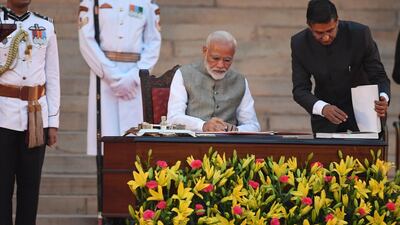
Narendra Modi signs documents after taking the oath of office as India's Prime Minister at the President house in New Delhi on May 30, 2019. AFP Photo -
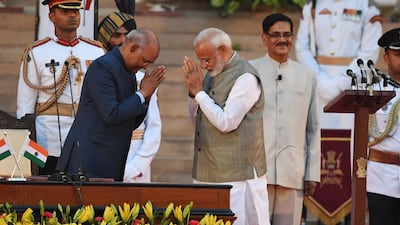
Newly sworn-in Indian Prime Minister Narendra Modi gestures towards Indian President Ram Nath Kovind. AFP -

Indian supporters and BJP workers celebrate with sparkles during the swearing-in ceremony. AFP -
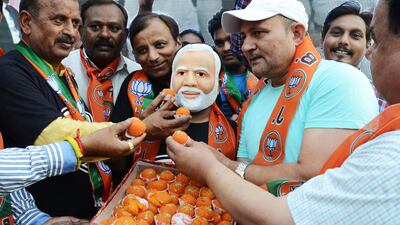
Indian supporters offer sweets to another wearing a mask of the newly sworn-in Indian Prime Minister Narendra Modi. AFP -

A general view of swearing-in ceremony at the presidential palace in New Delhi. Reuters -

Narendra Modi, back to camera, walks back after taking oath for a second term. AP Photo -
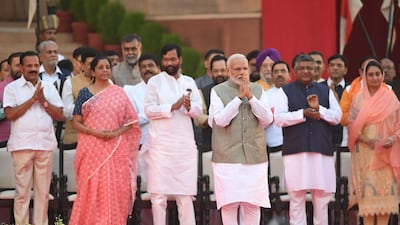
Narendra Modi gestures during his swearing-in ceremony. AFP -

Narendra Modi Fan Club members offer cake to underprivileged children as they celebrate his swearing-in ceremony iN Ahmedabad. AFP -

A young boy gets a Modi haircut. AFP -

The Abu Dhabi National Oil Company, ADNOC, has marked the inauguration of Narendra Modi as Prime Minister of India. To mark the occasion, the Indian and United Arab Emirates flags and a video of His Highness Sheikh Mohamed bin Zayed Al Nahyan, Crown Prince of Abu Dhabi and Deputy Supreme Commander of the UAE Armed Forces, and Narendra Modi were displayed on the facade of the ADNOC building in Abu Dhabi, symbolising the close bonds of friendship and co-operation that exist between both nations. Looking at the decorations on the ADNOC building in Abu Dhabi, Navdeep Singh Suri, the Indian Ambassador to the UAE, told WAM: "Beyond the symbolism of these images is also the clear direction that Prime Minister Modi and Sheikh Mohamed bin Zayed have provided to diplomats like us to make ‘the India-UAE Comprehensive Strategic Partnership’ a truly vibrant example of what we can achieve when we work together." -

The Abu Dhabi National Oil Company, ADNOC, has marked the inauguration of Narendra Modi as Prime Minister of India. To mark the occasion, the Indian and United Arab Emirates flags and a video of His Highness Sheikh Mohamed bin Zayed Al Nahyan, Crown Prince of Abu Dhabi and Deputy Supreme Commander of the UAE Armed Forces, and Narendra Modi were displayed on the facade of the ADNOC building in Abu Dhabi, symbolising the close bonds of friendship and co-operation that exist between both nations. Looking at the decorations on the ADNOC building in Abu Dhabi, Navdeep Singh Suri, the Indian Ambassador to the UAE, told WAM: "Beyond the symbolism of these images is also the clear direction that Prime Minister Modi and Sheikh Mohamed bin Zayed have provided to diplomats like us to make ‘the India-UAE Comprehensive Strategic Partnership’ a truly vibrant example of what we can achieve when we work together." -
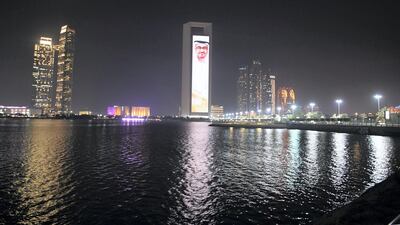
The Abu Dhabi National Oil Company, ADNOC, has marked the inauguration of Narendra Modi as Prime Minister of India. To mark the occasion, the Indian and United Arab Emirates flags and a video of His Highness Sheikh Mohamed bin Zayed Al Nahyan, Crown Prince of Abu Dhabi and Deputy Supreme Commander of the UAE Armed Forces, and Narendra Modi were displayed on the facade of the ADNOC building in Abu Dhabi, symbolising the close bonds of friendship and co-operation that exist between both nations. Looking at the decorations on the ADNOC building in Abu Dhabi, Navdeep Singh Suri, the Indian Ambassador to the UAE, told WAM: "Beyond the symbolism of these images is also the clear direction that Prime Minister Modi and Sheikh Mohamed bin Zayed have provided to diplomats like us to make ‘the India-UAE Comprehensive Strategic Partnership’ a truly vibrant example of what we can achieve when we work together."


Mr Modi retained several members of his previous cabinet. Rajnath Singh, who was the home minister in Mr Modi’s first term, is now the defence minister and Nitin Gadkari has retained the ministry of road transport and highways, according to a press communique from president’s secretariat. Dharmendra Pradhan has retained the ministry of petroleum, while getting additional charge of the steel ministry.
Narendra Singh Tomar was appointed minister for agriculture and farmer welfare, another key portfolio after Mr Modi faced widespread anger from farmers over low crop prices and lack of government support during his first term. Mr Tomar previously minister of rural affairs and local government.
Ms Sitharaman, 59, takes over the finance ministry at a time when there is pressure from industry for the government to provide some stimulus to halt a worrying slowdown in Asia's third-largest economy. Domestic consumption is weak while global demand is waning because of an escalating US-China trade war.
She will also need to find the money to fund Mr Modi’s populist campaign pledges without undermining the budget deficit target of 3.4 per cent of GDP for the fiscal year ending March 2020.
Her first priority will be preparing the government’s annual budget for this year, which is due in July.
As defence minister, she oversaw Mr Modi’s goal of spending as much as $250 billion (Dh918bn) by 2025 on defence hardware, including jet planes, naval ships and drones, to counter China’s growing military strength in the region. She also had oversight of Mr Modi’s flagship “Make in India” programme aimed at boosting domestic manufacturing, an initiative that included a significant defence focus.
While she does not have the political heft of her predecessors including Mr Jaitley and Palaniappan Chidambaram, she is known as a hardworking member of Mr Modi’s team and shares a good rapport with the prime minister.
She has also worked as a research manager for audit firm PricewaterhouseCoopers in London and has a master's degree in economics from New Delhi’s Jawaharlal Nehru University.
Mr Modi was sworn in for his second term on Thursday at a ceremony attended by several heads of state and 8,000 other guests.

