Doctors perform surgery to remove black fungus from a patient who recovered from Covid-19 at a hospital in Ghaziabad, near New Delhi. Indian doctors have now reported a case of green fungal infection, in addition to black, white and yellow. AFP
Doctors perform surgery to remove black fungus from a patient who recovered from Covid-19 at a hospital in Ghaziabad, near New Delhi. Indian doctors have now reported a case of green fungal infection,

India reports first case of green fungus infection in Covid-19 patient


  • English
  • Arabic

Indian doctors have reported the country's first case of "green fungus" in a Covid-19 patient after widespread infections of black fungus following the deadly second wave of the coronavirus pandemic that hit the country in March.

The 34-year-old man was diagnosed this week with a fungal infection known as aspergillosis, which targets the lungs, doctors in Madhya Pradesh state said.

India has been plagued by a slew of opportunistic fungal infections among recovered Covid-19 patients whose immune systems were weakened by the illness and the drugs taken to treat it.

The first cases to appear were of mucormycosis, or black fungus, which has affected more than 31,000 people and claimed at least 2,100 lives so far, according to local media reports.

While the black fungus infections are caused by a group of moulds called mucormycetes, the green fungus infection is caused by a common mould called aspergillus that occurs indoors and outdoors. Most people breathe in aspergillus spores every day without getting sick, but those with weak immune systems or lung diseases are at a higher risk of contracting aspergillosis, according to the US Centres for Disease Control and Prevention.

Doctors at the Sri Aurobindo Institute of Medical Sciences (SAIMS) in Indore, the capital of Madhya Pradesh, said the patient who developed aspergillosis had battled Covid-19 for two months, with severe lung involvement, and spent almost a month in intensive care.

"He started showing signs of improvement so he was discharged with home oxygen but after going home, in a week's time he started developing high-grade fever, nosebleeds and became extremely sick," Dr Ravi Dosi, the head of the Department of Chest Diseases at SAIMS, told The National.

Doctors at first suspected it be a case of mucormycosis.

“We were giving him medication on line of black fungus because of the symptoms…but he showed very poor response to it. We did a biopsy and special blood tests, by the time reports started trickling in, it became evident that he was suffering from aspergillosis,” Dr Dosi said.

“We have the largest Covid-19 health facility in central India and haven't seen such a case till now. It is pretty alarming as we were till now treating patients with such symptoms for mucormycosis,” he said.

He said the green fungus infection was not uncommon and was treatable, but “we have never found it with such ferocity ... It could be because of his extremely weak condition.”

The emergence of fungal infections among Covid-19 patients – including cases of white and yellow fungus – have placed additional strain on a healthcare system that was brought to its knees by the second wave of coronavirus, with more than 400,000 new cases each day at one point.

More than 170,000 people died and more than 20 million were infected by the virus since March as the hospitals across India struggled with shortages of medicines, oxygen and hospital beds.

In addition to black and green fungus, four cases of white fungus, believed to be more dangerous than the black fungus, have been detected in India, and at least one case of yellow fungus was found in Ghaziabad, outside the capital New Delhi.

  • People watch fireworks as New York celebrates reaching a 70 per cent vaccination threshold. Reuters
    People watch fireworks as New York celebrates reaching a 70 per cent vaccination threshold. Reuters
  • An Indian soldier patrols the Taj Mahal after it reopened to visitors following the easing of Covid-19 restrictions. AFP
    An Indian soldier patrols the Taj Mahal after it reopened to visitors following the easing of Covid-19 restrictions. AFP
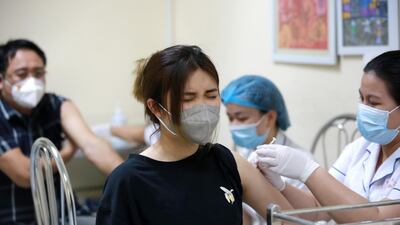
  • A woman is vaccinated at a hospital in Hanoi. More than 59,000 people in Vietnam have been fully vaccinated against the coronavirus, according to latest official data. EPA
    A woman is vaccinated at a hospital in Hanoi. More than 59,000 people in Vietnam have been fully vaccinated against the coronavirus, according to latest official data. EPA
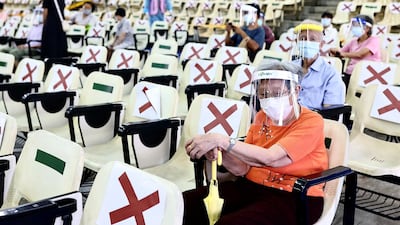
  • People wait at an observation area after receiving a vaccination dose during an inoculation session for people over 85 years in New Taipei City, Taiwan. Reuters
    People wait at an observation area after receiving a vaccination dose during an inoculation session for people over 85 years in New Taipei City, Taiwan. Reuters
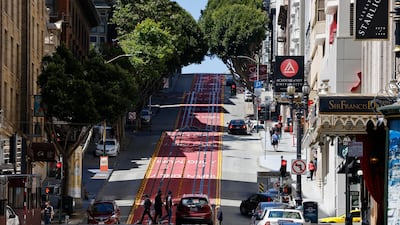
  • A quiet Powell Street cable car route in San Francisco, California. The cable car was closed during the coronavirus pandemic. California has lifted virtually all coronavirus restrictions on businesses and social gatherings. EPA
    A quiet Powell Street cable car route in San Francisco, California. The cable car was closed during the coronavirus pandemic. California has lifted virtually all coronavirus restrictions on businesses and social gatherings. EPA
  • A woman scans a check-in code at a coronavirus testing centre in Melbourne, Australia. Reuters
    A woman scans a check-in code at a coronavirus testing centre in Melbourne, Australia. Reuters
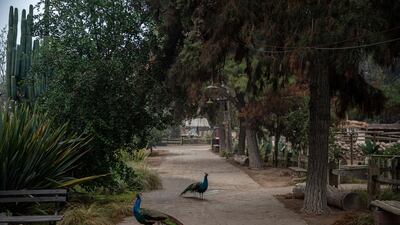
  • Peacocks at a deserted Buin Zoo in Santiago, Chile. The largest private zoo in Chile has started a campaign called Sponsor an Animal to raise money to maintain its wildlife. AP
    Peacocks at a deserted Buin Zoo in Santiago, Chile. The largest private zoo in Chile has started a campaign called Sponsor an Animal to raise money to maintain its wildlife. AP
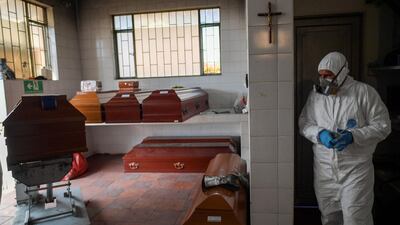
  • A worker prepares the coffin of a person who died from Covid-19 at Zipaquira cemetery park near Bogota. Colombia has recorded more than 90,000 Covid-19 deaths. AFP
    A worker prepares the coffin of a person who died from Covid-19 at Zipaquira cemetery park near Bogota. Colombia has recorded more than 90,000 Covid-19 deaths. AFP
  • A person receives a vaccine against Covid-19 in Bogota, Colombia. Colombia is experiencing a critical situation owing to a prolonged third wave of the pandemic. EPA
    A person receives a vaccine against Covid-19 in Bogota, Colombia. Colombia is experiencing a critical situation owing to a prolonged third wave of the pandemic. EPA
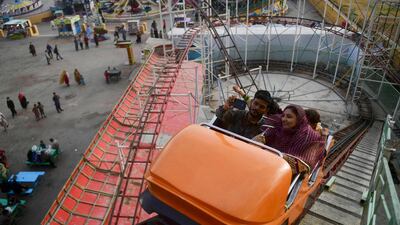
  • People enjoy a funfair ride in Karachi after Pakistan's government eased restrictions following a drop in new cases for several weeks. AFP
    People enjoy a funfair ride in Karachi after Pakistan's government eased restrictions following a drop in new cases for several weeks. AFP

Although the number of daily Covid-19 cases has dropped sharply, with only about 67,000 reported on Thursday, doctors say they face a challenge not only from the spate of related fungal infections but also  from tuberculosis.

“Post-Covid, people where there was lung involvement are suffering from abnormal presentation ... there is a spurt of TB cases," Dr Dosi said.

"We now believe in doing biopsies and culture for pinpoint treatment – empirical treatment might prove wrong.”

The number and variety of fungal infections has also created panic and confusion among the general public, leading experts to warn against identifying them by colour.

"It's better to use the correct name because the colour of the fungus may seem different according to the part of the body in which it is growing," Dr Randeep Guleria, director of the All India Institute of Medical Sciences in New Delhi, told reporters recently.

Dr Dosi, however, believes that using colour and not scientific names helps create public awareness.

“It may be misleading but I think using colours is an easier way of putting forward the message; even people from villages understand the colours rather than using words such as mucormycosis. It creates awareness in a good way,” he said.


Emirates exiles

Will Wilson is not the first player to have attained high-class representative honours after first learning to play rugby on the playing fields of UAE.

Jonny Macdonald
Abu Dhabi-born and raised, the current Jebel Ali Dragons assistant coach was selected to play for Scotland at the Hong Kong Sevens in 2011.

Jordan Onojaife
Having started rugby by chance when the Jumeirah College team were short of players, he later won the World Under 20 Championship with England.

Devante Onojaife
Followed older brother Jordan into England age-group rugby, as well as the pro game at Northampton Saints, but recently switched allegiance to Scotland.

Ten tax points to be aware of in 2026

1. Domestic VAT refund amendments: request your refund within five years

If a business does not apply for the refund on time, they lose their credit.

2. E-invoicing in the UAE

Businesses should continue preparing for the implementation of e-invoicing in the UAE, with 2026 a preparation and transition period ahead of phased mandatory adoption. 

3. More tax audits

Tax authorities are increasingly using data already available across multiple filings to identify audit risks. 

4. More beneficial VAT and excise tax penalty regime

Tax disputes are expected to become more frequent and more structured, with clearer administrative objection and appeal processes. The UAE has adopted a new penalty regime for VAT and excise disputes, which now mirrors the penalty regime for corporate tax.

5. Greater emphasis on statutory audit

There is a greater need for the accuracy of financial statements. The International Financial Reporting Standards standards need to be strictly adhered to and, as a result, the quality of the audits will need to increase.

6. Further transfer pricing enforcement

Transfer pricing enforcement, which refers to the practice of establishing prices for internal transactions between related entities, is expected to broaden in scope. The UAE will shortly open the possibility to negotiate advance pricing agreements, or essentially rulings for transfer pricing purposes. 

7. Limited time periods for audits

Recent amendments also introduce a default five-year limitation period for tax audits and assessments, subject to specific statutory exceptions. While the standard audit and assessment period is five years, this may be extended to up to 15 years in cases involving fraud or tax evasion. 

8. Pillar 2 implementation 

Many multinational groups will begin to feel the practical effect of the Domestic Minimum Top-Up Tax (DMTT), the UAE's implementation of the OECD’s global minimum tax under Pillar 2. While the rules apply for financial years starting on or after January 1, 2025, it is 2026 that marks the transition to an operational phase.

9. Reduced compliance obligations for imported goods and services

Businesses that apply the reverse-charge mechanism for VAT purposes in the UAE may benefit from reduced compliance obligations. 

10. Substance and CbC reporting focus

Tax authorities are expected to continue strengthening the enforcement of economic substance and Country-by-Country (CbC) reporting frameworks. In the UAE, these regimes are increasingly being used as risk-assessment tools, providing tax authorities with a comprehensive view of multinational groups’ global footprints and enabling them to assess whether profits are aligned with real economic activity. 

Contributed by Thomas Vanhee and Hend Rashwan, Aurifer

HAJJAN
%3Cp%3EDirector%3A%20Abu%20Bakr%20Shawky%C2%A0%3C%2Fp%3E%0A%3Cp%3E%3Cbr%3EStarring%3A%20Omar%20Alatawi%2C%20Tulin%20Essam%2C%20Ibrahim%20Al-Hasawi%C2%A0%3C%2Fp%3E%0A%3Cp%3E%3Cbr%3ERating%3A%204%2F5%3C%2Fp%3E%0A
How green is the expo nursery?

Some 400,000 shrubs and 13,000 trees in the on-site nursery

An additional 450,000 shrubs and 4,000 trees to be delivered in the months leading up to the expo

Ghaf, date palm, acacia arabica, acacia tortilis, vitex or sage, techoma and the salvadora are just some heat tolerant native plants in the nursery

Approximately 340 species of shrubs and trees selected for diverse landscape

The nursery team works exclusively with organic fertilisers and pesticides

All shrubs and trees supplied by Dubai Municipality

Most sourced from farms, nurseries across the country

Plants and trees are re-potted when they arrive at nursery to give them room to grow

Some mature trees are in open areas or planted within the expo site

Green waste is recycled as compost

Treated sewage effluent supplied by Dubai Municipality is used to meet the majority of the nursery’s irrigation needs

Construction workforce peaked at 40,000 workers

About 65,000 people have signed up to volunteer

Main themes of expo is  ‘Connecting Minds, Creating the Future’ and three subthemes of opportunity, mobility and sustainability.

Expo 2020 Dubai to open in October 2020 and run for six months