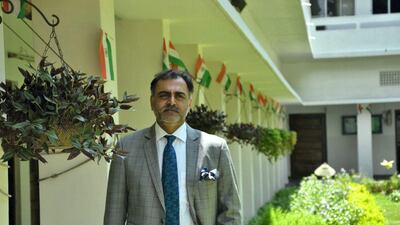
Amreesh Chandra believes schooling should shift to a blended model permanently. Amreesh Chandra

Education Day: school system needs reform after impact of Covid-19 lockdown


Jamie Prentis
  • English
  • Arabic

Schoolchildren have had to resort to online learning in the Covid-19 pandemic but as recovery begins the focus is shifting to incorporating virtual education across teaching in ways that improve the classroom.

India-based educationalist Amreesh Chandra says his biggest concern when the world emerges from the pandemic is “the deficit in knowledge, especially in these ones that are graduating from one life into the other”.

Mr Chandra set up Chandra Edu Links in 2006, which has provided education services around the world. As the pandemic took hold, it launched what is thought to be India’s first live web school.

The Online World School in India was followed by Online Learning World, which aims to complement the education of Indian pupils in the GCC through live, interactive tutoring in the form of after-school lessons.

Amreesh Chandra set up the Online World School in India last year, the country’s first online live school last year. Courtesy Amreesh Chandra

Mr Chandra said conventional schools modelled on traditional systems failed to adapt to the crisis.

“The most important thing that happened with the pandemic was, no matter how modern a country was or how developed the country was or how underdeveloped a country was, our education system was never structured enough to handle such a pressure point,” he said.

In the first peak of the outbreak, last spring, 188 countries closed their schools, affecting 1.54 billion pupils.

“My worry from the pandemic is how would these students perform when they go into their professional lives,” he said.

There needs to be a properly thought-out plan for how these gaps will be closed, he said.

Mr Chandra believes there should be a hybrid system that incorporates some online learning – but not of the type most children have become accustomed to in the past 10 months.

“We developed a programme where we would replicate what happens offline, online. So we said we’re not going to do any video tutorials. We will not make WhatsApp groups and pass instructions. We will not send worksheets for them to fill out,” Mr Chandra said.

“What we would do is create a conveyer belt of technology that allows a live-streaming of every class that is taught and allows a child to raise his hand or her hand and ask a question as he or she would in an offline class.”

Online Learning World has since created 15 live studios for teaching. The online idea was accelerated by the frustrations of parents who couldn’t justify the school fees they were paying and the angst felt by children whose education was suffering at such a crucial time.

“Not all schools are teaching through a live-streaming facility. If a child has a question, for him to go back to his subject teacher is an ordeal for him. Classroom teaching is based on questions and answers. We wanted to capture that live.”

Online Learning World is one of the very few organisations in the UAE education sector to have received an online education trade licence from Fujairah Free Zone during the pandemic.

Moving forwards, Mr Chandra believes it will take two to three academic terms to make up for the educational losses sustained during the lockdown and says incorporating technology could help offset the negative impact of any future crises that would compel pupils to stay at home.

As he points, uncertainty still reigns over when children will be able to return to the classroom.

The most worrying issue, Mr Chandra says, is that many teachers lack sufficient technology skills and this needs to be addressed.

But he says shifting to a combination of in-class and online learning is a “no-brainer”.

“It has to be blended learning, which means it’s a combination of offline and online. We never know when there could be a sudden pandemic outburst in an institution.”


Desert Warrior

Starring: Anthony Mackie, Aiysha Hart, Ben Kingsley

Director: Rupert Wyatt

Rating: 3/5

Poacher
%3Cp%3E%3Cstrong%3EDirector%3A%20%3C%2Fstrong%3ERichie%20Mehta%26nbsp%3B%3C%2Fp%3E%0A%3Cp%3E%3Cstrong%3EStarring%3A%3C%2Fstrong%3E%20Nimisha%20Sajayan%2C%20Roshan%20Mathew%2C%20Dibyendu%20Bhattacharya%3C%2Fp%3E%0A%3Cp%3E%3Cstrong%3ERating%3A%20%3C%2Fstrong%3E3%2F5%3C%2Fp%3E%0A
MEDIEVIL%20(1998)
%3Cp%3E%3Cstrong%3EDeveloper%3A%3C%2Fstrong%3E%20SCE%20Studio%20Cambridge%3Cbr%3E%3Cstrong%3EPublisher%3A%3C%2Fstrong%3E%20Sony%20Computer%20Entertainment%3Cbr%3E%3Cstrong%3EConsole%3A%3C%2Fstrong%3E%20PlayStation%2C%20PlayStation%204%20and%205%3Cbr%3E%3Cstrong%3ERating%3A%3C%2Fstrong%3E%203.5%2F5%3C%2Fp%3E%0A
The specs
  • Engine: 3.9-litre twin-turbo V8
  • Power: 640hp
  • Torque: 760nm
  • On sale: 2026
  • Price: Not announced yet
The Pope's itinerary

Sunday, February 3, 2019 - Rome to Abu Dhabi
1pm: departure by plane from Rome / Fiumicino to Abu Dhabi
10pm: arrival at Abu Dhabi Presidential Airport


Monday, February 4
12pm: welcome ceremony at the main entrance of the Presidential Palace
12.20pm: visit Abu Dhabi Crown Prince at Presidential Palace
5pm: private meeting with Muslim Council of Elders at Sheikh Zayed Grand Mosque
6.10pm: Inter-religious in the Founder's Memorial


Tuesday, February 5 - Abu Dhabi to Rome
9.15am: private visit to undisclosed cathedral
10.30am: public mass at Zayed Sports City – with a homily by Pope Francis
12.40pm: farewell at Abu Dhabi Presidential Airport
1pm: departure by plane to Rome
5pm: arrival at the Rome / Ciampino International Airport

THE BIO

BIO:
Born in RAK on December 9, 1983
Lives in Abu Dhabi with her family
She graduated from Emirates University in 2007 with a BA in architectural engineering
Her motto in life is her grandmother’s saying “That who created you will not have you get lost”
Her ambition is to spread UAE’s culture of love and acceptance through serving coffee, the country’s traditional coffee in particular.

Mercer, the investment consulting arm of US services company Marsh & McLennan, expects its wealth division to at least double its assets under management (AUM) in the Middle East as wealth in the region continues to grow despite economic headwinds, a company official said.

Mercer Wealth, which globally has $160 billion in AUM, plans to boost its AUM in the region to $2-$3bn in the next 2-3 years from the present $1bn, said Yasir AbuShaban, a Dubai-based principal with Mercer Wealth.

Within the next two to three years, we are looking at reaching $2 to $3 billion as a conservative estimate and we do see an opportunity to do so,” said Mr AbuShaban.

Mercer does not directly make investments, but allocates clients’ money they have discretion to, to professional asset managers. They also provide advice to clients.

“We have buying power. We can negotiate on their (client’s) behalf with asset managers to provide them lower fees than they otherwise would have to get on their own,” he added.

Mercer Wealth’s clients include sovereign wealth funds, family offices, and insurance companies among others.

From its office in Dubai, Mercer also looks after Africa, India and Turkey, where they also see opportunity for growth.

Wealth creation in Middle East and Africa (MEA) grew 8.5 per cent to $8.1 trillion last year from $7.5tn in 2015, higher than last year’s global average of 6 per cent and the second-highest growth in a region after Asia-Pacific which grew 9.9 per cent, according to consultancy Boston Consulting Group (BCG). In the region, where wealth grew just 1.9 per cent in 2015 compared with 2014, a pickup in oil prices has helped in wealth generation.

BCG is forecasting MEA wealth will rise to $12tn by 2021, growing at an annual average of 8 per cent.

Drivers of wealth generation in the region will be split evenly between new wealth creation and growth of performance of existing assets, according to BCG.

Another general trend in the region is clients’ looking for a comprehensive approach to investing, according to Mr AbuShaban.

“Institutional investors or some of the families are seeing a slowdown in the available capital they have to invest and in that sense they are looking at optimizing the way they manage their portfolios and making sure they are not investing haphazardly and different parts of their investment are working together,” said Mr AbuShaban.

Some clients also have a higher appetite for risk, given the low interest-rate environment that does not provide enough yield for some institutional investors. These clients are keen to invest in illiquid assets, such as private equity and infrastructure.

“What we have seen is a desire for higher returns in what has been a low-return environment specifically in various fixed income or bonds,” he said.

“In this environment, we have seen a de facto increase in the risk that clients are taking in things like illiquid investments, private equity investments, infrastructure and private debt, those kind of investments were higher illiquidity results in incrementally higher returns.”

The Abu Dhabi Investment Authority, one of the largest sovereign wealth funds, said in its 2016 report that has gradually increased its exposure in direct private equity and private credit transactions, mainly in Asian markets and especially in China and India. The authority’s private equity department focused on structured equities owing to “their defensive characteristics.”

GRAN%20TURISMO
%3Cp%3E%3Cstrong%3EDirector%3A%3C%2Fstrong%3E%20Neill%20Blomkamp%3C%2Fp%3E%0A%3Cp%3E%3Cstrong%3EStars%3A%3C%2Fstrong%3E%20David%20Harbour%2C%20Orlando%20Bloom%2C%20Archie%20Madekwe%2C%20Darren%20Barnet%3C%2Fp%3E%0A%3Cp%3E%3Cstrong%3ERating%3A%3C%2Fstrong%3E%203%2F5%3C%2Fp%3E%0A

Day 1 results:

Open Men (bonus points in brackets)
New Zealand 125 (1) beat UAE 111 (3)
India 111 (4) beat Singapore 75 (0)
South Africa 66 (2) beat Sri Lanka 57 (2)
Australia 126 (4) beat Malaysia -16 (0)

Open Women
New Zealand 64 (2) beat South Africa 57 (2)
England 69 (3) beat UAE 63 (1)
Australia 124 (4) beat UAE 23 (0)
New Zealand 74 (2) beat England 55 (2)

Living in...

This article is part of a guide on where to live in the UAE. Our reporters will profile some of the country’s most desirable districts, provide an estimate of rental prices and introduce you to some of the residents who call each area home.

The biog

Favourite films: Casablanca and Lawrence of Arabia

Favourite books: Start with Why by Simon Sinek and Good to be Great by Jim Collins

Favourite dish: Grilled fish

Inspiration: Sheikh Zayed's visionary leadership taught me to embrace new challenges.


Voy!%20Voy!%20Voy!
%3Cp%3E%3Cstrong%3EDirector%3A%3C%2Fstrong%3E%20Omar%20Hilal%3Cbr%3E%3Cstrong%3EStars%3A%3C%2Fstrong%3E%20Muhammad%20Farrag%2C%20Bayoumi%20Fouad%2C%20Nelly%20Karim%3Cbr%3E%3Cstrong%3ERating%3A%3C%2Fstrong%3E%204%2F5%3C%2Fp%3E%0A
David Haye record

Total fights: 32
Wins: 28
Wins by KO: 26
Losses: 4

THE%20SWIMMERS
%3Cp%3E%3Cstrong%3EDirector%3A%20%3C%2Fstrong%3ESally%20El-Hosaini%3C%2Fp%3E%0A%3Cp%3E%3Cstrong%3EStars%3A%20%3C%2Fstrong%3ENathalie%20Issa%2C%20Manal%20Issa%2C%20Ahmed%20Malek%20and%20Ali%20Suliman%C2%A0%3C%2Fp%3E%0A%3Cp%3E%3Cstrong%3ERating%3A%20%3C%2Fstrong%3E4%2F5%3C%2Fp%3E%0A