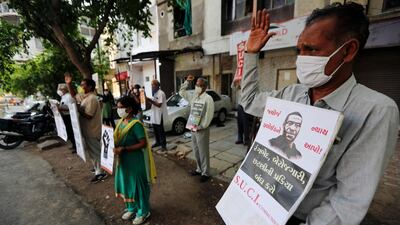
Activists of Socialist Unity Centre of India shout slogans in Ahmedabad, India, Tuesday, June 2, 2020 in solidarity with protests against the recent killing of George Floyd. AP

Black Lives Matter protests stir racism debate in India


  • English
  • Arabic

“Back home I never paid attention to my skin colour, but here in India I am always reminded that I am black,” Mayomi Taiwo, a 24-year-old Nigerian student says about India, where racism and colourism is well entrenched in the society.

As the ‘Black Lives Matter’ campaign rages globally after the killing of African-American George Floyd, India too is now witnessing a fierce debate around the issue that some say is swept under the carpet despite it impacting the lives of millions every day.

Mr Taiwo came to India in 2014 to study at a university in Greater Noida, a cosmopolitan satellite town near capital New Delhi, believing its culture and people would make him feel at home compared to western countries.

But over the years, the master’s student has regularly faced discrimination, insults and racial slurs, and an arbitrary police raid because of his dark skin color.

"Four policemen barged into the house with a random woman who was pretended to be looking for her lost mobile phone but it in fact was a raid to check if we are running a sex trafficking racket. It was humiliating," Mr Taiwo told The National.

“I often face discrimination when I have to rent out a place, landlords straight away say no when they hear African sounding name,” he added.

Last week, former West Indies cricket captain Darren Sammy said he too was subjected to racist comments by his teammates during his stint with Indian Premier League, a claim backed by his former teammate Chris Gayle.

Mr Sammy made the allegations on social media following the global protests for racial justice in the aftermath of the killing of Mr Floyd last month by a white police officer in Minneapolis in the US.

The cricketer said he would be messaging those who used a Hindi slur for blacks in the team dressing room and ask them what they meant.

Like the top cricketers, thousands of students from African countries, who come to study in high-quality low-cost private universities in New Delhi, Pune and Greater Noida, face rampant racism on a daily basis.

Most struggle to find accommodation and are often forced to pay exorbitant rents for housing and frequently swindled by taxis drivers amid racial profiling and type-casting as criminals, narcos, prostitutes and even cannibals.

Some are targeted violently.

Five Nigerian students were brutally beaten in Noida in 2017 over false allegations after a local died of drug overdose and cannibalism. A year earlier a Congolese man was beaten to death over an argument for hiring a taxi in Delhi. Same year a Tanzanian woman was stripped and beaten in public after a road crash in Bangalore city.

Chidozie Agumadu, 27, the general secretary of Association of African Students in India said most Indians are unapologetic as well as ignorant about what constitutes racism, making race prejudice a dangerous phenomenon in the country.

"I have heard people casually calling me Kala or with the N-word," Mr Agumadu, who is from Nigeria, told The National.

Mr Agumadu said many in India still had a colonial hangover of fair skin superiority and called on movements like “Black Lives Matter” in India to bring racial justice for all dark skinned people and not just Africans.

“It should be a voice for everyone in India specially for those who have been discriminated against,” he said.

The world’s second most populous nation is a complex mix of many races and ethnicities that have historically imposed supremacy over each other and used skin color and facial features as a weapon.

Millions from India’s north-eastern states are racially discriminated against because of their south-east Asian looks, while indigenous Indians and those from lower castes in India’s caste system face prejudice for dark skins.

For centuries, despite a large majority of the population being brown-skinned, Indians have an obsession for light skin that many associate with beauty, high caste and privilege.

From preferring a fair daughter-in-law to white babies, the country is struggling with a serious problem of colourism that is further fueled by India’s booming fairness cosmetic industry worth more than $500 million.

Last week several Bollywood celebrities, lending their support to the “Black Lives Matter” campaign, were called out for endorsing fairness products that many say perpetuates prejudices for millions of Indians, almost to the level of black discrimination.

“Endorsing fairness creams and saying being white is beautiful but then shamefully tweeting about #blacklivesmatters #hypocrites,” a user Sunil Sinha replied to actress Sonam Kapoor’s tweet on the black rights movement.

Experts say the prejudice against dark skin is a complex issue in India that is guided not only by religious scriptures but also traditional beliefs about white being beautiful and modern propaganda about dark being evil.

"In India, colourism is basically casteism because the ancient scriptures teach us that a fair woman is beautiful, no one expects a lower caste woman to be fair and beautiful," Sowjanya Tamalapakula, an expert on caste and gender studies, told The National.

“Our ancient roots of colourism have certainly amalgamated with colonial influence and have given a mixed ideology that white people are more beautiful than the black. There is also an influence of the media that blacks are criminals,” she said.


The specs

Engine: 2.0-litre 4cyl turbo

Power: 261hp at 5,500rpm

Torque: 405Nm at 1,750-3,500rpm

Transmission: 9-speed auto

Fuel consumption: 6.9L/100km

On sale: Now

Price: From Dh117,059

The specs

Price, base / as tested Dh1,470,000 (est)
Engine 6.9-litre twin-turbo W12
Gearbox eight-speed automatic
Power 626bhp @ 6,000rpm
Torque: 900Nm @ 1,350rpm
Fuel economy, combined 14.0L / 100km

COMPANY PROFILE

Company name: Blah

Started: 2018

Founder: Aliyah Al Abbar and Hend Al Marri

Based: Dubai

Industry: Technology and talent management

Initial investment: Dh20,000

Investors: Self-funded

Total customers: 40

UAE%20v%20West%20Indies
%3Cp%3EFirst%20ODI%20-%20Sunday%2C%20June%204%20%0D%3Cbr%3ESecond%20ODI%20-%20Tuesday%2C%20June%206%20%0D%3Cbr%3EThird%20ODI%20-%20Friday%2C%20June%209%26nbsp%3B%3C%2Fp%3E%0A%3Cp%3EMatches%20at%20Sharjah%20Cricket%20Stadium.%20All%20games%20start%20at%204.30pm%0D%3Cbr%3E%0D%3Cbr%3E%3Cstrong%3EUAE%20squad%3C%2Fstrong%3E%0D%3Cbr%3EMuhammad%20Waseem%20(captain)%2C%20Aayan%20Khan%2C%20Adithya%20Shetty%2C%20Ali%20Naseer%2C%20Ansh%20Tandon%2C%20Aryansh%20Sharma%2C%20Asif%20Khan%2C%20Basil%20Hameed%2C%20Ethan%20D%E2%80%99Souza%2C%20Fahad%20Nawaz%2C%20Jonathan%20Figy%2C%20Junaid%20Siddique%2C%20Karthik%20Meiyappan%2C%20Lovepreet%20Singh%2C%20Matiullah%2C%20Mohammed%20Faraazuddin%2C%20Muhammad%20Jawadullah%2C%20Rameez%20Shahzad%2C%20Rohan%20Mustafa%2C%20Sanchit%20Sharma%2C%20Vriitya%20Aravind%2C%20Zahoor%20Khan%0D%3C%2Fp%3E%0A
RESULTS

5pm: Maiden (PA) Dh80,000 1,600m
Winner: Raghida, Szczepan Mazur (jockey), Ibrahim Al Hadhrami (trainer)
5.30pm: Maiden (PA) Dh80,000 1,600m
Winner: AF Alareeq, Connor Beasley, Ahmed Al Mehairbi
6pm: Arabian Triple Crown Round-2 Group 3 (PA) Dh300,000 2,200m 
Winner: Basmah, Fabrice Veron, Eric Lemartinel
6.30pm: Liwa Oasis Group 2 (PA) Dh300,000 1,400m
Winner: AF Alwajel, Tadhg O’Shea, Ernst Oertel
7pm: Wathba Stallions Cup Handicap (PA) Dh70,000 1,600m
Winner: SS Jalmod, Richard Mullen, Satish Seemar
7.30pm: Handicap (TB) Dh100,000 1,600m
Winner: Trolius, Ryan Powell, Simon Crisford

Who was Alfred Nobel?

The Nobel Prize was created by wealthy Swedish chemist and entrepreneur Alfred Nobel.

  • In his will he dictated that the bulk of his estate should be used to fund "prizes to those who, during the preceding year, have conferred the greatest benefit to humankind".
  • Nobel is best known as the inventor of dynamite, but also wrote poetry and drama and could speak Russian, French, English and German by the age of 17. The five original prize categories reflect the interests closest to his heart.
  • Nobel died in 1896 but it took until 1901, following a legal battle over his will, before the first prizes were awarded.
Company%20Profile
%3Cp%3E%3Cstrong%3ECompany%20name%3A%3C%2Fstrong%3E%20Hoopla%3Cbr%3E%3Cstrong%3EDate%20started%3A%20%3C%2Fstrong%3EMarch%202023%3Cbr%3E%3Cstrong%3EFounder%3A%3C%2Fstrong%3E%20Jacqueline%20Perrottet%3Cbr%3E%3Cstrong%3EBased%3A%3C%2Fstrong%3E%20Dubai%3Cbr%3E%3Cstrong%3ENumber%20of%20staff%3A%3C%2Fstrong%3E%2010%3Cbr%3E%3Cstrong%3EInvestment%20stage%3A%20%3C%2Fstrong%3EPre-seed%3Cbr%3E%3Cstrong%3EInvestment%20required%3A%3C%2Fstrong%3E%20%24500%2C000%3C%2Fp%3E%0A
ITU Abu Dhabi World Triathlon

For more information go to www.abudhabi.triathlon.org.

Squads

Pakistan: Sarfaraz Ahmed (c), Babar Azam (vc), Abid Ali, Asif Ali, Fakhar Zaman, Haris Sohail, Mohammad Hasnain, Iftikhar Ahmed, Imad Wasim, Mohammad Amir, Mohammad Nawaz, Mohammad Rizwan, Shadab Khan, Usman Shinwari, Wahab Riaz

Sri Lanka: Lahiru Thirimanne (c), Danushka Gunathilaka, Sadeera Samarawickrama, Avishka Fernando, Oshada Fernando, Shehan Jayasuriya, Dasun Shanaka, Minod Bhanuka, Angelo Perera, Wanindu Hasaranga, Lakshan Sandakan, Nuwan Pradeep, Isuru Udana, Kasun Rajitha, Lahiru Kumara

The five pillars of Islam

1. Fasting 

2. Prayer 

3. Hajj 

4. Shahada 

5. Zakat 

Indoor cricket in a nutshell

Indoor Cricket World Cup – Sep 16-20, Insportz, Dubai

16 Indoor cricket matches are 16 overs per side

8 There are eight players per team

There have been nine Indoor Cricket World Cups for men. Australia have won every one.

5 Five runs are deducted from the score when a wickets falls

Batsmen bat in pairs, facing four overs per partnership

Scoring In indoor cricket, runs are scored by way of both physical and bonus runs. Physical runs are scored by both batsmen completing a run from one crease to the other. Bonus runs are scored when the ball hits a net in different zones, but only when at least one physical run is score.

Zones

A Front net, behind the striker and wicketkeeper: 0 runs

B Side nets, between the striker and halfway down the pitch: 1 run

Side nets between halfway and the bowlers end: 2 runs

Back net: 4 runs on the bounce, 6 runs on the full

The National in Davos

We are bringing you the inside story from the World Economic Forum's Annual Meeting in Davos, a gathering of hundreds of world leaders, top executives and billionaires.

The Outsider

Stephen King, Penguin

COMPANY PROFILE
Name: Almnssa
Started: August 2020
Founder: Areej Selmi
Based: Gaza
Sectors: Internet, e-commerce
Investments: Grants/private funding