
A summit of Southeast Asian states held on Tuesday to discuss last month's coup in Myanmar failed to find a breakthrough to get the nation back on the path to democracy, sources with knowledge of the meeting said.
Speaking after foreign ministers from the Association of Southeast Asian Nations (Asean) ended their virtual meeting, Indonesia's chief envoy Retno Marsudi urged the junta to allow the bloc to resolve escalating tensions.
"It takes two to tango," she said after the meeting. "Asean's good intentions and readiness will be meaningless if Myanmar does not open its door."
Asean did not forge a common position during the meeting, two diplomatic sources said.
A statement from the meeting's chair, Brunei, on the outcome of the meeting, said Asean expressed concern about the situation in Myanmar and called on "all parties to refrain from instigating further violence".
"We expressed Asean's readiness to assist Myanmar in a positive, peaceful and constructive manner," it said.
In a statement of remarks made during the summit, Singapore's Foreign Minister Vivian Balakrishnan warned an inability to find a common Asean position "would starkly underscore our lack of unity, and undermine our credibility and relevance as an organisation".
The use of lethal force against unarmed civilians was "inexcusable", he said.
The US also issued a warning on Monday to Myanmar's military rulers that it would take more action if the country's security forces continue to kill unarmed people and attack journalists and activists.
"If the Burmese military continues down this path, if the Burmese military refuses to restore the democratically elected government and to cease this abhorrent violence against peaceful demonstrators, there will be additional measures forthcoming from the United States," State Department spokesman Ned Price said.
Myanmar is also known as Burma.
A White House official said on Sunday the US was preparing additional sanctions against those responsible for the latest outbreak of violence.
Bloodiest day
The Asean talks come two days after the bloodiest day of unrest since the military removed Aung San Suu Kyi's elected government a month ago, unleashing anger and street protests across Myanmar.
The streets were largely quiet in the largest city Yangon early on Tuesday, ahead of what protesters said would be another big demonstration. Several shopping malls announced closures due to the unrest, some in places where protests have taken place.
Police fired tear gas and stun grenades to disperse hundreds of protesters in Yangon on Monday and later combed side streets, firing rubber bullets, witnesses said.
In remarks read on state television by a newsreader, junta leader Sen Gen Min Aung Hlaing said protest leaders and "instigators" would be punished and threatened action against civil servants who were refusing to work.
Min Aung Hlaing has pledged to hold new elections and hand power, but has given no clear timeframe.
-
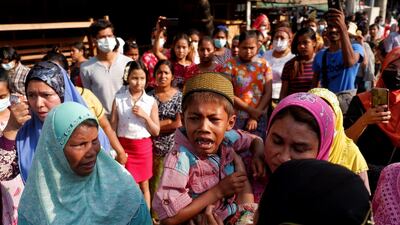
People attend the funeral of a woman who was shot dead yesterday while police were trying to disperse an anti-coup demonstration in Mandalay, Myanmar. Reuters -
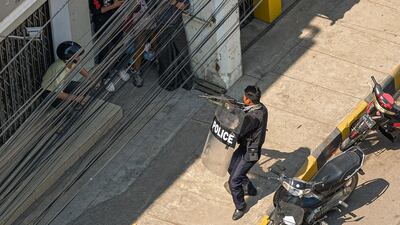
A policeman points his weapon at people in Taunggyi, a city in Shan State, as security forces continue to crackdown on demonstrations by protesters against the military coup. AFP -
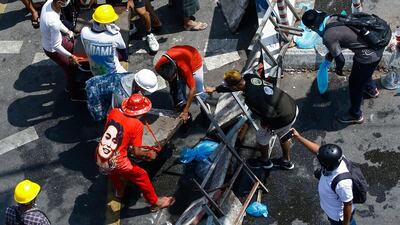
Protesters erect makeshift barricades to obstruct security forces during a demonstration against the military coup in Yangon. AFP -
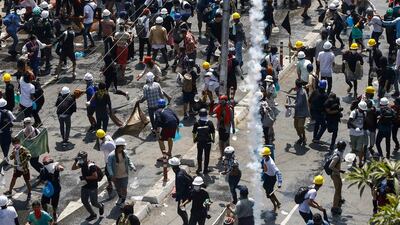
Protesters run as tear gas is fired during a demonstration against the military coup in Yangon. AFP -

Tear gas and fire extinguisher gas float around protesters as they clash with riot police officers during a protest against the military coup in Yangon, Myanmar. Reuters -
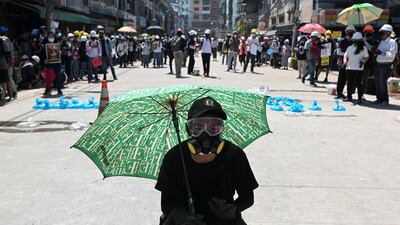
A demonstrator holds an umbrella during a protest against the military coup in Yangon, Myanmar. Reuters -
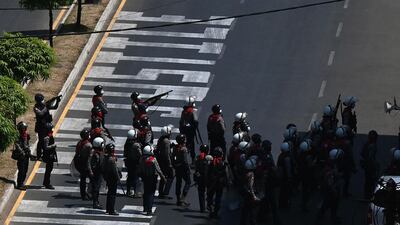
Police, with some holding up firearms, stand by a sign on a road that reads "We Want Justice" as protesters take part in a demonstration against the military coup in Yangon. AFP -

Protesters take cover behind a makeshift barrier during an anti-coup protest following the military crackdown in Yangon, Myanmar. EPA -
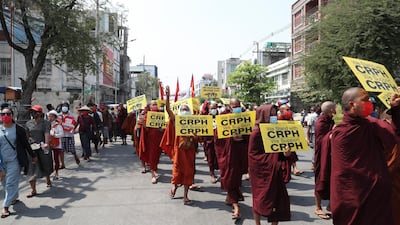
Buddhist monks holding signs lead an anti-coup protest march in Mandalay, Myanmar. AP Photo -
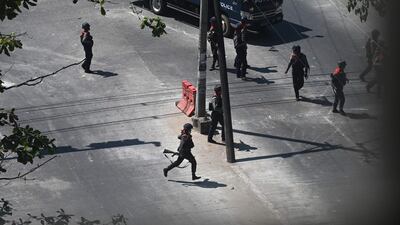
A policeman runs as protesters take part in a demonstration against the military coup in Yangon. AFP -
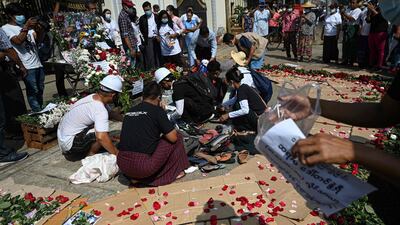
Protesters arrange abandoned flip flops and other belongings next to a makeshift altar for teacher Tin Nwe Yi left behind during a crackdown in Yangon after she was killed during a demonstration against the military coup. AFP -
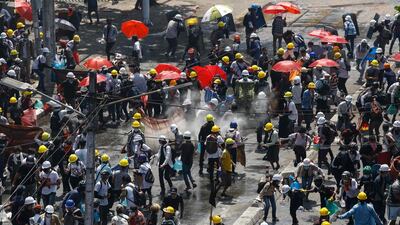
Protesters react after tear gas is fired during a demonstration against the military coup in Yangon. AFP -
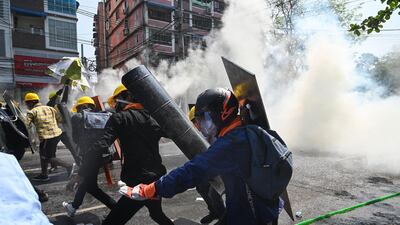
Protesters run while holding homemade shields after tear gas was fired during a demonstration against the military coup in Yangon. AFP -
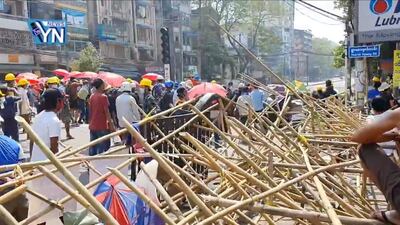
Barricades are seen during a protest on the street in Yangon, Myanmar in this screengrab obtained from a social media video. Reuters -
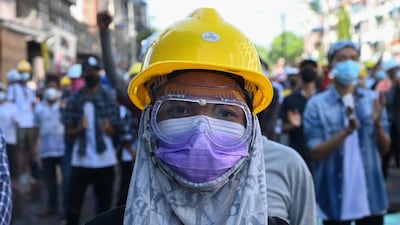
A protester wearing basic protective gear looks on during a demonstration against the military coup in Yangon. AFP


His coup on February 1 halted Myanmar's tentative steps towards democracy, after nearly 50 years of military rule, and has drawn condemnation and sanctions from the US and other Western countries, and growing concern among its neighbours.
Ms Suu Kyi, 75, appeared at a court hearing via video-conferencing on Monday and looked in good health, one of her lawyers said. Two more charges were added to those filed against her after the coup, she said.
The Nobel Peace laureate has not been seen in public since her government was toppled and she was detained along with other party leaders.
Hundreds of people have been arrested since the coup, according to activists, the latest a journalist for the Democratic Voice of Burma, who live-streamed security forces outside his apartment on Monday in the coastal town of Myeik, where he had been filming protests. DVB confirmed the arrest.

