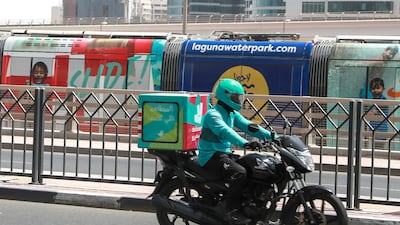
As a heatwave engulfed northern and central Vietnam this month, customers reaching for their phones to order food or a ride on the Grab app learnt they would have to pay a surcharge.
The extra fee, applied when the temperature hits 35°C, came months after the South-East Asian platform introduced a rainy-weather fee in Vietnam.
"Working under such bad weather conditions can be tough on our drivers and delivery partners. We want to ensure they are fairly compensated for it," a Grab representative told the Thomson Reuters Foundation.
In Hanoi and Ho Chi Minh City, the surcharge is 5,000 Vietnamese dong ($0.21) for Grab's motorcycle taxi, and food and grocery deliveries, and 3,000 dong for its quick delivery service.
Nguyen Tuan, a Grab driver in Ho Chi Minh City, said the additional payment gave him and his colleagues an incentive, because they had to work regardless of weather conditions.
"If I don't work, where do I get money to eat? I make a living day by day," said Mr Tuan, who works for several hours a day as a food delivery and motorcycle-taxi driver.
App companies offering delivery and ride-hailing services have come under increased scrutiny for their planet-heating emissions linked to traffic congestion and packaging.
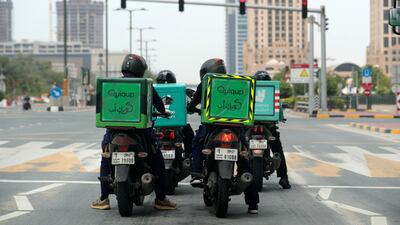
But there has been little discussion of how riders and drivers are dealing with extreme weather, as they often work long hours, waiting at street corners and outside restaurants for orders, and have limited access to medical care.
Only now is the issue starting to grab the public's attention as climate change brings more frequent and intense heatwaves and floods around the world, raising questions about the health impacts for the must vulnerable in the labour force.
When it's too hot to walk
India, which is estimated to have more than 7.5 million gig workers, was hit by several heatwaves in April and May, with temperatures of 55°C to 50°C recorded in parts of the country.
In May, a series of tweets from Mumbai resident Parizad Baria-Unwalla went viral as she described finding out that her food order was delayed because the delivery worker was walking to her home from the restaurant.
"It is a summer afternoon in Mumbai and the restaurant was 4.5km away. This is absolutely inhumane," she wrote, as she appealed to the Swiggy platform to get him a taxi or an auto rickshaw, and offered to pay for the transport.
Dozens weighed in, with one user saying they stopped ordering from Swiggy after a delivery worker cycled at least 5km to their home at noon.
Swiggy did not respond to a request for comment.
"Gig workers in India have no protections because they are not recognised as workers, and hence don't fall under the occupational health and safety rules," said Rikta Krishnaswamy, a representative of the All India Gig Workers' Union.
While several app companies increase prices during rain, that is more due to heavy demand, she said. Few compannies make similar concessions in hot weather.
"The workers are not even allowed to go into restaurants to pick up orders or get a drink of water, or use the washroom to freshen up. Meanwhile, companies are pushing more of their workers to cycle as part of their ESG drive," she said.
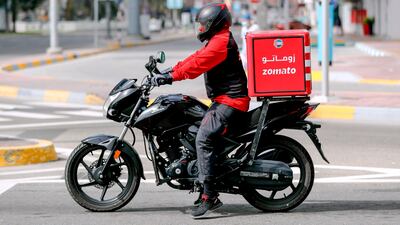
Zomato, another Indian platform, delivered nearly a fifth of its food orders by bicycle in the financial year to March 2022, according to its Environmental, Social and Governance report.
Zomato pays riders an extra fee for deliveries in the rain, and reduces the distance they have to travel, a company representative said.
During the recent heatwaves in India, the company set up refreshment centres in several cities for riders to rest between deliveries and get free cold drinks, the spokesperson added.
Rising risks
Demand for gig work has surged in recent years with the growth in e-commerce and the so-called "platformisation" of work, with advocates saying it offers both sides greater freedom and flexibility. The pandemic further boosted demand.
But critics say it exploits workers who have few other choices, and that it undercuts hard-won labour rights, with gig workers in poorer nations largely treated as casual labour.
Heat stress occurs at temperatures above 35°C in high humidity, according to the International Labour Organisation. Heatstroke can occur if body temperature rises above 40°C.
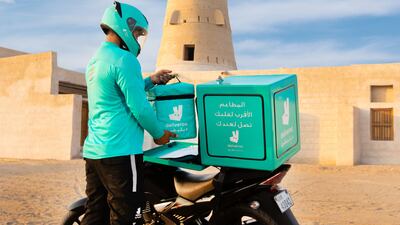
In the UAE, where summer temperatures can top 45°C, delivery workers take a mandatory break from 12.30pm to 3pm, between June 15 and September 15, introduced to protect labourers from the "risks of exposure to high temperatures".
Where labourers have to work during these hours, employers must provide cold drinking water, first-aid kits, cooling facilities and shaded rest areas.
Similarly in India, while several states have adopted heat action plans that recommend minimal outdoor activity during the hottest hours of the day, this is not an option for gig workers.
Exposure to extreme heat can have adverse health impacts, and also carries an increased risk of injury or lapses in concentration, said Jaya Dhindaw, programme director for urban development, planning and resilience at WRI India, a think-tank.
"Platform workers will be especially susceptible to this," she said. "However, strategies like a hot-weather surcharge should not be used as a way to exploit workers and drive them to deliver under dangerous or unsafe circumstances."
Meanwhile, in Vietnam, on a public Facebook group of Grab drivers in Ho Chi Minh City, with more than 51,000 members, there were dozens of comments on the heatwave surcharge.
In one post that has garnered more than 300 likes and more than 100 comments, a member said that of the additional fee of 5,000 Vietnamese dong, drivers only get 3,600 dong, while Grab gets the rest for "sitting around doing nothing".
Tan Giang, a Grab user in southern Vietnam, said he would be happy to pay the surcharge if it benefited drivers 100 per cent.
"As a customer I support that because it is their sweat and tears," he said.
ANDROID%20VERSION%20NAMES%2C%20IN%20ORDER
%3Cp%3EAndroid%20Alpha%3C%2Fp%3E%0A%3Cp%3EAndroid%20Beta%3C%2Fp%3E%0A%3Cp%3EAndroid%20Cupcake%3C%2Fp%3E%0A%3Cp%3EAndroid%20Donut%3C%2Fp%3E%0A%3Cp%3EAndroid%20Eclair%3C%2Fp%3E%0A%3Cp%3EAndroid%20Froyo%3C%2Fp%3E%0A%3Cp%3EAndroid%20Gingerbread%3C%2Fp%3E%0A%3Cp%3EAndroid%20Honeycomb%3C%2Fp%3E%0A%3Cp%3EAndroid%20Ice%20Cream%20Sandwich%3C%2Fp%3E%0A%3Cp%3EAndroid%20Jelly%20Bean%3C%2Fp%3E%0A%3Cp%3EAndroid%20KitKat%3C%2Fp%3E%0A%3Cp%3EAndroid%20Lollipop%3C%2Fp%3E%0A%3Cp%3EAndroid%20Marshmallow%3C%2Fp%3E%0A%3Cp%3EAndroid%20Nougat%3C%2Fp%3E%0A%3Cp%3EAndroid%20Oreo%3C%2Fp%3E%0A%3Cp%3EAndroid%20Pie%3C%2Fp%3E%0A%3Cp%3EAndroid%2010%20(Quince%20Tart*)%3C%2Fp%3E%0A%3Cp%3EAndroid%2011%20(Red%20Velvet%20Cake*)%3C%2Fp%3E%0A%3Cp%3EAndroid%2012%20(Snow%20Cone*)%3C%2Fp%3E%0A%3Cp%3EAndroid%2013%20(Tiramisu*)%3C%2Fp%3E%0A%3Cp%3EAndroid%2014%20(Upside%20Down%20Cake*)%3C%2Fp%3E%0A%3Cp%3EAndroid%2015%20(Vanilla%20Ice%20Cream*)%3C%2Fp%3E%0A%3Cp%3E%3Cem%3E*%20internal%20codenames%3C%2Fem%3E%3C%2Fp%3E%0A
How the UAE gratuity payment is calculated now
Employees leaving an organisation are entitled to an end-of-service gratuity after completing at least one year of service.
The tenure is calculated on the number of days worked and does not include lengthy leave periods, such as a sabbatical. If you have worked for a company between one and five years, you are paid 21 days of pay based on your final basic salary. After five years, however, you are entitled to 30 days of pay. The total lump sum you receive is based on the duration of your employment.
1. For those who have worked between one and five years, on a basic salary of Dh10,000 (calculation based on 30 days):
a. Dh10,000 ÷ 30 = Dh333.33. Your daily wage is Dh333.33
b. Dh333.33 x 21 = Dh7,000. So 21 days salary equates to Dh7,000 in gratuity entitlement for each year of service. Multiply this figure for every year of service up to five years.
2. For those who have worked more than five years
c. 333.33 x 30 = Dh10,000. So 30 days’ salary is Dh10,000 in gratuity entitlement for each year of service.
Note: The maximum figure cannot exceed two years total salary figure.
The specs
Engine: 3.8-litre twin-turbo flat-six
Power: 650hp at 6,750rpm
Torque: 800Nm from 2,500-4,000rpm
Transmission: 8-speed dual-clutch auto
Fuel consumption: 11.12L/100km
Price: From Dh796,600
On sale: now
Mercer, the investment consulting arm of US services company Marsh & McLennan, expects its wealth division to at least double its assets under management (AUM) in the Middle East as wealth in the region continues to grow despite economic headwinds, a company official said.
Mercer Wealth, which globally has $160 billion in AUM, plans to boost its AUM in the region to $2-$3bn in the next 2-3 years from the present $1bn, said Yasir AbuShaban, a Dubai-based principal with Mercer Wealth.
“Within the next two to three years, we are looking at reaching $2 to $3 billion as a conservative estimate and we do see an opportunity to do so,” said Mr AbuShaban.
Mercer does not directly make investments, but allocates clients’ money they have discretion to, to professional asset managers. They also provide advice to clients.
“We have buying power. We can negotiate on their (client’s) behalf with asset managers to provide them lower fees than they otherwise would have to get on their own,” he added.
Mercer Wealth’s clients include sovereign wealth funds, family offices, and insurance companies among others.
From its office in Dubai, Mercer also looks after Africa, India and Turkey, where they also see opportunity for growth.
Wealth creation in Middle East and Africa (MEA) grew 8.5 per cent to $8.1 trillion last year from $7.5tn in 2015, higher than last year’s global average of 6 per cent and the second-highest growth in a region after Asia-Pacific which grew 9.9 per cent, according to consultancy Boston Consulting Group (BCG). In the region, where wealth grew just 1.9 per cent in 2015 compared with 2014, a pickup in oil prices has helped in wealth generation.
BCG is forecasting MEA wealth will rise to $12tn by 2021, growing at an annual average of 8 per cent.
Drivers of wealth generation in the region will be split evenly between new wealth creation and growth of performance of existing assets, according to BCG.
Another general trend in the region is clients’ looking for a comprehensive approach to investing, according to Mr AbuShaban.
“Institutional investors or some of the families are seeing a slowdown in the available capital they have to invest and in that sense they are looking at optimizing the way they manage their portfolios and making sure they are not investing haphazardly and different parts of their investment are working together,” said Mr AbuShaban.
Some clients also have a higher appetite for risk, given the low interest-rate environment that does not provide enough yield for some institutional investors. These clients are keen to invest in illiquid assets, such as private equity and infrastructure.
“What we have seen is a desire for higher returns in what has been a low-return environment specifically in various fixed income or bonds,” he said.
“In this environment, we have seen a de facto increase in the risk that clients are taking in things like illiquid investments, private equity investments, infrastructure and private debt, those kind of investments were higher illiquidity results in incrementally higher returns.”
The Abu Dhabi Investment Authority, one of the largest sovereign wealth funds, said in its 2016 report that has gradually increased its exposure in direct private equity and private credit transactions, mainly in Asian markets and especially in China and India. The authority’s private equity department focused on structured equities owing to “their defensive characteristics.”
The specs: 2018 Mercedes-Benz E 300 Cabriolet
Price, base / as tested: Dh275,250 / Dh328,465
Engine: 2.0-litre four-cylinder
Power: 245hp @ 5,500rpm
Torque: 370Nm @ 1,300rpm
Transmission: Nine-speed automatic
Fuel consumption, combined: 7.0L / 100km
So what is Spicy Chickenjoy?
Just as McDonald’s has the Big Mac, Jollibee has Spicy Chickenjoy – a piece of fried chicken that’s crispy and spicy on the outside and comes with a side of spaghetti, all covered in tomato sauce and topped with sausage slices and ground beef. It sounds like a recipe that a child would come up with, but perhaps that’s the point – a flavourbomb combination of cheap comfort foods. Chickenjoy is Jollibee’s best-selling product in every country in which it has a presence.
'How To Build A Boat'
Jonathan Gornall, Simon & Schuster
Museum of the Future in numbers
- 78 metres is the height of the museum
- 30,000 square metres is its total area
- 17,000 square metres is the length of the stainless steel facade
- 14 kilometres is the length of LED lights used on the facade
- 1,024 individual pieces make up the exterior
- 7 floors in all, with one for administrative offices
- 2,400 diagonally intersecting steel members frame the torus shape
- 100 species of trees and plants dot the gardens
- Dh145 is the price of a ticket
Diriyah%20project%20at%20a%20glance
%3Cp%3E-%20Diriyah%E2%80%99s%201.9km%20King%20Salman%20Boulevard%2C%20a%20Parisian%20Champs-Elysees-inspired%20avenue%2C%20is%20scheduled%20for%20completion%20in%202028%3Cbr%3E-%20The%20Royal%20Diriyah%20Opera%20House%20is%20expected%20to%20be%20completed%20in%20four%20years%3Cbr%3E-%20Diriyah%E2%80%99s%20first%20of%2042%20hotels%2C%20the%20Bab%20Samhan%20hotel%2C%20will%20open%20in%20the%20first%20quarter%20of%202024%3Cbr%3E-%20On%20completion%20in%202030%2C%20the%20Diriyah%20project%20is%20forecast%20to%20accommodate%20more%20than%20100%2C000%20people%3Cbr%3E-%20The%20%2463.2%20billion%20Diriyah%20project%20will%20contribute%20%247.2%20billion%20to%20the%20kingdom%E2%80%99s%20GDP%3Cbr%3E-%20It%20will%20create%20more%20than%20178%2C000%20jobs%20and%20aims%20to%20attract%20more%20than%2050%20million%20visits%20a%20year%3Cbr%3E-%20About%202%2C000%20people%20work%20for%20the%20Diriyah%20Company%2C%20with%20more%20than%2086%20per%20cent%20being%20Saudi%20citizens%3Cbr%3E%3C%2Fp%3E%0A
Name: Peter Dicce
Title: Assistant dean of students and director of athletics
Favourite sport: soccer
Favourite team: Bayern Munich
Favourite player: Franz Beckenbauer
Favourite activity in Abu Dhabi: scuba diving in the Northern Emirates
ARSENAL IN 1977
Feb 05 Arsenal 0-0 Sunderland
Feb 12 Manchester City 1-0 Arsenal
Feb 15 Middlesbrough 3-0 Arsenal
Feb 19 Arsenal 2-3 West Ham
Feb 26 Middlesbrough 4-1 Arsenal (FA Cup)
Mar 01 Everton 2-1 Arsenal
Mar 05 Arsenal 1-4 ipswich
March 08 Arsenal 1-2 West Brom
Mar 12 QPR 2-1 Arsenal
Mar 23 Stoke 1-1 Arsenal
Apr 02 Arsenal 3-0 Leicester
Key changes
Commission caps
For life insurance products with a savings component, Peter Hodgins of Clyde & Co said different caps apply to the saving and protection elements:
• For the saving component, a cap of 4.5 per cent of the annualised premium per year (which may not exceed 90 per cent of the annualised premium over the policy term).
• On the protection component, there is a cap of 10 per cent of the annualised premium per year (which may not exceed 160 per cent of the annualised premium over the policy term).
• Indemnity commission, the amount of commission that can be advanced to a product salesperson, can be 50 per cent of the annualised premium for the first year or 50 per cent of the total commissions on the policy calculated.
• The remaining commission after deduction of the indemnity commission is paid equally over the premium payment term.
• For pure protection products, which only offer a life insurance component, the maximum commission will be 10 per cent of the annualised premium multiplied by the length of the policy in years.
Disclosure
Customers must now be provided with a full illustration of the product they are buying to ensure they understand the potential returns on savings products as well as the effects of any charges. There is also a “free-look” period of 30 days, where insurers must provide a full refund if the buyer wishes to cancel the policy.
“The illustration should provide for at least two scenarios to illustrate the performance of the product,” said Mr Hodgins. “All illustrations are required to be signed by the customer.”
Another illustration must outline surrender charges to ensure they understand the costs of exiting a fixed-term product early.
Illustrations must also be kept updatedand insurers must provide information on the top five investment funds available annually, including at least five years' performance data.
“This may be segregated based on the risk appetite of the customer (in which case, the top five funds for each segment must be provided),” said Mr Hodgins.
Product providers must also disclose the ratio of protection benefit to savings benefits. If a protection benefit ratio is less than 10 per cent "the product must carry a warning stating that it has limited or no protection benefit" Mr Hodgins added.
Who's who in Yemen conflict
Houthis: Iran-backed rebels who occupy Sanaa and run unrecognised government
Yemeni government: Exiled government in Aden led by eight-member Presidential Leadership Council
Southern Transitional Council: Faction in Yemeni government that seeks autonomy for the south
Habrish 'rebels': Tribal-backed forces feuding with STC over control of oil in government territory