


The government in India's Karnataka state has banned clothing showing religious affiliation from minority educational institutions amid tensions over female Muslim pupils being barred from wearing the hijab to class by some schools and colleges.
The order issued late on Thursday by the Minority Welfare, Hajj and Wakf Department follows a temporary ban on all “religious clothes” in classrooms that was imposed by the Karnataka High Court last week while it hears petitions challenging the ban on the Muslim headscarf.
“We restrain all the students regardless of their religion or faith from wearing saffron shawl, scarves, hijab or any other religious flags in the classrooms until further orders,” the department circular said.
The order extends the ban on religious dress to education institutions catering to minority groups, which enjoy special rights under the constitution in the Hindu-majority country and were exempt from the high court ban.
-
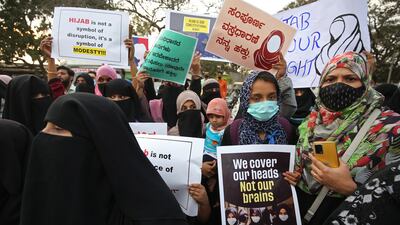
Muslim women wearing the hijab protest in Bangalore after students in the southern Indian state of Karnataka were barred from entering colleges wearing the traditional headscarves. EPA -
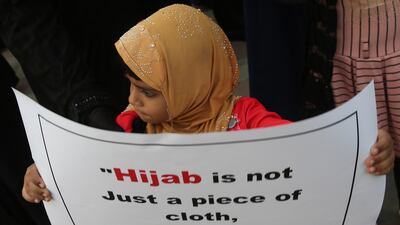
A girl with a placard reading 'Hijab is not just a piece of cloth, it's our dignity'. EPA -
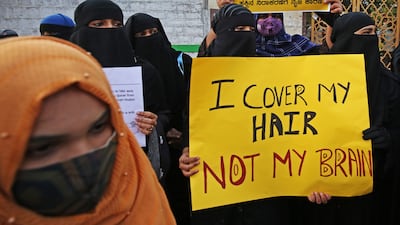
Dozens of women have been protesting for weeks in a dispute that started when a college said students wearing the hijab were breaking dress policy. EPA -
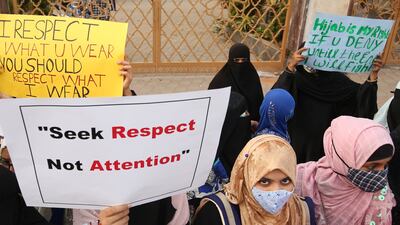
Hijab bans and demonstrations against them have since spread to other institutions in India. EPA -
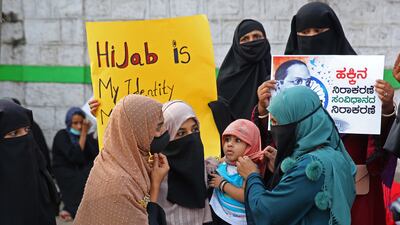
The women have received the backing of several organisations, while the colleges' stance has won the support of the state's ruling Bharatiya Janata Party. EPA -
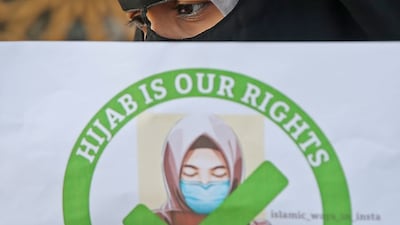
An Indian Muslim woman attends one of the protests in Bangalore. EPA -
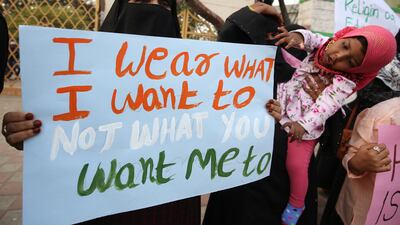
The colleges' ruling is being challenged in court by women who say the right to wear the headscarf is guaranteed under India's secular constitution. EPA -
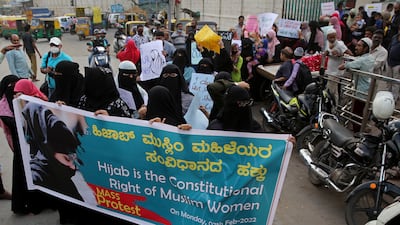
A banner makes the case for the constitutional right to wear the hijab. EPA -
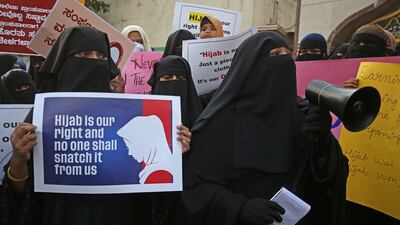
Protests have been held for more than a month, since the first action was taken against six students in late December. EPA -
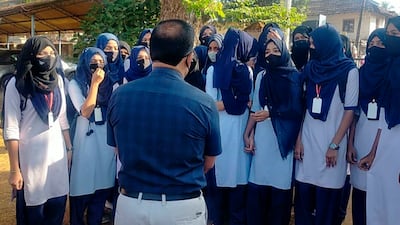
Hijab-wearing students speak to their principal outside a college campus in Udupi. AP -
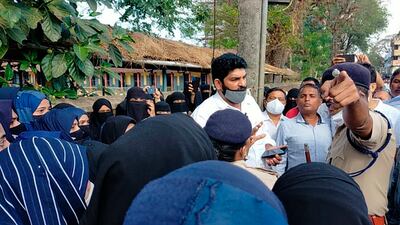
Parents argue with a police official during a protest outside a college in Udupi. AP


The controversy was triggered in December when some state-run education institutions in Karnataka's Udupi district began denying entry to students wearing the hijab, arguing that it violated their dress code.
The move triggered protests in the state that have since spread across the ethnically and religiously diverse country, both by supporters of the Muslim students as well as by Hindu students wearing saffron scarves — a colour associated with right-wing Hindu groups.
The Karnataka government closed schools and colleges over fears of violence for three days last week but the high court ordered them to reopen after issuing its ban on religious clothing.
Pupils and staff wearing the hijab were denied entry when schools reopened on Monday. Some teachers were asked to remove their headscarves and burkas.
The high court is hearing a petition filed by a group of Muslim students who say rules against wearing the hijab violate their rights under India’s secular constitution.
Lawyers representing the students have also criticised the court's temporary ban as a “suspension of fundamental rights”.
One of the lawyers, Vinod Kulkarni, told the court on Thursday that the issue was “creating hysteria” and affecting the mental health of Muslim girls.
He asked the court to pass an interim order to let Muslim students wear the hijab at least on Fridays, the most auspicious day for Muslims, and during Ramadan.
Another lawyer suggested mediation between the petitioners and the state government to resolve the issue but the court rejected the proposal since the case pertained to constitutional rights.
The Karnataka government, led by Prime Minister Narendra Modi's Hindu nationalist Bharatiya Janata Party, has expressed support for banning hijabs in classrooms.
The stance has been criticised by opposition parties, other countries including the US, and by the Organisation of Islamic Co-operation.

