
Denis Mukwege, the Congolese doctor who shared the 2018 Nobel Peace Prize with Yazidi activist Nadia Murad, has been described as "the world's leading expert on repairing injuries of rape" and is known to grateful patients as "Doctor Miracle" for his work in his homeland.
The 63-year-old gynaecologist has spent more than 20 years working with women who have been the victims of sexual abuse and rape during conflicts in the Democratic Republic of Congo, where he founded the Panzi hospital in Bukavu in 1999.
The 450-bed hospital has treated more than 85,000 women since it opened, performing reconstructive surgery and offering free consultations.
_______________
Read more:
Denis Mukwege and Nadia Murad win Nobel Peace Prize
Who is the Nobel Peace Prize 2018 winner Nadia Murad?
Nobel Peace Prize 2018: who was in contention to win the award?
_______________
Born in Bukavu in 1955, Mr Mukwege initially studied medicine in Burundi and practised as a paediatrician in a rural hospital in Lemera near his hometown. However, he was moved to study gynaecology after seeing the plight of women who suffered from post-partum injuries.
After training at the university of Angers in France, he returned to Lemera where he first became aware of the use of sexual violence against women after the First Congo War between 1996-97.
Mr Mukwege described how in 1999 he encountered a woman who had been horrifically injured after soldiers inserted a gun into her genitals and fired.
“Her whole pelvis was destroyed. I thought it was the work of a madman, but the same year I treated 45 similar cases,” he said.
“For 15 years I have witnessed mass atrocities committed against women’s bodies and I cannot remain with my arms folded because our common humanity calls on us to care for each other.”
His crusading work has seen him honoured on many occasions, receiving the Olof Palme Prize in 2009, the Sakharov Prize five years later, and the Seoul Peace Prize in 2016. He has been nominated for the Nobel award on numerous previous occasions.
He has also been recognised by the United Nations, which he addressed in 2012, criticising the Congolese government and neighbouring countries for pursuing “an unjust war that has used violence against women and rape as a strategy of war.”
Mr Mukwege has also drawn unwelcome attention for his work, surviving an assassination attempt in October 2012 which saw his daughters held hostage and his guard killed. The Panzi hospital is now under the permanent protection of UN peacekeepers.
He remains a fierce advocate for woman who have been victims of sexual abuse during war. “We have been able to draw a red line against chemical weapons, biological weapons and nuclear arms,” he said in 2016.
“Today we must also draw a red line against rape as a weapon of war," he said, adding that it is a "cheap and efficient” way to terrorise communities and leaves its victims suffering from "a life sentence”.
There is growing evidence, according to Mr Mukwege, that “unbearable atrocities” are increasingly being committed in eastern Congo’s east. “Crimes and cruelties that have plagued [us] for 20 years have been reborn with a new intensity,” he warned.
In pictures: recent Nobel Peace laureates:
-
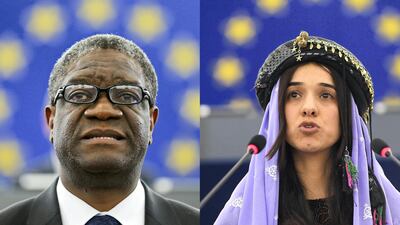
Congolese gynecologist Denis Mukwege, left, and Nadia Murad Basee Taha is a Yazidi human rights activist from Iraq, have been named as the winners of the Nobel Peace Prize 2018. Photos: Reuters and AFP -
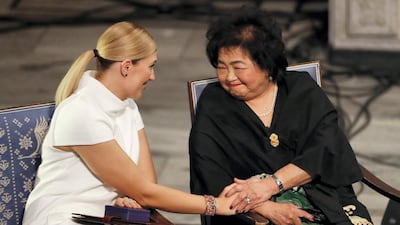
Hiroshima nuclear bombing survivor Setsuko Thurlow (R) touches the hand of Beatrice Fihn, leader of the International Campaign to Abolish Nuclear Weapons during the award ceremony of the 2017 Nobel Peace Prize. Odd Andersen / AFP -
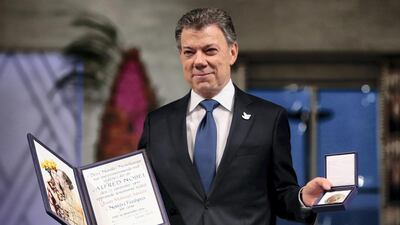
Nobel Peace Prize laureate Colombian President Juan Manuel Santos poses with the medal and diploma during the award ceremony of the Nobel Peace Prize for 2016. Haakon Mosvold Larsen / AFP -
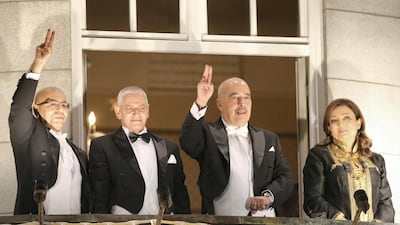
2015 Nobel Peace Prize laureates of the Tunisian National Dialogue Quartet, left to right: President of the National Order of Tunisian Lawyers Fadhel Mahfoudh, the Secretary General of the Tunisian General Labour Union Houcine Abbassi, the Tunisian Human Rights League (LTDH) Abdessatar Ben Moussa and the President of the Tunisian employers union (UTICA) Wided Bouchamaoui. Audun Braastad / AFP -
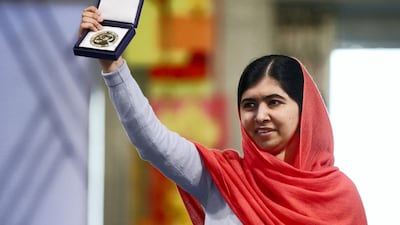
2014 Nobel Peace Prize laureate Malala Yousafzai displays her medal during the Nobel Peace Prize awards ceremony at the City Hall in Oslo. Cornelius Poppe / AFP -
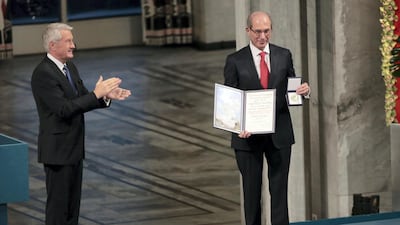
Ahmet Uzumcu, Director General of the Organisation for the Prohibiton of Chemical Weapons (OPCW), receives the 2013 Peace Nobel Prize. AFP -
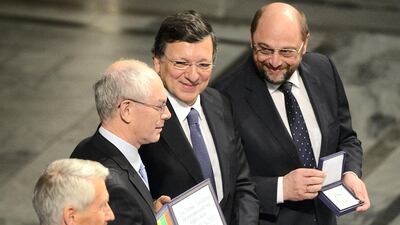
The European Union won in 2012. John Macdougall / AFP -
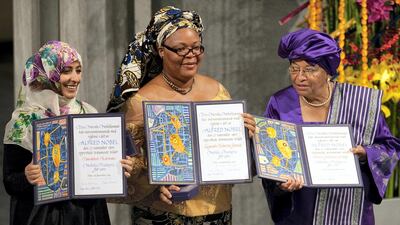
The 2011 Nobel Peace Prize laureates, Liberian President Ellen Johnson Sirleaf, right, Liberian peace activist Leymah Gbowee, centrem and Yemeni activist Tawakkol Karman. Odd Andersen / AFP -
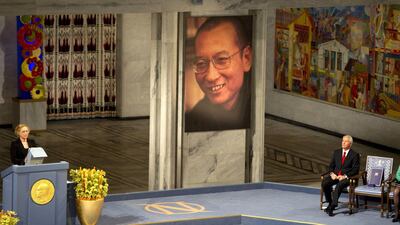
Norwegian actress Liv Ullmann reads Liu Xiaobo's text "I have no enemies" next to the The Nobel Peace Prize committee Chairman Thorbjoern Jagland. Li won in 2010 for his long struggle for human rights in China Odd Andersen / AFP -
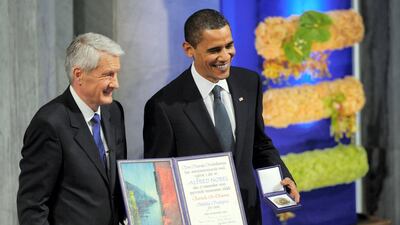
US President Barack Obama won in 2009 for his efforts to strengthen international diplomacy and co-operation. Jewel Samad / AFP



