

Sudan’s government has launched a nationwide campaign to help the country’s poor majority, granting families a monthly stipend of $5 to help them secure some of their basic needs.
Economic conditions have worsened sharply since the start of the year, with the country experiencing hyperinflation and shortages of basic goods like bread and fuel.
The $400-million program, launched this week in four of Sudan's 18 provinces, is bankrolled by bilateral donors, with the European Union and its member states providing most of the money. It is meant to reach 80 per cent of Sudan's 40-plus million people.
The program was launched on Thursday by Prime Minister Abdalla Hamdok in the southern Khartoum district of Al Kalaklah. Its commencement came four days after Sudan devalued its currency by 85 per cent as part of an ambitious overhaul of the economy, which has been battered by three decades of mismanagement and corruption.
For many Sudanese, this is the enduring legacy of the 29-year rule of now-ousted president Omar Al Bashir.
To poor families, experts say, the monthly payment of $5, or 1,875 pounds, is a welcome, although not a hugely significant addition to their meager incomes.
“The needs of a poor family are limited,” said Mohammed Shenedy, a government employee. “For a family like mine, we can get by with roughly 1,000 pounds a day. So, the $5 can carry us for two days.”
But not everyone agrees that $5 can make a difference.
“We are still waiting for the government to give real support to poor families,” said Salma Al Fakky, also a government employee. “Those five dollars are nothing. They can barely cover one breakfast for my family.”
Mr Hamdok’s government has not marketed the $5 monthly payment as a solution to the woeful economic hardship endured by most Sudanese, but rather as a symbolic addition to the incomes of the most vulnerable.
“The idea is not helping the poor but to add to their incomes so that they can better cope with the changes brought about by economic reforms,” said Sulaima Ishaq, a prominent women’s rights activist.
“You are tempted to think five dollars is a tiny amount of money, but the new exchange rate following the devaluation makes it a significant sum.”
The importance of the $5 maybe be heightened due to ongoing subsidies for food: a single loaf of subsidised bread sells for 5 pounds apiece in Sudan, less than one cent in dollars.
However, many buy their bread on the free market because of the long lines outside bakeries and shortages, paying 20-25 pounds per loaf. A kilogram of subsidised sugar sells for 280 pounds, but fetches 360 on the free market, closer to $1.
A cylinder of cooking gas is sold for 450 pounds at state-run warehouses, but chronic shortages also mean that many Sudanese secure it on the free market, paying 2,000-2,500, more than $5.
These sums quickly add up for a struggling family, but at least in terms of essentials like bread, the $5 cash handout will have an impact.
The $5 program comes at a time when many in Sudan fear that the February 21 devaluation would send prices soaring, further fueling inflation and upping the price of daily essentials.
The post-devaluation exchange rate has hovered around 375-380 pounds to the dollar, up from an official rate of 55 pounds before the devaluation.
“It is to some extent a positive step, but it is too soon to authoritatively speak about its impact,” said economic analyst Mohammed Saad. “We may have to wait months to be able to accurately gauge its impact.”
Since the devaluation, Khartoum residents have spoken of the near complete disappearance of the thriving dollar black market, where tens of millions of the US currency had changed hands every day through a network that extended from the streets of the capital to the Gulf region. A large number of Sudanese expatriates live and work in Gulf States and regularly send money home to their families.
Activists have meanwhile launched a social media campaign to encourage Sudanese to change their dollars at banks. Concurrently, authorities have ordered banks to extend their working hours to absorb a dramatic surge in the number of clients changing their dollars there.
“It’s going to be a tough fight,” said banking expert Omar Sidahmed, referring to the competition between banks and the black market. “It is a fast and capable (black) market that operates with a massive network.”
Except for a brief reprieve fueled by oil revenues in the 2000s, Sudan’s post-independence economy has often been mired in crisis. Seemingly endless strife in the south and west of the country has denied the country any realistic chance of getting the economy firmly on its feet.

When the mostly animist and Christian south seceded in 2011, the country lost the majority of its oil wealth and plunged into its worst economic crisis in living memory.
Now, the country is gripped by the coronavirus pandemic, the impact of which has meant higher prices, more unemployment and falling exports, according to a World Bank report. The target of GDP growth this year is only 1 per cent, according to the report.
But there’s a glimmer of hope.
A quarter of the 2021 budget, or nearly 260 billion pounds, will go to social support programs, while 54 billion will be spent on the implementation of a peace deal signed last October with a number of rebel groups in the west and south of the country. Another 137 billion pounds has been set aside for education, roughly the same as the defence budget.
__________________
Gallery: Sudan rejoins the international community
-
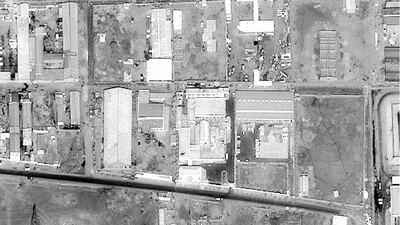
This satellite image released by the US Department of Defence on August 20 shows the Shifa Pharmaceutical Plant in Khartoum, Sudan, which the Pentagon says was producing components for making chemical weapons before the August 20 attack by US cruise missiles. AFP -

Ruins of Shifa pharmaceutical plant, alleged chemical weapons manufacturing facility said bankrolled by Osama bin Laden, cruise missile target in retaliatory US air strikes after terror bombings of US embassies in Africa. Getty Images -
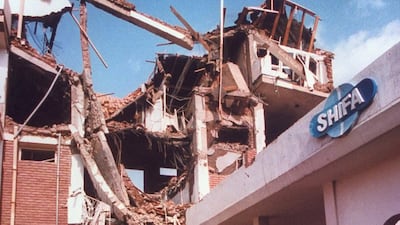
Ruins of Shifa pharmaceutical plant, alleged chemical weapons manufacturing facility said bankrolled by Islamic terrorist financer Osama bin Laden, cruise missile target in retaliatory US air strikes after terror bombings of US embassies in Africa. Getty Images -

Sudanese President Omar al-Bashir points at the remains of a US cruise missile which hit the al-Shifa pharmaceutical plant one year ago 20 August 1999 in Khartoum. Bashir and several Sudanese officials attended a ceremony at the remains of the factory to mark the anniversary of the US missile strike. AFP -
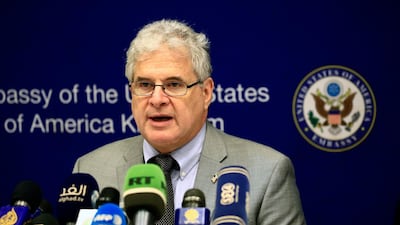
Top US envoy in Khartoum, Charge D'affaires Steven Koutsis, speaks during a press conference at the US embassy on October 7, 2017, a day after Washington lifted its 20-year-old trade embargo imposed on Sudan over alleged support to violent Islamist groups. The US decision came after months of diplomatic talks between the two countries that began during the tenure of former US president Barack Obama. AFP -
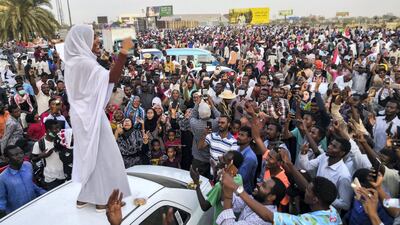
Alaa Salah, a Sudanese woman propelled to internet fame earlier this week after clips went viral of her leading powerful protest chants against President Omar al-Bashir, addresses protesters during a demonstration in front of the military headquarters in the capital Khartoum on April 10, 2019. AFP -
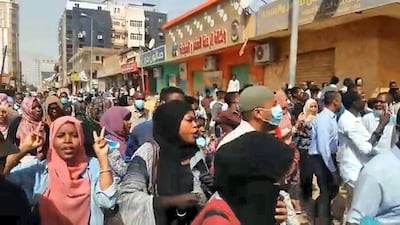
An image grab taken from AFP TV on January 17, 2019, shows people chanting and shouting during a protest calling for the resignation of the Sudanese President in the capital Khartoum. Sudanese police fired tear gas at hundreds of protesters marching towards the presidential palace demanding President Omar al-Bashir's resignation. AFP -
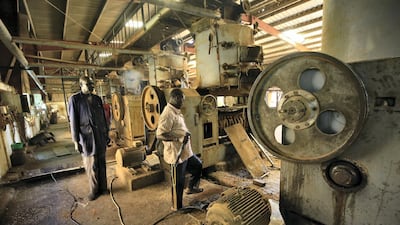
Workers operate machinery at Teital Oil Mills in the Sudanese capital Khartoum on November 24, 2019. A year after the start of a protest movement that led to the fall of dictator Omar al-Bashir, Sudan is looking for a fresh start despite a stagnant economy. The United States in 1997 imposed a trade embargo on Sudan for hosting Al-Qaeda leader Osama bin Laden between 1992 and 1996, affecting not only international banking but also technology and trade in spare parts. While the embargo was lifted in 2017, business owners are still unable to invest in their facilities as the country is not part of the global banking system and they are unable to make international money transfers. AFP -

Sarah al-Fateh, General Manager at Teital Oil Mills, walks at the facility in the Sudanese capital Khartoum on November 24, 2019. A year after the start of a protest movement that led to the fall of dictator Omar al-Bashir, Sudan is looking for a fresh start despite a stagnant economy. The United States in 1997 imposed a trade embargo on Sudan for hosting Al-Qaeda leader Osama bin Laden between 1992 and 1996, affecting not only international banking but also technology and trade in spare parts. While the embargo was lifted in 2017, business owners are still unable to invest in their facilities as the country is not part of the global banking system and they are unable to make international money transfers. AFP -
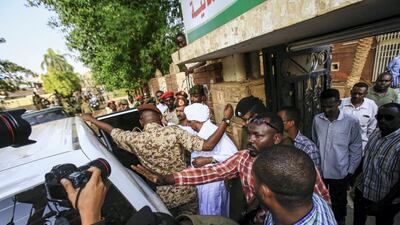
Sudan's ousted president Omar al-Bashir is escorted into a vehicle as he returns to prison following his appearance before prosecutors over charges of corruption and illegal possession of foreign currency, in the capital Khartoum on June 16, 2019. Bashir was On June 16 seen in public for the first time since being ousted, as he was driven to the prosecutor's office. The former strongman, who ruled his northeast African nation with an iron fist for three decades, was toppled on April 11 after weeks of protests against his reign. AFP -
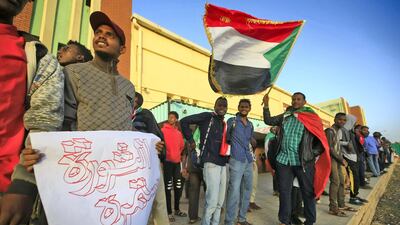
Sudanese protesters wait at a train station in Khartoum to board a train to Atbara on December 19, 2019 to celebrate the one-year anniversary of their protest movement that brought down Omar al-Bashir last April after a thirty-year rule. A year after demonstrations broke out in Sudan over soaring bread prices, celebrations are planned across the country to mark the uprising that brought down veteran autocrat Bashir. AFP



