

Former Rwandan army colonel Theoneste Bagosora who was accused of masterminding the slaughter of 800,000 people during the 1994 genocide has died in prison in Mali, officials there said on Saturday.
“It is confirmed. He was over 80 years old, he was seriously ill, with heart troubles. He was hospitalised several times and had three surgeries. He died today in a clinic,” a source in Mali's prison administration, speaking anonymously, told Reuters.
A second source at Bamako's Court of Appeal confirmed the death.
Bagosora was serving a 35-year sentence after being found guilty of crimes against humanity by the International Criminal Tribunal for Rwanda.
His sentence had been reduced from life in prison.
Prosecutors accused Bagosora, then cabinet director in the defence ministry, of taking control of military and political affairs in the central African country after the president, Juvenal Habyarimana, was killed when his plane was shot down in 1994.
The Tanzania-based tribunal accused Bagosora of being in charge of the troops and Interahamwe Hutu militia who killed about 800,000 minority Tutsis and moderate Hutus in 100 days.
Canadian general Romeo Dallaire, head of UN peacekeepers during the genocide, described Bagosora as the “kingpin” behind the killings and said the former colonel had threatened to kill him.
-

-
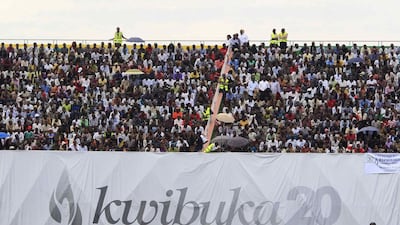
People follow the proceedings of the 20th anniversary commemoration of the Rwandan genocide, in Kigali April 7, 2014. An estimated 800,000 people were killed in 100 days during the genocide. Noor Khamis / Reuters -
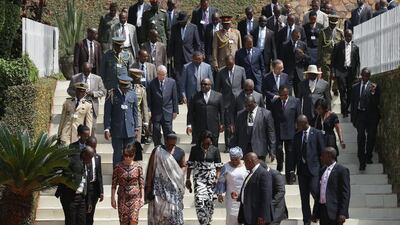
Global leaders, past and present, arrive for a commemoration ceremony at the Kigali Genocide Memorial Centre on April 7, 2014 in Kigali, Rwanda. Chip Somodevilla / Getty -
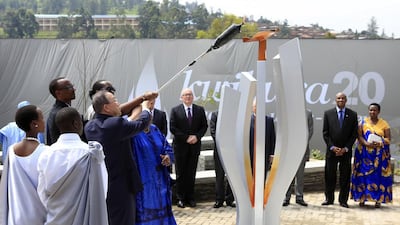
United Nations Secretary General Ban Ki-moon and Rwandan President Paul Kagame light a symbolic flame in Kigali April 7, 2014. . Noor Khamis / Reuters -
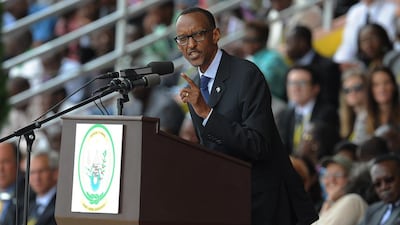
Rwandan President Paul Kagame took a thinly-veiled swipe at France on April 7, saying it was impossible to “change the facts” about the genocide 20 years ago. The anniversary has been marked by reminders of festering anger with a major diplomatic row breaking out over renewed allegations of French complicity in the genocide. Simon Maina / AFP -
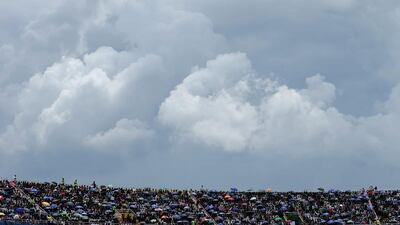
Thousands of people gathered at Amahoro Stadium to commemorate the anniversary. Chip Somodevilla / Getty -
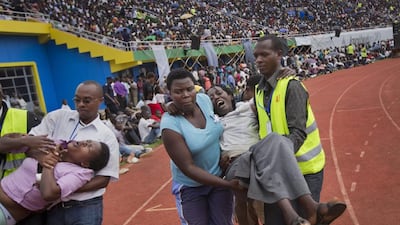
Two wailing and distraught Rwandan women, some of the dozens overcome by grief at recalling the horror of the genocide, are carried away to receive help during a public ceremony on Monday, April 7, 2014. Ben Curtis / AP -

Performers enter Amahoro Stadium during the commemoration of the genocide. Chip Somodevilla / Getty


Earlier this year, French President Emmanuel Macron said that he recognised his country's heavy responsibility for the 1994 genocide in Rwanda.
In a speech during a visit to the African country, Mr Macron detailed how France had failed the 800,000 victims but did not give an apology.
France “was not an accomplice” in the killings but ended up siding with Rwanda's “genocidal regime” and bore an “overwhelming responsibility” in the run-up to the massacres, he said at the genocide memorial in the capital, Kigali.

