


A pivotal month for the study of Mars will culminate with the arrival of Nasa’s Perseverance rover on Thursday, beginning a period of discovery that aims to pave the way for future human exploration of the Red Planet.
Perseverance was the third mission to reach Mars in a matter of weeks, after the UAE's history-making Hope and China's Tianwen-1 orbiters, and together the interplanetary voyagers will provide scientists with the clearest picture yet of our mysterious celestial neighbour.
But what are each mission's aims? And what does it mean for the future of space exploration?
At three metres long and weighing 1,250 kilograms, the Perseverance rover is the largest robotic explorer yet sent to Mars. Its size means it can carry a scientific payload more than 50 per cent larger than previous rovers, including a record 25 cameras and microphones, a drill and even a drone helicopter.
Perseverance is also the first rover designed specifically to seek evidence of ancient microbial life. After a dangerous landing on Mars' Jezero Crater, an ancient lake likely to contain any such evidence, the rover will continue to explore the planet's surface for at least two Earth years.
With Nasa targeting a crewed mission to Mars in the 2030s, Perseverance will also test technologies that could one day be used to help human beings explore or even colonise the planet.
The rover will use its sensors to monitor environmental conditions so that scientists can better understand how to protect future human explorers, as well as test technologies for creating oxygen on Mars.
The Mars Oxygen In-Situ Resource Utilisation Experiment, or Moxie, is intended to show how carbon dioxide in the Martian atmosphere can be converted into oxygen that could be used for breathing or fuel by future explorers.
If all goes to plan, Nasa’s robotic explorer will be sharing the planet with its Curiosity rover that landed in 2012 and the InSight lander, which arrived in 2018.
To date, only Nasa has landed craft on and explored Mars.
That will change with China's Tianwen-1 rover, which is due to touch down in the southern part of Mars’s Utopia Planitia in May, close to where Nasa’s Viking 2 mission landed in 1976.
One of the rover’s priorities is to use a radar that will try to detect pockets of water beneath the surface, which may contain life.
Orbiting high above the Martian surface, the UAE’s Hope probe and its suite of sensors will carry out its mission over two Earth years to analyse changes in the atmosphere across the entire planet.

The Arab world's first interplanetary mission will also study the presence of oxygen and hydrogen in the atmosphere, and could help scientists to better understand why those elements are lost to space.
Alongside the Hope probe, other orbiters from the US, Europe and India are aloft over Mars, helping to transmit data over tens of millions of kilometres back to Earth.
To facilitate this busy period of exploration, Nasa's Jet Propulsion Laboratory is preparing what it called a "tightly choreographed dance" by its Martian satellites to maintain vital data links back to Earth throughout the Perseverance landing.
"It is a huge endeavour to maintain communications with our spacecraft throughout the solar system, but Mars surface missions take this commitment to another level," said Bradford Arnold, project manager of Nasa's venerable Deep Space Network.
The choreography will allow viewers on Earth to watch the Perseverance's entry and landing. Although it is by now a well-practised procedure, it is highly complicated.
"While the choreography of this relay scheme is now somewhat commonplace, it is still extremely challenging to co-ordinate all the communication links for the very brief time during a lander's arrival," Mr Arnold said.
-
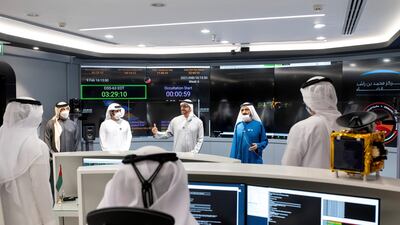
Sheikh Mohammed bin Rashid, Vice President and Ruler of Dubai, and Sheikh Mohamed bin Zayed, Crown Prince of Abu Dhabi and Deputy Supreme Commander of the Armed Forces, meet the Hope Probe team, after its successful entry into the orbit of Mars, at Mohammed Bin Rashid Space Centre. Seen with Sheikh Hamdan bin Mohammed, Crown Prince of Dubai, and Sheikh Mansour bin Zayed, Deputy Prime Minister and Minister of Presidential Affairs. Mohamed Al Hammadi / Ministry of Presidential Affairs -
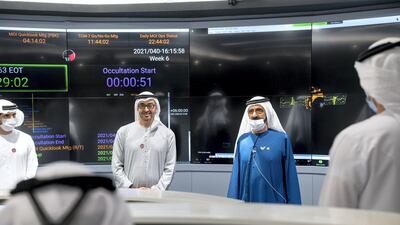
Sheikh Mohammed bin Rashid, Vice President and Ruler of Dubai, and Sheikh Mohamed bin Zayed, Crown Prince of Abu Dhabi and Deputy Supreme Commander of the Armed Forces, meet the Hope Probe team. Mohamed Al Hammadi / Ministry of Presidential Affairs -
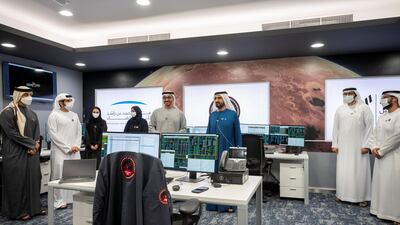
Sheikh Mohammed bin Rashid, Vice President and Ruler of Dubai, and Sheikh Mohamed bin Zayed, Crown Prince of Abu Dhabi and Deputy Supreme Commander of the Armed Forces, at Mohammed Bin Rashid Space Centre. Also there are Sheikh Hamdan bin Mohammed, Crown Prince of Dubai, and Sheikh Mansour bin Zayed, Deputy Prime Minister and Minister of Presidential Affairs. Rashid Al Mansoori / Ministry of Presidential Affairs -

Sheikh Saif bin Zayed, Deputy Prime Minister and Minister of Interior, Sheikh Mansour bin Zayed, Deputy Prime Minister and Minister of Presidential Affairs, and Mohammed Abdulla Al Gergawi, Minister of Cabinet Affairs, at Mohammed Bin Rashid Space Centre. Mohamed Al Hammadi / Ministry of Presidential Affairs -
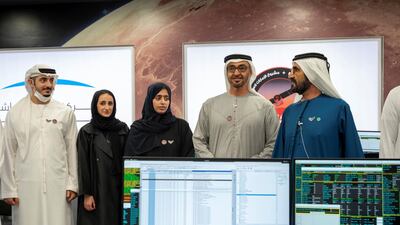
Sheikh Mohammed bin Rashid, Vice President and Ruler of Dubai, and Sheikh Mohamed bin Zayed, Crown Prince of Abu Dhabi and Deputy Supreme Commander of the Armed Forces, meet the Hope Probe team, after its successful entry into the orbit of Mars, at Mohammed Bin Rashid Space Centre. Rashid Al Mansoori / Ministry of Presidential Affairs -
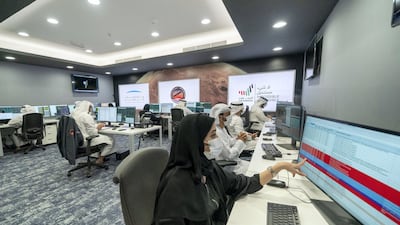
Members of Mohammed Bin Rashid Space Centre participate during the arrival of the Hope Probe in the orbit of Mars. Mohamed Al Hammadi / Ministry of Presidential Affairs -
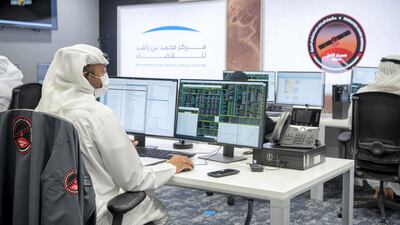
Member of Mohammed Bin Rashid Space Centre participates during the arrival of the Hope Probe in the orbit of Mars. Rashid Al Mansoori / Ministry of Presidential Affairs -

Sheikh Mohammed bin Rashid, Vice-President and Ruler of Dubai, and Sheikh Mohamed bin Zayed, Crown Prince of Abu Dhabi and Deputy Supreme Commander of the Armed Forces, Sheikh Mansour bin Zayed, Deputy Prime Minister and Minister of Presidential Affairs, Sheikh Saif bin Zayed, Deputy Prime Minister and Minister of Interior, Sheikh Hamdan bin Mohammed, Crown Prince of Dubai, Sheikh Hamdan bin Mohammed bin Zayed, Mohammed Al Gergawi, Minister of Cabinet Affairs, Talal Humaid Belhoul Al Falasi, Vice President of Mohammed bin Rashid Space Centre and Hamad Obaid Al Mansoori, Director-General of the Telecommunications Regulatory Authority, witness the arrival of the Hope Probe in the orbit of Mars, at Mohammed Bin Rashid Space Centre. Rashid Al Mansoori / Ministry of Presidential Affairs -

Mohammed Al Gergawi, Minister of Cabinet Affairs, Talal Humaid Belhoul Al Falasi, Vice President of Mohammed bin Rashid Space Centre, and Hamad Obaid Al Mansoori, Director-General of the Telecommunications Regulatory Authority, witness the arrival of the Hope Probe in the orbit of Mars, at Mohammed Bin Rashid Space Centre. Ismaeel Al Zaher / Ministry of Presidential Affairs -

Sheikh Hamdan bin Mohammed bin Zayed, witnesses the arrival of the Hope Probe in the orbit of Mars, at Mohammed Bin Rashid Space Centre. Rashid Al Mansoori / Ministry of Presidential Affairs -

Sheikh Mohammed bin Rashid, Vice President and Ruler of Dubai, Sheikh Mansour bin Zayed, Deputy Prime Minister and Minister of Presidential Affairs, Sheikh Saif bin Zayed, Deputy Prime Minister and Minister of Interior, and Sheikh Hamdan bin Mohammed bin Zayed, witness the arrival of the Hope Probe in the orbit of Mars, at Mohammed Bin Rashid Space Centre. Ismaeel Al Zaher / Ministry of Presidential Affairs -

Khaldoon Al Mubarak, chief executive and managing director of Mubadala Investment Company, and Sheikh Mohammed bin Hamad bin Tahnoon, witness the arrival of the Hope Probe in the orbit of Mars, at Mohammed Bin Rashid Space Centre. Ismaeel Al Zaher / Ministry of Presidential Affairs


All three of the latest missions to arrive at Mars started the journey during a launch window in 2020, when the positions of Earth and Mars meant a shorter journey was possible.
The next launch window will arrive in 2022, when European and Russian missions to the Red Planet are scheduled to take off carrying new experiments.
SpaceX is also working on Mars exploration, and chief executive Elon Musk said late last year that a first uncrewed mission to the Red Planet using the Starship spacecraft it is developing could happen as early as 2024.

