
From floods in India, drought in Europe, earthquakes in Afghanistan and hurricanes in America, this year was plagued by climate disasters.
It’s impossible to calculate the human cost, though. Whatever the death toll, countless lives will have been disrupted, with the United Nations estimating millions of people have been displaced, driven to refugee status by extreme weather.
In March, Tropical Cyclone Gombe struck northern Mozambique, displacing up to 2.2 million people, and killing at least 1,000. And that’s only one disaster.
This summer, heatwave records were broken across the globe. Europe particularly suffered, with the mercury reaching shocking new highs. The UK recorded its hottest temperature on July 19, when temperatures hit 40.2°C. Compare that to the average UK temperature for July, which is around 21°C. The World Health Organisation estimated that the heat caused at least 15,000 deaths in Europe, with Spain and Germany worst affected, recording 4,000 and 4,500 fatalities respectively.
-
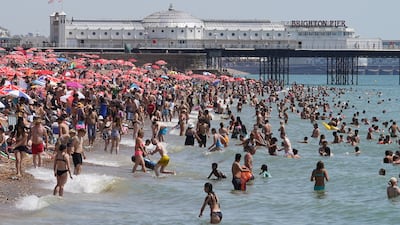
People basking in the sun on a crowded Brighton beach. The temperature in Britain smashed through the 40ºC barrier for the first time in recorded history. PA -
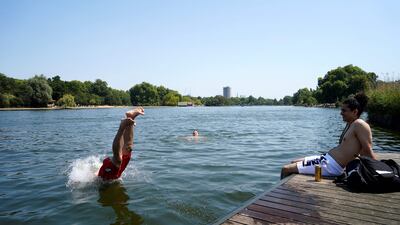
A man dives into the Serpentine Lake to cool off in Hyde Park, west London. AFP -
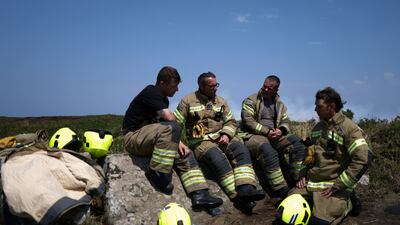
Firefighters rest as they attend a gorse bush fire, near Zennor, Cornwall. Reuters -
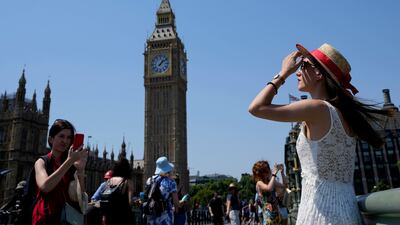
A tourist wears a hat to shield herself from the sun on Westminster Bridge in central London. AP -

A man cools off at Trafalgar Square, central London. Reuters -
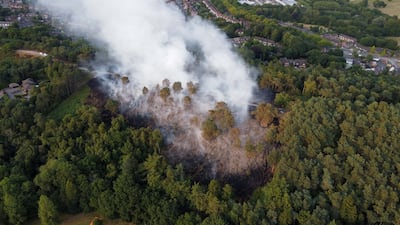
Firefighters respond to a large wildfire in woodland at Lickey Hills Country Park on the edge of Birmingham. PA -
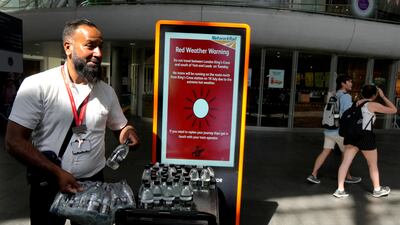
A railway worker hands out bottles of water to passengers at London's King's Cross, where there are train cancellations due to the heat. AP -
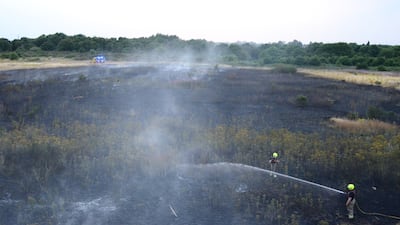
Firefighters control a grass fire in Ravenswood, Suffolk. PA -

Train tracks are painted white to help with the heat at Alexandra Palace train station in London. PA -
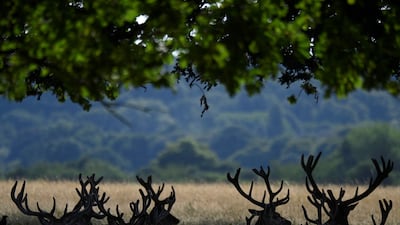
Deer rest in the shade at London's Richmond Park. Reuters -

An empty freezer section at Sainsbury's Nine Elms in London. PA -
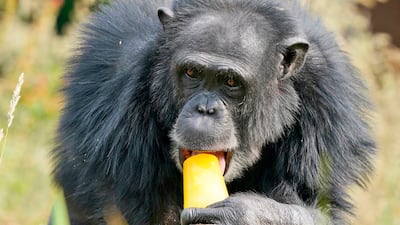
Chippy the chimpanzee enjoys an ice treat at Blair Drummond Safari and Adventure Park, near Stirling. AP -

A student dips her head into the fountain at Trafalgar Square, London. Getty Images -
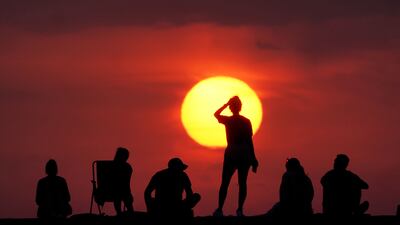
People turn out to watch the sunrise on Tuesday morning at Cullercoats Bay, North Tyneside. PA -

A digital thermometer displaying a temperature of 39°C on a London Underground train. PA -

A fan finds a way to keep cool while watching the Women's Euro 2022 football match between Italy and Belgium at Manchester City Academy Stadium. AP -

An aerial view shows swimmers at Hathersage Swimming Pool, west of Sheffield in northern England. AFP -
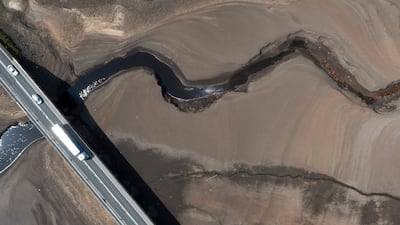
Traffic crosses a bridge at Woodhead Resevoir in West Yorkshire as water levels dip dangerously low. AP -
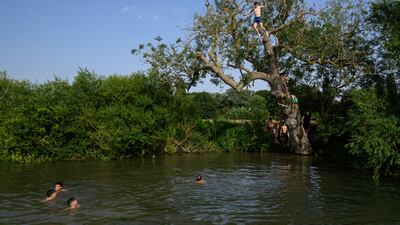
A man leaps from the top of a tree into the River Cam, in Cambridge. Getty Images -
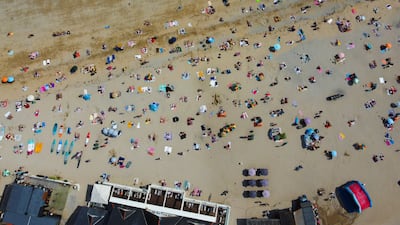
A packed Gyllyngvase beach in Falmouth. Getty Images -

A police officer gives water to a sentry in heavy ceremonial uniform, outside Buckingham Palace in central London. AP -
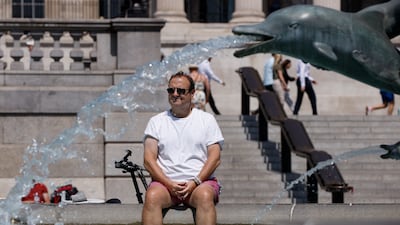
A man cools off in a fountain in London. Reuters -

A man sunbathes at the harbour in Mousehole, Cornwall. AP -
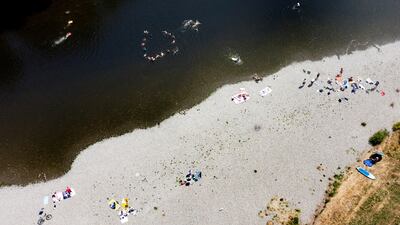
People swim in the River Wye. Reuters -

Passengers feel the heat on the London Underground. The operator advised its customers not to use the metro during the worst of the heatwave. AP -

Palm House supervisor Will Spolestra waters the plants at the Royal Botanical Gardens Kew, west London, where temperatures inside the greenhouses are cooler than outside during the heatwave. PA -
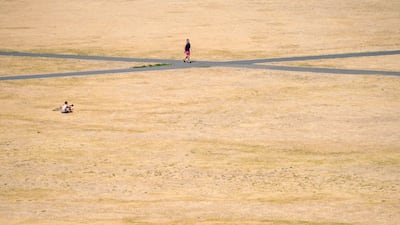
Dry grass at Greenwich Park, south-east London. AP -

A swimmer takes an early morning dip in the cool water of Jesus Green Lido in Cambridge, eastern England. Getty Images -

Assistant horticulturalist Katie Martyr checks the temperature at the Cambridge University Botanic Garden. Forecasts are for record temperatures exceeding 40°C. Getty Images -
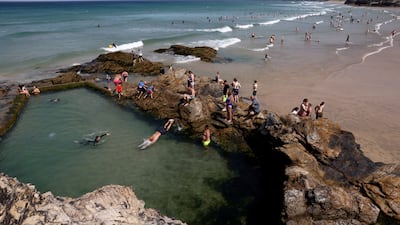
Bathers keep cool in a tidal pool at Perranporth Beach in Cornwall, south-west England. Reuters -
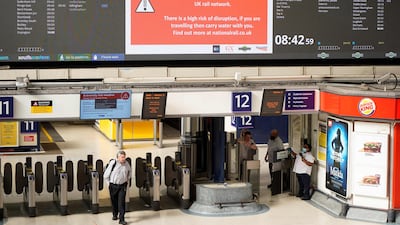
Message boards at London's Victoria Station warn passengers of potential disruption to train services due to the extreme heat. AFP -
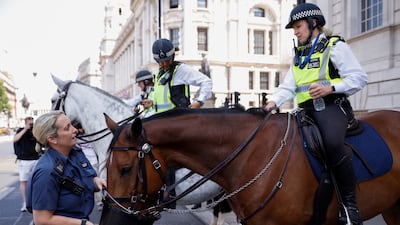
Zorro the police horse drinks water from a bucket to cool down during hot weather, on Whitehall in London. Reuters -
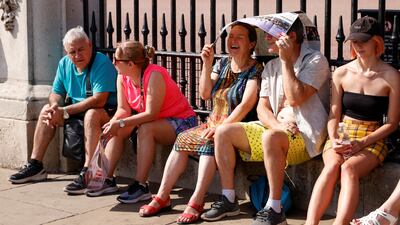
People use a map to shelter from the sun outside Buckingham Palace in London. Reuters -
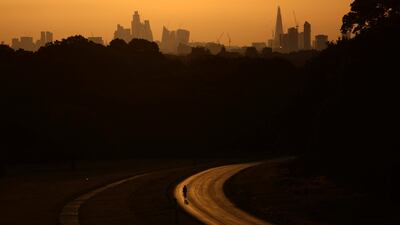
A cyclist rides through Richmond Park in south-west London at sunrise on Monday. Reuters -
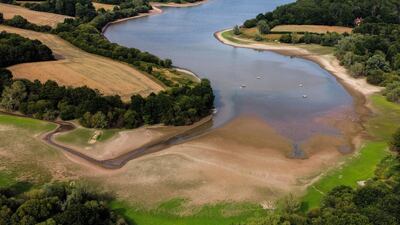
The reduced water level at Weir Wood reservoir, near Crawley, south-east England. The UK's Met Office has issued its first 'red warning' for exceptional heat. AFP -
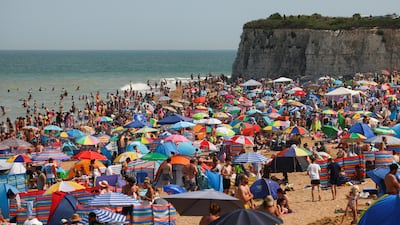
A crowded beach at Joss Bay in Broadstairs, south-east England. Reuters -
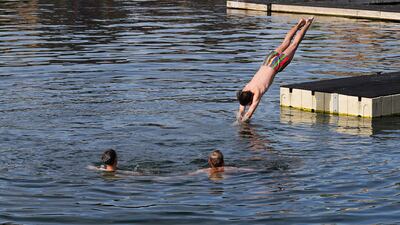
Swimmers take the plunge to escape the heat in east London. Reuters -
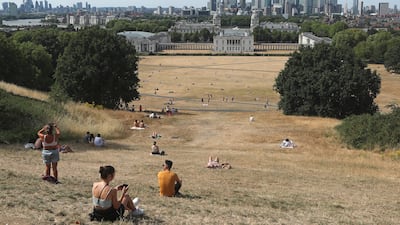
Sunbathers on the parched grass in Greenwich Park, south-east London. AP -
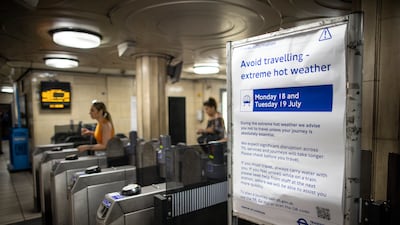
A sign advises people not to travel on the London Underground during the heatwave. EPA


In central and eastern Afghanistan, unseasonably heavy rain struck villages in August, setting off flash floods that killed at least 182 people. The country was already reeling from drought, and an earthquake that killed more than 1,000 people two months before the rainfall.
In India, flooding and landslides killed 192 people, due to a monsoon season with 3.4 per cent above average rainfall, with floods in Pakistan claiming at least 1,739 lives. A tropical storm in the Philippines killed 214 people, while in Indonesia, a 5.6-magnitude earthquake killed 344. In South Africa, 461 people lost their lives in heavy rain. Months later, more than 70 are still missing and thousands are without permanent housing.
“The theme is more extremes,” Jeff Parrish, global managing director for Protect Oceans, Lands and Waters, at The Nature Conservancy, told The National. “Bigger and longer droughts. Biblical floods in Pakistan. Tornadoes in winter. Late fall hurricanes. Arctic and Antarctic sea ice extent some of the lowest on record. We are not heading in the right direction."
Climate refugees
Climate events such as these don’t merely result in more refugees. The correlation between conflict and the climate crisis has been well documented since the desertification of fertile farming land in Syria. Between 2006 and 2010, 85 per cent of livestock died and 800,000 people lost their income, exacerbating existing tensions and playing a pivotal role in the breakout of civil war.
And, Mr Parrish said, the world is not getting any better at dealing with disaster.
“We simply can’t engineer our way out of these extremes," he said. "The best climate adaptation safeguards are those created over hundreds of millions of years by nature, and we need to protect, restore, and fortify those solutions — create habitat linkages; protect and restore wetlands, mangroves and coral reefs; continue to green our cities to reduce urban heat islands; and use nature to pull more CO2 out of the air.”
A costly problem
In financial terms, there were at least 29 billion-dollar weather disasters this year, according to a quarterly disaster report released in October. There has been a noticeable rise in disasters wreaking $20 billion plus of damage in recent years, a huge cause for concern. Disrupting global supply chains and the recovery of small communities or developing nations with little resources to cope with such disasters, are only two examples.
“Disasters that cause $20 billion of losses or more remain relatively rare and there hasn’t been such a significant increase in their number over the past 30 years as can be observed, for example, in billion-dollar disasters,” says Michal Lorinc, head of catastrophe insight for Aon’s Reinsurance Solutions.
“There were two such events in 2022 — Hurricane Ian and the European drought. Beyond primary physical impacts, secondary and tertiary losses related to large-scale disasters pose a threat to economies that can extend beyond regional boundaries.”
This includes a risk of supply chain disruption, putting additional pressure on the global economy, Mr Lorinc added.
Hurricane Ian, which hit Florida, South Carolina, North Carolina and Cuba in late September, has caused $20 billion of damage so far, with insurance broker Aon saying financial losses will continue to add up. They may even top $100 billion, according to another broker, Gallagher Re. The drought in West, South and Central Europe throughout this year has caused an estimated $20 billion of damage, while flooding in China racked up $12 billion in costs.
Cumulatively, drought damage has cost $38.4 billion globally, a figure projected to continue rising. However, there were fewer billion-dollar tropical cyclones this year than last; there were three — Hurricanes Ian and Fiona, and Typhoon Nanmadol in the western Pacific – compared to six in 2021.
Extreme weather events are becoming more frequent and more severe. Meanwhile, global CO2 emissions from fossil fuels — the main driver for climate change — hit a record high this year. This came despite a worldwide effort to curb fossil fuel-use and keep the world’s temperature rise to under 1.5°C. To achieve this, CO2 emissions must decline by 45 per cent. The outlook appears bleak; the UN Environment Programme (Unep) insisted in a report released in October that there was “no credible pathway to 1.5°C”.
Inger Andersen, executive director of UNEP, said: “This report tells us in cold scientific terms what nature has been telling us all year, through deadly floods, storms and raging fires: we have to stop filling our atmosphere with greenhouse gases, and stop doing it fast."
And unless drastic action is taken, next year may be even worse in terms of extreme weather events, although there is some hope that the world is waking up to the seriousness of the situation.
“This year, more people and more governments have come to realise that the climate crisis and the biodiversity and nature crisis are one in the same,” says Mr Parrish, who recently attended Cop15 in Montreal, Canada. “They are tightly intertwined and we can’t mitigate and adapt to the climate crisis without saving nature, and vice versa. Organisations are beginning to collaborate rather than compete, like never before, reflecting the urgency we face.”

