

Rights groups have warned that executions of protesters in Iran could rise sharply in the coming weeks.
The government conducted its first execution of a protester last week, when Mohsen Shekari, who was accused of “crimes against God”, was killed on Thursday.
He is one of 11 people sentenced to death in connection with the nationwide protest movement.
Iran says more than 200 people have been killed, including around 50 members of the security forces, in more than two months of protests following the death of Iranian Kurdish woman Mahsa Amini, 22, in police custody. She had been accused of breaching the country’s strict dress code for women.
Her death energised an anti-government movement spanning a broad spectrum of Iranian society, including students, teachers, Kurds and the Baloch minority in the south of the country.
Other tallies of the death toll are far higher. The Norway-based Iranian Human Rights says around 500 have been killed in the unrest.
-

Iranians protest in Tehran after the death of 22-year-old Mahsa Amini after she was detained by the morality police in September. AP Photo -
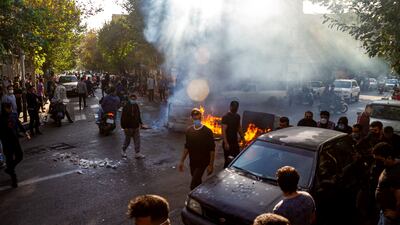
Protests have intensified despite a vicious government crackdown that has left as many as 200 people dead, although estimates of the toll by rights groups vary. AP Photo -
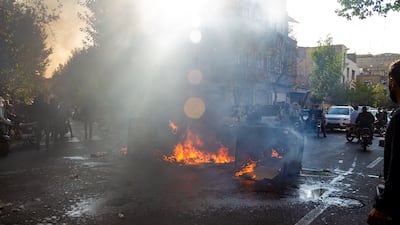
At least eight members of the security forces have also been killed or wounded during the unrest and there are signs that violent resistance could be intensifying. AP Photo -
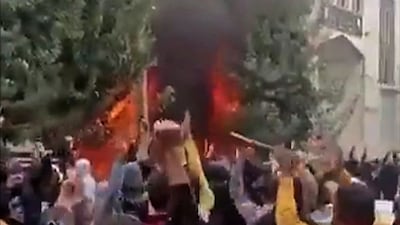
A fire burns at the office of the governor of Mahabad, in the West Azerbaijan province of Iran. AFP -
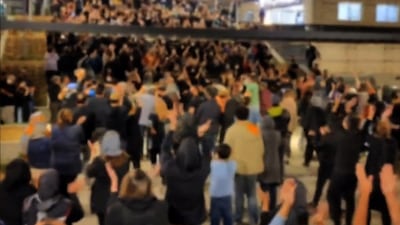
Protesters gather in the a courtyard of Chitgar complex in western Tehran. AFP -

Iranian protesters continue to defy a deadly crackdown by security forces. AFP -

A woman cuts her hair at the grave site of Nika Shahkarami in the city of Khorramabad, during a reported memorial held to mark 40 days since the death of the 16-year-old. AFP -
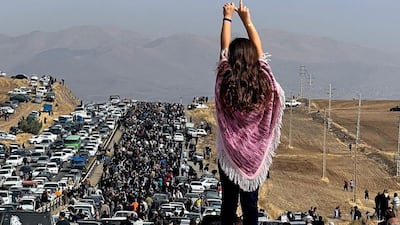
A woman not wearing a headscarf stands on top of a vehicle as thousands make their way towards Saqez, Mahsa Amini's home town, to mark 40 days since her death in police custody. AFP -
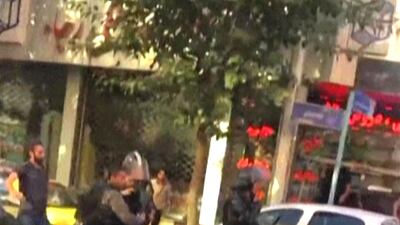
Iranian riot police prepare to confront protesters the capital, Tehran. AFP -
Iranian protesters surge forward amid clashes with riot police in Tehran. AFP -
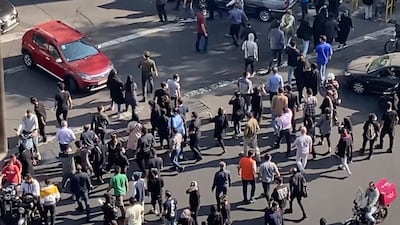
A crowd blocks an intersection during a protest to mark 40 days since Amini's death in custody. AP Photo -
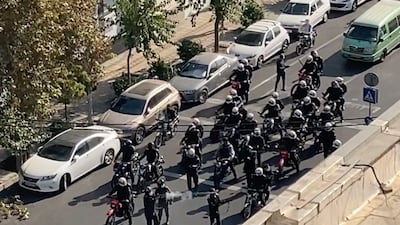
Iranian police arrive to disperse a protest in Tehran. AP Photo -
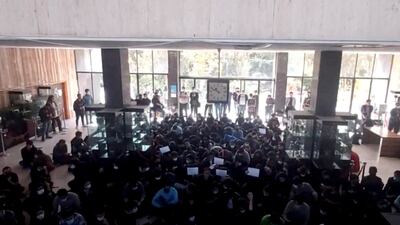
Protesters chant at a vigil for Amini at the Khajeh Nasir Toosi University of Technology in Tehran. Reuters -
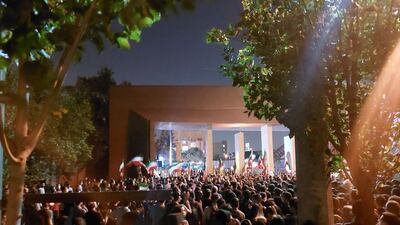
Students at Sharif University of Technology attend a protest. AP Photo -

Police outside Sharif University during a student protest. AP Photo -
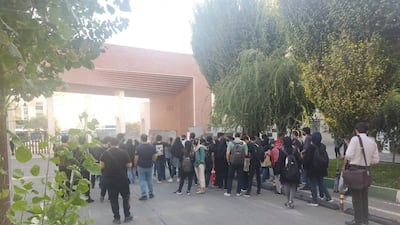
Students at the university protest over the death of Amini, who was in 'morality police' custody for allegedly breaking strict rules on head coverings for women. AP Photo -
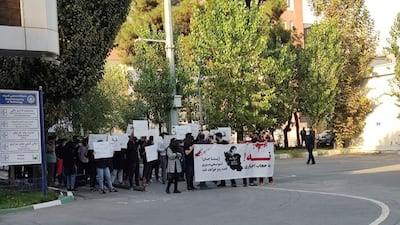
The students' banner says: 'No to mandatory hijab'. AP Photo


The UN says Iran is holding around 14,000 people in connection with the protests.
Unless foreign governments “significantly increase” the diplomatic and economic costs to Iran, the world “is sending a green light to this carnage”, said Hadi Ghaemi, executive director of the New York-based Centre for Human Rights in Iran.
Amnesty International said Iran was now “preparing to execute” Mahan Sadrat, 22, just a month after his “grossly unfair” trial. He was convicted of drawing a knife in the protests, accusations he strongly denied in court.
On Saturday Mr Sadrat was transferred from Greater Tehran Prison to Rajai Shahr prison in the nearby city of Karaj “sparking concerns that his execution may be carried out imminently”, Amnesty said.
“Like all other death row prisoners, he was denied any access to his lawyer during the interrogations, proceedings and show trial,” said Iran Human Rights.
Amnesty warned the life of another young man arrested over the protests, Sahand Nourmohammadzadeh, was also at risk “after a fast-tracked proceeding which did not resemble a trial”.
He was sentenced to death in November on accusations of “tearing down highway railings and setting fire to rubbish cans and tyres”, the group said.
Among others given the same sentence is rapper Saman Seyedi, 24, from Iran's Kurdish minority. His mother pleaded for his life on social media in a video where she stated “my son is an artist not a rioter”.
Another dissident rapper, Toomaj Salehi, who expressed support for anti-regime protests, is charged with “corruption on earth” and could face a death sentence, Iranian judicial authorities confirmed last month.
“We fear for the life of Iranian artists who have been indicted on charges carrying the death penalty,” UN experts said, referring to the cases of Mr Sayedi and Mr Salehi.
Amnesty and IHR have also raised the case of Hamid Gharehasanlou, a medical doctor sentenced to death. They say he was tortured in custody and his wife was coerced into giving evidence against him which she later sought to retract.
The US, EU members and UK strongly condemned the execution of Mr Shekari. German Foreign Minister Annalena Baerbock said it showed a “boundless contempt for human life”.
Iran on Friday and Saturday again summoned the British and German ambassadors to protest their countries' actions, marking the 15th time in less than three months Tehran has called in foreign envoys as the demonstrations continue.
Many activists want the foreign response to go further, extending even to severing diplomatic ties with Iran and expelling Tehran's envoys from European capitals.
After the widespread international outrage at Mr Shekari's execution, Iran said it was exercising restraint, both in the response by security forces, and the “proportionality” of the judicial process.

