


Ukraine’s President Volodymyr Zelenskyy said Russia may be planning to carry out “particularly nasty and cruel” attacks on its neighbour to coincide with the six-month mark of the invasion.
He said Russia’s aim was to “sow despondency, fear and conflict” among Ukrainians, more than 10 million of whom have fled abroad seeking shelter.
On Wednesday, Ukraine will celebrate Independence Day, with this year’s holiday also marking six months since Russia launched its assault.
Mr Zelenskyy said people should be vigilant in the run-up to the national holiday, which commemorates Ukraine’s independence from the Soviet Union.
“We should be aware that this week Russia may try to do something particularly nasty, something particularly cruel,” Mr Zelenskyy said in his nightly video address on Saturday.
“One of the key objectives of the enemy is to humiliate us,” and “to sow despondency, fear and conflict,” he said. “We must all be strong enough to resist any enemy provocations.”
The city of Nikopol, which lies across the Dnipro river from the Zaporizhzhia nuclear power plant, came under artillery fire overnight on Saturday.
The city was shelled in five bombardments, regional governor Valentyn Reznichenko wrote on Telegram. He said 25 artillery shells hit Nikopol, causing a fire at an industrial plant and cutting power to 3,000 residents.
The fighting near Zaporizhzhia — Europe’s largest nuclear power facility — and Saturday's missile strike on the southern town of Voznesensk, which is not far from Ukraine's second-largest atomic plant, has compounded fears of nuclear disaster.
-
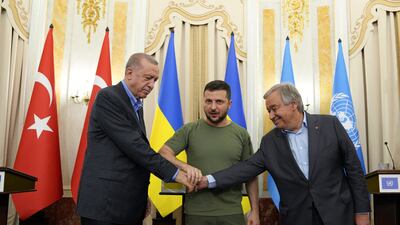
Turkish President Recep Tayyip Erdogan, Ukrainian President Volodymyr Zelenskyy and UN Secretary General Antonio Guterres shake hands after their meeting in Lviv, Ukraine. AP -

Russian missiles headed for Ukraine are launched from Russia's Belgorod region. AP -
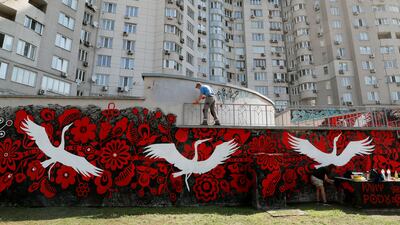
Street artists paint a mural on to a wall near a building in a residential area in Kyiv, Ukraine. EPA -
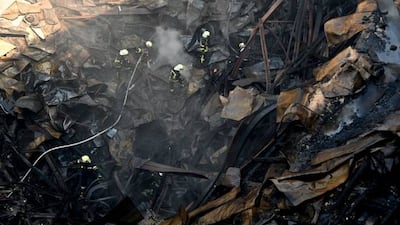
Firefighters put out flames and search through the rubble of the Culture Palace, which was destroyed by a Russian missile, in Ukraine's second-largest city of Kharkiv. Getty -
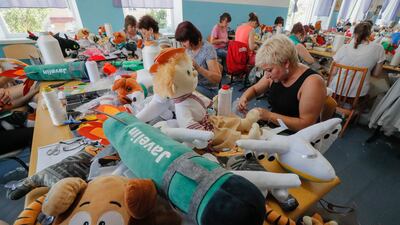
Seamstresses sew soft toys at the Kopytsia toy factory in Nizhyn, Ukraine. The factory makes toys that have became patriotic symbols for Ukrainians during Russia's invasion. EPA -

The logo of a new cafe called 'Stars Coffee', which opened in Moscow after Starbucks pulled out of Russia due to its invasion of Ukraine. Reuters -
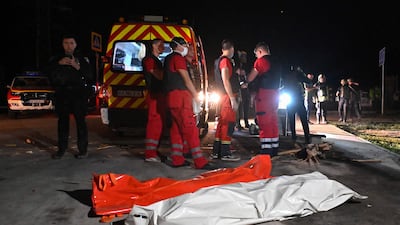
Rescue officials gather in front of the bodies of victims killed in a Russian missile strike on Kharkiv. AFP -
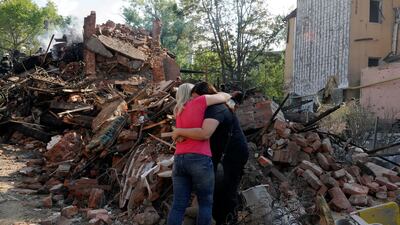
Women hug near the debris of a building that was destroyed after a rocket hit the Saltivka area in Kharkiv. EPA -
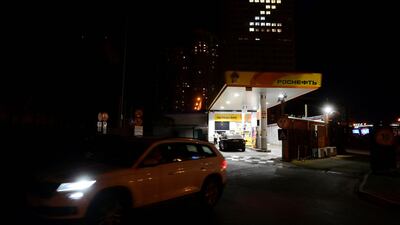
The letter 'Z', a symbol of support for Russia's invasion of Ukraine, is projected on to a building in Moscow. AFP -
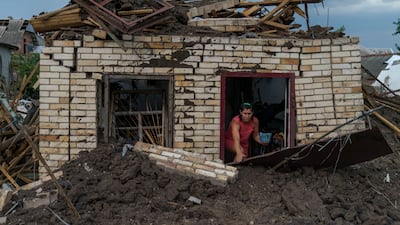
A woman recovers an item from the damaged home of her elderly neighbour after a Russian missile strike yesterday in Druzhkivka, in Ukraine's Donetsk enclave. AP -

Bronze medalist Andriy Protsenko of Ukraine celebrates after the men's high jump final on day eight of the European Championships in Munich, Germany. Getty


Zaporizhzhia has been under the control of Russian troops since March.
Missile attacks were reported in the Odesa region, home to Black Sea ports critical to the delivery of a UN-brokered plan to help Ukrainian agricultural exports reach world markets again.
Local authorities said five Russian Kalibr cruise missiles were fired from the Black Sea at the region, citing information from the southern military command. Two were shot down by Ukrainian air defences, while three hit agricultural targets, but there were no casualties.
Russia said on Sunday the missiles had destroyed an ammunition depot containing missiles for US-made Himars rockets, while Kyiv said a granary had been hit.
UN Secretary General Antonio Guterres urged wealthy nations to “open their wallets and their hearts” to help developing countries purchase Ukrainian grain.
Ships carrying grain have been leaving Odesa under the agreement, and Mr Guterres said the result was a symbol of what countries could achieve when they worked together for the common good.
Speaking in the port city on Friday, he issued a call to rich nations on behalf of vulnerable people everywhere who are bearing the brunt of the food crisis caused by the conflict in Ukraine.
“As these ports open, I appeal for wealthier countries to also open their wallets and their hearts,” he said. “After all, the movement of grain doesn’t mean much to countries that cannot afford it.
“It is time for massive and generous support so developing countries can purchase the food from this and other ports — and people can buy it. Developing countries need access to financing now. They need debt relief now. They need resources to invest in their people now.”
Mr Guterres also called for more action to ensure full access to Ukrainian food products, as well as Russian food and fertiliser, through the Black Sea Grain Initiative.
While no one expected the agreement to be “smooth sailing”, Mr Guterres said, it is unprecedented both in scope and scale.
The export of food and fertiliser from Ukraine and Russia is crucial to calm volatile commodity markets and lower prices, he said.
“But let’s not forget that what we see here in Odesa is only the more visible part of the solution,” he said. “The other part that is also important, that we have been defending, relates to the unimpeded access to the global markets of Russian food and fertiliser, which are not subject to sanctions.”
He said that “without fertiliser in 2022, there may not be enough food in 2023”.
Mr Guterres underlined his deep commitment to these objectives, which he said would only happen if all parties co-operated.
There were no reports of incidents in Crimea, the Black Sea peninsula Russia annexed from Ukraine in 2014, overnight on Saturday, after a spate of attacks in recent weeks.
Ukraine has not claimed responsibility for those.
In his speech, Mr Zelenskyy referred to the explosions in Crimea in cryptic fashion, saying: “You can literally feel Crimea in the air this year, saying that the occupation there is only temporary and that Ukraine is coming back.”
A Ukrainian drone was suspected of attacking Russia’s naval headquarters in the Crimean peninsula early on Saturday.
Roadblocks sprung up around Sevastopol, the largest city in Crimea, as authorities hunted for saboteurs.

