Will Ranil Wickremesinghe move into palace stormed by Sri Lankan protesters?


Taylor Heyman
  • English
  • Arabic

Ranil Wickremesinghe was sworn in as Sri Lanka's new president on Thursday — less than two weeks after protesters stormed the presidential residence in Colombo.

He will serve in the position until the end of his predecessor Gotabaya Rajapaksa's term in 2024.

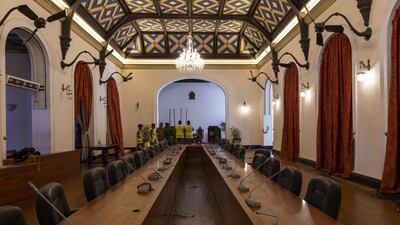
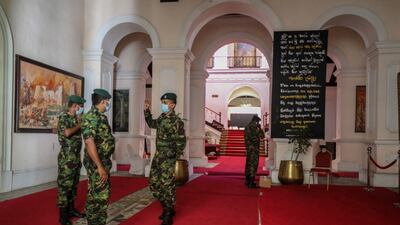
This means the President's House, a building that has become a symbol of the protest movement raging in the country for more than 100 days, could now become Mr Wickremesinghe's home.

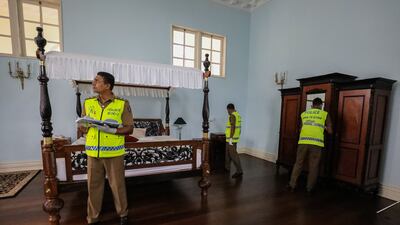
On July 9, hundreds of demonstrators stormed the palace, rooting through drawers containing Mr Rajapaksa's belongings, exploring bedrooms, eating picnics in the vast gardens and swimming in the presidential pool.

Millions of Sri Lankan rupees found in the property by protesters were handed over to a court on Monday.

Demonstrators said they would occupy the site until the country's leaders resigned, but it turned into something of a tourist destination.

Ordinary Sri Lankans came to look at the opulence of the presidential palace, in contrast to the hardship faced by much of the population during the country's economic crisis.

Mr Rajapaksa fled the country to Singapore last week.

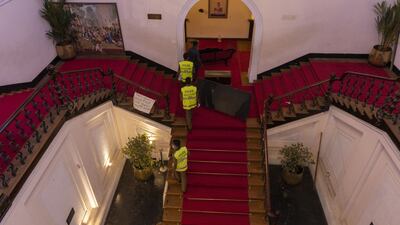
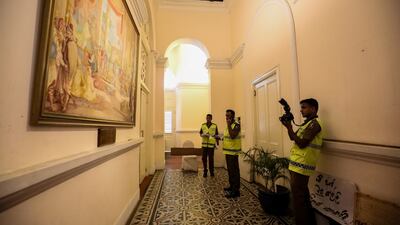
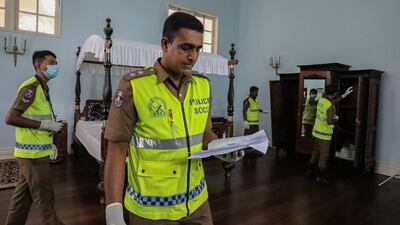
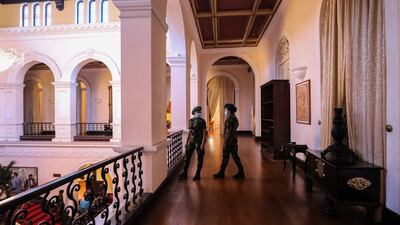
Now the clean-up has begun. Photos released last week showed police dusting surfaces for fingerprints, staff hanging paintings that had been torn off the wall and broken furniture being repaired.

The pool has been returned to its blue hue, after hundreds of people frolicked there last week.

Mr Wickremesinghe, who was serving as prime minister — his sixth term in the job — before he became president, has not yet confirmed if he intends to move into the sprawling complex.

But he will need a base, after his home in Colombo was burnt to the ground by protesters on July 9.

The protest movement that pushed out Mr Rajapaksa — the first sitting Sri Lankan president to quit office — remained largely muted, following Mr Wickremesinghe's election as president. He secured the votes of 134 MPs from the country's 225-member Parliament.

Mr Wickremesinghe is unpopular with some Sri Lankans due to his close ties to the powerful Rajapaksa family, that has dominated politics in the country for decades.

Only a handful of people were present outside the Presidential Secretariat on Thursday. The president's office, dating from the British colonial era, was stormed by a sea of protesters earlier this month along with the president and prime minister's official residences.

But some members of the protest movement have vowed to oppose Mr Wickremesinghe.

“We won't give up because what the country needs is a total system change,” said Pratibha Fernando, a protester at the secretariat. “We want to get rid of these corrupted politicians, so that's what we are doing.”

Hours after winning the parliamentary vote, Mr Wickremesinghe appeared to distance himself from the Rajapaksa family.

“I am not a friend of the Rajapaksas. I am a friend of the people,” he said, after praying at a Buddhist temple in Colombo.

Mr Wickremesinghe, who served as prime minister and finance minister under Mr Rajapaksa, has been involved in negotiations with the International Monetary Fund for a bail out package worth up to $3 billion.


The Energy Research Centre

Founded 50 years ago as a nuclear research institute, scientists at the centre believed nuclear would be the “solution for everything”.
Although they still do, they discovered in 1955 that the Netherlands had a lot of natural gas. “We still had the idea that, by 2000, it would all be nuclear,” said Harm Jeeninga, director of business and programme development at the centre.
"In the 1990s, we found out about global warming so we focused on energy savings and tackling the greenhouse gas effect.”
The energy centre’s research focuses on biomass, energy efficiency, the environment, wind and solar, as well as energy engineering and socio-economic research.

Mica

Director: Ismael Ferroukhi

Stars: Zakaria Inan, Sabrina Ouazani

3 stars

What sanctions would be reimposed?

Under ‘snapback’, measures imposed on Iran by the UN Security Council in six resolutions would be restored, including:

  • An arms embargo
  • A ban on uranium enrichment and reprocessing
  • A ban on launches and other activities with ballistic missiles capable of delivering nuclear weapons, as well as ballistic missile technology transfer and technical assistance
  • A targeted global asset freeze and travel ban on Iranian individuals and entities
  • Authorisation for countries to inspect Iran Air Cargo and Islamic Republic of Iran Shipping Lines cargoes for banned goods
Who's who in Yemen conflict

Houthis: Iran-backed rebels who occupy Sanaa and run unrecognised government

Yemeni government: Exiled government in Aden led by eight-member Presidential Leadership Council

Southern Transitional Council: Faction in Yemeni government that seeks autonomy for the south

Habrish 'rebels': Tribal-backed forces feuding with STC over control of oil in government territory

Dengue%20fever%20symptoms
%3Cul%3E%0A%3Cli%3EHigh%20fever%3C%2Fli%3E%0A%3Cli%3EIntense%20pain%20behind%20your%20eyes%3C%2Fli%3E%0A%3Cli%3ESevere%20headache%3C%2Fli%3E%0A%3Cli%3EMuscle%20and%20joint%20pains%3C%2Fli%3E%0A%3Cli%3ENausea%3C%2Fli%3E%0A%3Cli%3EVomiting%3C%2Fli%3E%0A%3Cli%3ESwollen%20glands%3C%2Fli%3E%0A%3Cli%3ERash%3C%2Fli%3E%0A%3C%2Ful%3E%0A%3Cp%3EIf%20symptoms%20occur%2C%20they%20usually%20last%20for%20two-seven%20days%3C%2Fp%3E%0A
The biog

Age: 32

Qualifications: Diploma in engineering from TSI Technical Institute, bachelor’s degree in accounting from Dubai’s Al Ghurair University, master’s degree in human resources from Abu Dhabi University, currently third years PHD in strategy of human resources.

Favourite mountain range: The Himalayas

Favourite experience: Two months trekking in Alaska

Second ODI

England 322-7 (50 ovs)
India 236 (50 ovs)

England win by 86 runs

Next match: Tuesday, July 17, Headingley 

Mercer, the investment consulting arm of US services company Marsh & McLennan, expects its wealth division to at least double its assets under management (AUM) in the Middle East as wealth in the region continues to grow despite economic headwinds, a company official said.

Mercer Wealth, which globally has $160 billion in AUM, plans to boost its AUM in the region to $2-$3bn in the next 2-3 years from the present $1bn, said Yasir AbuShaban, a Dubai-based principal with Mercer Wealth.

Within the next two to three years, we are looking at reaching $2 to $3 billion as a conservative estimate and we do see an opportunity to do so,” said Mr AbuShaban.

Mercer does not directly make investments, but allocates clients’ money they have discretion to, to professional asset managers. They also provide advice to clients.

“We have buying power. We can negotiate on their (client’s) behalf with asset managers to provide them lower fees than they otherwise would have to get on their own,” he added.

Mercer Wealth’s clients include sovereign wealth funds, family offices, and insurance companies among others.

From its office in Dubai, Mercer also looks after Africa, India and Turkey, where they also see opportunity for growth.

Wealth creation in Middle East and Africa (MEA) grew 8.5 per cent to $8.1 trillion last year from $7.5tn in 2015, higher than last year’s global average of 6 per cent and the second-highest growth in a region after Asia-Pacific which grew 9.9 per cent, according to consultancy Boston Consulting Group (BCG). In the region, where wealth grew just 1.9 per cent in 2015 compared with 2014, a pickup in oil prices has helped in wealth generation.

BCG is forecasting MEA wealth will rise to $12tn by 2021, growing at an annual average of 8 per cent.

Drivers of wealth generation in the region will be split evenly between new wealth creation and growth of performance of existing assets, according to BCG.

Another general trend in the region is clients’ looking for a comprehensive approach to investing, according to Mr AbuShaban.

“Institutional investors or some of the families are seeing a slowdown in the available capital they have to invest and in that sense they are looking at optimizing the way they manage their portfolios and making sure they are not investing haphazardly and different parts of their investment are working together,” said Mr AbuShaban.

Some clients also have a higher appetite for risk, given the low interest-rate environment that does not provide enough yield for some institutional investors. These clients are keen to invest in illiquid assets, such as private equity and infrastructure.

“What we have seen is a desire for higher returns in what has been a low-return environment specifically in various fixed income or bonds,” he said.

“In this environment, we have seen a de facto increase in the risk that clients are taking in things like illiquid investments, private equity investments, infrastructure and private debt, those kind of investments were higher illiquidity results in incrementally higher returns.”

The Abu Dhabi Investment Authority, one of the largest sovereign wealth funds, said in its 2016 report that has gradually increased its exposure in direct private equity and private credit transactions, mainly in Asian markets and especially in China and India. The authority’s private equity department focused on structured equities owing to “their defensive characteristics.”

How to get there

Emirates (www.emirates.com) flies directly to Hanoi, Vietnam, with fares starting from around Dh2,725 return, while Etihad (www.etihad.com) fares cost about Dh2,213 return with a stop. Chuong is 25 kilometres south of Hanoi.
 

The more serious side of specialty coffee

While the taste of beans and freshness of roast is paramount to the specialty coffee scene, so is sustainability and workers’ rights.

The bulk of genuine specialty coffee companies aim to improve on these elements in every stage of production via direct relationships with farmers. For instance, Mokha 1450 on Al Wasl Road strives to work predominantly with women-owned and -operated coffee organisations, including female farmers in the Sabree mountains of Yemen.

Because, as the boutique’s owner, Garfield Kerr, points out: “women represent over 90 per cent of the coffee value chain, but are woefully underrepresented in less than 10 per cent of ownership and management throughout the global coffee industry.”

One of the UAE’s largest suppliers of green (meaning not-yet-roasted) beans, Raw Coffee, is a founding member of the Partnership of Gender Equity, which aims to empower female coffee farmers and harvesters.

Also, globally, many companies have found the perfect way to recycle old coffee grounds: they create the perfect fertile soil in which to grow mushrooms. 

The specs

Engine: 1.5-litre, 4-cylinder turbo

Transmission: CVT

Power: 170bhp

Torque: 220Nm

Price: Dh98,900

Surianah's top five jazz artists

Billie Holliday: for the burn and also the way she told stories.  

Thelonius Monk: for his earnestness.

Duke Ellington: for his edge and spirituality.

Louis Armstrong: his legacy is undeniable. He is considered as one of the most revolutionary and influential musicians.

Terence Blanchard: very political - a lot of jazz musicians are making protest music right now.

Updated: July 21, 2022, 12:28 PM