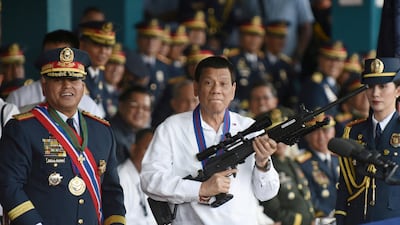
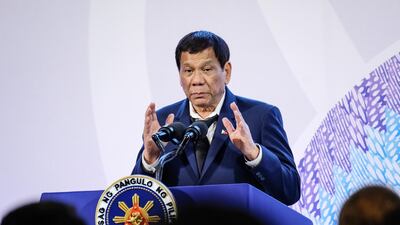
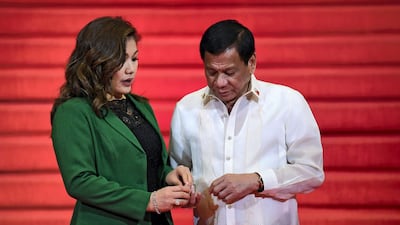
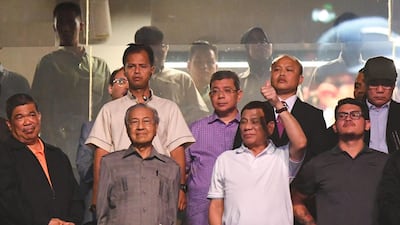
Ferdinand Marcos Jr was sworn in as president of the Philippines on Thursday amid protests over his namesake father's rule.
The inauguration of Mr Marcos Jr was held at the steps of the National Museum in Manila on Thursday.
The Philippine Congress last month proclaimed his landslide victory, as well as that of his running mate Sara Duterte, daughter of departing president Rodrigo Duterte, in the vice-presidential race.
“I ask you all pray for me, wish me well. I want to do well because when the president does well, the country does well,” Mr Marcos Jr said after his congressional proclamation, without taking any questions.
He received more than 31 million votes and Ms Duterte had more than 32 million of the more than 55 million votes cast in the May 9 election — emphatic victories that will provide them robust political capital as they face tremendous challenges as well as doubts arising from their fathers’ reputations.
It was the first majority presidential victory in the Philippines in decades.
Chinese Vice President Wang Qishan and Doug Emhoff, US Vice President Kamala Harris’s husband, were among foreign dignitaries at the swearing-in ceremony.
The inauguration comes 36 years after an army-backed revolt removed his father Ferdinand Marcos Sr from power.
Activists and survivors of the martial law-era under his father staged protests on the sidelines of the inauguration. Thousands of police officers, including anti-riot contingents, Swat commandos and snipers, were deployed in the bayside tourist district for security.
A public holiday, monuments and the Philippine constitution stand as reminders of his father’s tyrannical rule.
“Wow is this really happening?” Bonifacio Ilagan, 70, an activist who was detained and severely tortured by counterinsurgency forces during the elder Marcos’s rule, told AP.
“For victims of martial law like me, this is a nightmare.”
Such historical baggage and antagonism stand to hound Marcos Jr during a six-year presidency beginning at a time of intense crises.
The Philippines has been among the countries in Asia worst-hit by the two-year coronavirus pandemic, after more than 60,000 deaths and extended lockdowns sent the economy to its worst recession since the Second World War and worsened poverty, unemployment and hunger.
As the pandemic was easing early this year, Russia’s invasion of Ukraine sent global inflation soaring and sparked fears of food shortages.
Last week, Mr Marcos Jr announced he would serve as secretary of agriculture temporarily after he takes office to prepare for possible food supply emergencies. “I think the problem is severe enough,” he said and added he has asked his key advisers to brace for “emergency situations, especially when it comes to food supply.”
He also inherits decades-old Islamist and communist insurgencies, crime, gaping inequality and political divisions inflamed by his election.
Mr Duterte presided over a brutal anti-drugs campaign that left thousands of mostly poor suspects dead in an unprecedented scale of killings the International Criminal Court was investigating as a possible crime against humanity.
The probe was suspended in November, but the ICC chief prosecutor has asked that it be resumed immediately.
Mr Marcos Jr and Ms Duterte have faced calls to help prosecute her father and co-operate with the international court when they office, a looming political dilemma.
A former governor, congressman and senator, Mr Marcos Jr has refused to acknowledge or apologise for massive human rights breaches and plunder under his father’s rule and has defended his legacy.
He has appealed to be judged “not by my ancestors, but by my actions”.

Who has lived at The Bishops Avenue?
- George Sainsbury of the supermarket dynasty, sugar magnate William Park Lyle and actress Dame Gracie Fields were residents in the 1930s when the street was only known as ‘Millionaires’ Row’.
- Then came the international super rich, including the last king of Greece, Constantine II, the Sultan of Brunei and Indian steel magnate Lakshmi Mittal who was at one point ranked the third richest person in the world.
- Turkish tycoon Halis Torprak sold his mansion for £50m in 2008 after spending just two days there. The House of Saud sold 10 properties on the road in 2013 for almost £80m.
- Other residents have included Iraqi businessman Nemir Kirdar, singer Ariana Grande, holiday camp impresario Sir Billy Butlin, businessman Asil Nadir, Paul McCartney’s former wife Heather Mills.
Hunting park to luxury living
- Land was originally the Bishop of London's hunting park, hence the name
- The road was laid out in the mid 19th Century, meandering through woodland and farmland
- Its earliest houses at the turn of the 20th Century were substantial detached properties with extensive grounds
The design
The protective shell is covered in solar panels to make use of light and produce energy. This will drastically reduce energy loss.
More than 80 per cent of the energy consumed by the French pavilion will be produced by the sun.
The architecture will control light sources to provide a highly insulated and airtight building.
The forecourt is protected from the sun and the plants will refresh the inner spaces.
A micro water treatment plant will recycle used water to supply the irrigation for the plants and to flush the toilets. This will reduce the pavilion’s need for fresh water by 30 per cent.
Energy-saving equipment will be used for all lighting and projections.
Beyond its use for the expo, the pavilion will be easy to dismantle and reuse the material.
Some elements of the metal frame can be prefabricated in a factory.
From architects to sound technicians and construction companies, a group of experts from 10 companies have created the pavilion.
Work will begin in May; the first stone will be laid in Dubai in the second quarter of 2019.
Construction of the pavilion will take 17 months from May 2019 to September 2020.
Abu Dhabi traffic facts
Drivers in Abu Dhabi spend 10 per cent longer in congested conditions than they would on a free-flowing road
The highest volume of traffic on the roads is found between 7am and 8am on a Sunday.
Travelling before 7am on a Sunday could save up to four hours per year on a 30-minute commute.
The day was the least congestion in Abu Dhabi in 2019 was Tuesday, August 13.
The highest levels of traffic were found on Sunday, November 10.
Drivers in Abu Dhabi lost 41 hours spent in traffic jams in rush hour during 2019
In numbers
1,000 tonnes of waste collected daily:
- 800 tonnes converted into alternative fuel
- 150 tonnes to landfill
- 50 tonnes sold as scrap metal
800 tonnes of RDF replaces 500 tonnes of coal
Two conveyor lines treat more than 350,000 tonnes of waste per year
25 staff on site
COMPANY%20PROFILE
%3Cp%3E%3Cstrong%3EName%3A%20%3C%2Fstrong%3EShaffra%3Cbr%3E%3Cstrong%3EStarted%3A%20%3C%2Fstrong%3E2023%3Cbr%3E%3Cstrong%3EBased%3A%20%3C%2Fstrong%3EDIFC%20Innovation%20Hub%3Cbr%3E%3Cstrong%3ESector%3A%20%3C%2Fstrong%3Emetaverse-as-a-Service%20(MaaS)%3Cbr%3E%3Cstrong%3EInvestment%3A%20%3C%2Fstrong%3Ecurrently%20closing%20%241.5%20million%20seed%20round%3Cbr%3E%3Cstrong%3EInvestment%20stage%3A%20%3C%2Fstrong%3Epre-seed%3Cbr%3E%3Cstrong%3EInvestors%3A%20%3C%2Fstrong%3EFlat6Labs%20Abu%20Dhabi%20and%20different%20PCs%20and%20angel%20investors%20from%20Saudi%20Arabia%3Cbr%3E%3Cstrong%3ENumber%20of%20staff%3A%20%3C%2Fstrong%3Enine%3C%2Fp%3E%0A
Ten tax points to be aware of in 2026
1. Domestic VAT refund amendments: request your refund within five years
If a business does not apply for the refund on time, they lose their credit.
2. E-invoicing in the UAE
Businesses should continue preparing for the implementation of e-invoicing in the UAE, with 2026 a preparation and transition period ahead of phased mandatory adoption.
3. More tax audits
Tax authorities are increasingly using data already available across multiple filings to identify audit risks.
4. More beneficial VAT and excise tax penalty regime
Tax disputes are expected to become more frequent and more structured, with clearer administrative objection and appeal processes. The UAE has adopted a new penalty regime for VAT and excise disputes, which now mirrors the penalty regime for corporate tax.
5. Greater emphasis on statutory audit
There is a greater need for the accuracy of financial statements. The International Financial Reporting Standards standards need to be strictly adhered to and, as a result, the quality of the audits will need to increase.
6. Further transfer pricing enforcement
Transfer pricing enforcement, which refers to the practice of establishing prices for internal transactions between related entities, is expected to broaden in scope. The UAE will shortly open the possibility to negotiate advance pricing agreements, or essentially rulings for transfer pricing purposes.
7. Limited time periods for audits
Recent amendments also introduce a default five-year limitation period for tax audits and assessments, subject to specific statutory exceptions. While the standard audit and assessment period is five years, this may be extended to up to 15 years in cases involving fraud or tax evasion.
8. Pillar 2 implementation
Many multinational groups will begin to feel the practical effect of the Domestic Minimum Top-Up Tax (DMTT), the UAE's implementation of the OECD’s global minimum tax under Pillar 2. While the rules apply for financial years starting on or after January 1, 2025, it is 2026 that marks the transition to an operational phase.
9. Reduced compliance obligations for imported goods and services
Businesses that apply the reverse-charge mechanism for VAT purposes in the UAE may benefit from reduced compliance obligations.
10. Substance and CbC reporting focus
Tax authorities are expected to continue strengthening the enforcement of economic substance and Country-by-Country (CbC) reporting frameworks. In the UAE, these regimes are increasingly being used as risk-assessment tools, providing tax authorities with a comprehensive view of multinational groups’ global footprints and enabling them to assess whether profits are aligned with real economic activity.
Contributed by Thomas Vanhee and Hend Rashwan, Aurifer
COMPANY%20PROFILE
%3Cp%3E%3Cstrong%3EName%3A%20%3C%2Fstrong%3ESmartCrowd%0D%3Cbr%3E%3Cstrong%3EStarted%3A%20%3C%2Fstrong%3E2018%0D%3Cbr%3E%3Cstrong%3EFounder%3A%20%3C%2Fstrong%3ESiddiq%20Farid%20and%20Musfique%20Ahmed%0D%3Cbr%3E%3Cstrong%3EBased%3A%20%3C%2Fstrong%3EDubai%0D%3Cbr%3E%3Cstrong%3ESector%3A%20%3C%2Fstrong%3EFinTech%20%2F%20PropTech%0D%3Cbr%3E%3Cstrong%3EInitial%20investment%3A%20%3C%2Fstrong%3E%24650%2C000%0D%3Cbr%3E%3Cstrong%3ECurrent%20number%20of%20staff%3A%3C%2Fstrong%3E%2035%0D%3Cbr%3E%3Cstrong%3EInvestment%20stage%3A%20%3C%2Fstrong%3ESeries%20A%0D%3Cbr%3E%3Cstrong%3EInvestors%3A%20%3C%2Fstrong%3EVarious%20institutional%20investors%20and%20notable%20angel%20investors%20(500%20MENA%2C%20Shurooq%2C%20Mada%2C%20Seedstar%2C%20Tricap)%3C%2Fp%3E%0A
World record transfers
1. Kylian Mbappe - to Real Madrid in 2017/18 - €180 million (Dh770.4m - if a deal goes through)
2. Paul Pogba - to Manchester United in 2016/17 - €105m
3. Gareth Bale - to Real Madrid in 2013/14 - €101m
4. Cristiano Ronaldo - to Real Madrid in 2009/10 - €94m
5. Gonzalo Higuain - to Juventus in 2016/17 - €90m
6. Neymar - to Barcelona in 2013/14 - €88.2m
7. Romelu Lukaku - to Manchester United in 2017/18 - €84.7m
8. Luis Suarez - to Barcelona in 2014/15 - €81.72m
9. Angel di Maria - to Manchester United in 2014/15 - €75m
10. James Rodriguez - to Real Madrid in 2014/15 - €75m