


Live updates: follow the latest news on Russia-Ukraine
American astronaut Mark Vande Hei will return to Earth on a Russian spacecraft despite tensions caused by Russia’s invasion of Ukraine, Nasa has confirmed.
The astronaut will land on the Steppe of Kazakhstan on board a Soyuz spacecraft on March 30, along with cosmonauts Pyotr Dubrov and Anton Shkaplerov.
Last week, Russia’s space chief Dmitry Rogozin posted a video on Twitter showing Russian crew departing the floating laboratory and leaving an American astronaut behind, creating fear that Russia would abandon Mr Hei on the station.
Nasa confirmed in a press conference on Monday that it was still “working closely” with Russian space agency Roscosmos, despite Mr Rogozin’s dangerous rhetoric on social media.
“The reality is Mark Vande Hei is coming home on March 30 with Anton and Pyotr. We have confirmation from our Russian colleagues,” said Joel Montalbano, manager of the International Space Station programme.
“We hold a readiness review for each of these major events. We had a readiness review with all the participants of the international partners, and everybody confirmed that the three people coming home will be Anton, Pyotr and Mark.”
It is an unprecedented time for the space sector, as the future of the space station and international co-operation is threatened.
Roscosmos is responding aggressively to the sanctions imposed by the West, and has suspended a few agreements with countries that it once worked closely with.
It is no longer launching its Soyuz rockets from the European spaceport in French Guiana and refused to launch satellites owned by a UK start-up.
Mr Rogozin, who has made repeated threats about leaving the ISS in the past, said in recent days that the space station could fall on US or European territory.
“If you block co-operation with us, who will save the ISS from an uncontrolled deorbit and fall into the United States or … Europe? There is also the option of dropping a 500-tonne structure [on] India and China,” he tweeted.
“Do you want to threaten them with such a prospect? The ISS does not fly over Russia, so all the risks are yours. Are you ready for them?”
Nasa had already announced plans to retire the space station in 2031, but Roscosmos has not said if it would leave earlier.
The Russian segment on the station is a vital part of the structure that helps provide thrust, particularly the Russian cargo ship Progress MS-19, which performs reboosting manoeuvres to keep the ISS in place.
The US-owned Cygnus spacecraft on the station does have reboost capabilities, but Mr Montalbano said it is not strong enough to control the attitude of the ISS.
“The Cygnus spacecraft is designed to do some reboosts, but it needs the Russian thrusters to control during that reboost,” he said.
“So, while the Cygnus spacecraft will do the reboost, the Russian thrusters on the Progress will be active and helping control attitude.
“The thrusters on that Cygnus spacecraft are not powerful enough to go ahead and do attitude control during that reboost.”
UAE astronauts learn how to use space station's robotic arm — in pictures
-

UAE astronauts Hazza Al Mansouri and Sultan Al Neyadi are learning how to operate the Canadarm2, a robotic arm on the International Space Station, at the Nasa Johnson Space Centre in Houston. The arm is used by astronauts to capture Cygnus cargo supply vehicles that brings food and science experiments. Photo: Dr Al Neyadi Twitter -
Maj Al Mansouri became the first Arab to go to the ISS in 2019 when he spent eight days there. Photo: Maj Al Mansouri Twitter -
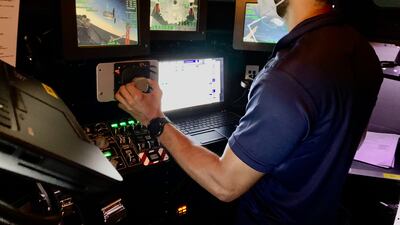
Dr Al Neyadi learning how to operate the Canadarm2 robotic arm on the International Space Station. Photo: Dr Al Neyadi Twitter -

Maj Al Mansouri said operating the robotic arm on the International Space Station requires a lot of teamwork. Photo: Maj Al Mansouri Twitter -
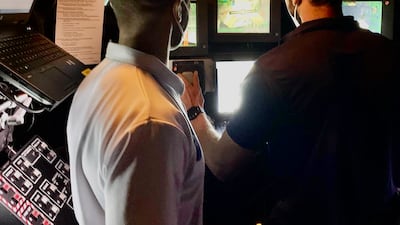
Maj Al Mansouri and Dr Al Neyadi are training at Nasa Johnson Space Centre in Houston. Photo: Dr Al Neyadi Twitter



