


Live updates: follow the latest news on Russia-Ukraine
Belarusian military chiefs are among the targets of the UK’s first tranche of sanctions against Minsk for the role it is playing in the Ukraine crisis.
British Foreign Secretary Liz Truss said Belarus President Alexander Lukashenko’s administration “actively aids and abets Russia’s illegal invasion” and should face the consequences.
Four senior defence officials and two military enterprises have had sanctions imposed with immediate effect under the UK’s Russia sanctions regime, the Foreign, Commonwealth and Development Office said.
The people sanctioned will be unable to travel to the UK and any of their UK-based assets will be frozen.
The decision affects the Belarus chief of the general staff and first deputy minister of defence, Maj Gen Viktor Gulevich, who is responsible for directing the Belarusian armed forces.
The Foreign Office said the Belarusian military has “supported and enabled the Russian invasion of Ukraine”.
Others sanctioned were Maj Gen Andrei Burdyko, the deputy minister of defence for logistics and chief of logistics of the Belarusian armed forces; deputy minister of defence for armament and chief of armament of the Belarusian armed forces, Maj Gen Sergei Simonenko; and deputy minister of defence, Maj Gen Andrey Zhuk.
State enterprises JSC 558 Aircraft Repair Plant and JSC Integral, a military semi-conductor maker, have also been included, the office said.
JSC 558 provides maintenance and servicing to military aircraft at Baranovichi air base, from which Russian aircraft operated as part of the invasion, the office said.
-

A solemn welcoming ceremony of US soldiers at Adazi military base, Latvia, on February 25, 2022. More than 300 soldiers of the 173rd Air Force Brigade arrived to demonstrate the US commitment to defend Nato allies and strengthen Latvia's defence capabilities following Russia's military operation in Ukraine. EPA -
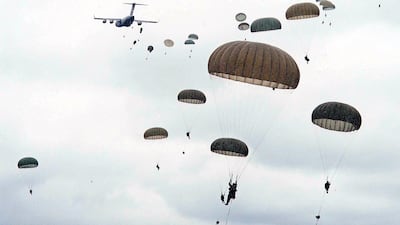
US paratroopers in Ukraine's western Lviv region during a Nato-sponsored training exercise in 2020. AP -
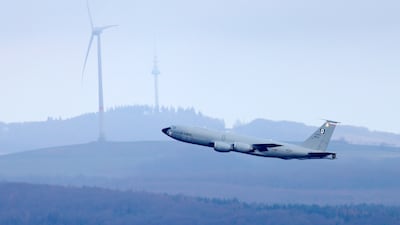
A US military aircraft takes off at the US Air Base Ramstein, in Landstuhl, Germany, on February 25. US President Joe Biden February 24 authorised the deployment of further armed forces to Germany as part of Nato's response to Russia's military aggression on Ukraine. EPA -
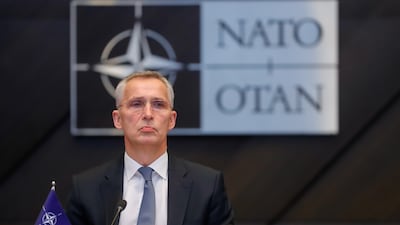
Nato Secretary General Jens Stoltenberg at the alliance's headquarters in Brussels, Belgium, on February 25. EPA -
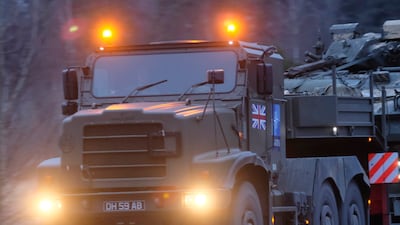
A convoy of British armoured vehicles of the Royal Welsh Battlegroup on the way to Estonia, driving through Liepupe, Latvia, on February 25. British troops and equipment are heading to Estonia as part of the UK's contribution to strengthen Nato's uplift to Eastern Europe. EPA -
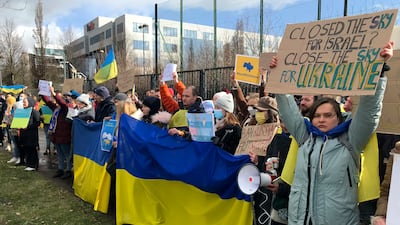
Protesters outside a Nato leaders virtual summit in Brussels on February 25. AP -
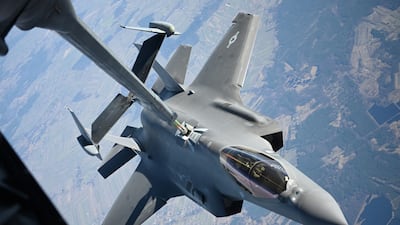
A US Air Force F-35 Lightning II aircraft assigned to the 34th Fighter Squadron receives fuel from a KC-10 Extender aircraft over Poland on February 24. US Air Force/Reuters -
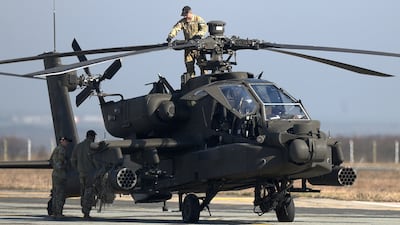
US military personnel check an Apache attack helicopter AH-64 during a technical stop on the tarmac at Traian Vuia International Airport in Timisoara, Romania, on February 24. EPA -
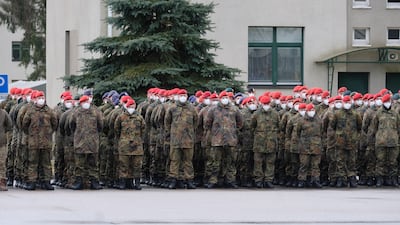
German soldiers of the Nato enhanced Forward Presence (EFP) Battalion Battle Group in Lithuania attend a ceremony during a visit of German Defence Minister Christine Lambrecht to Rukla Military Base, Lithuania, on February 22. EPA


“We are inflicting economic pain on Putin and those closest to him," Ms Truss said. “We will not rest until Ukraine’s sovereignty and territorial integrity is restored.
“The Lukashenko regime actively aids and abets Russia’s illegal invasion and will be made to feel the economic consequences for its support for Putin.
“There will be nowhere to hide. Nothing – and no one – is off the table.”
The Belarus sanctions are on top of those already applied on Minsk by the UK since 2020.
More than 100 people and organisations have become targets after the fraudulent elections in Belarus and the “litany of abhorrent acts and human rights violations that the Lukashenko regime continues to commit”, the Foreign Office has said.
The move follows separate sanctions against Russia, including the banning of Russian ships from UK ports.
The ban includes any vessels owned or operated by anyone connected to Russia and authorities will also gain new powers to hold Russian vessels.
More economic measures introduced by Ms Truss, including against the Russian Central Bank and the state’s sovereign wealth fund, mean most of Russia’s financial system is now covered by UK sanctions.
The new measures ban UK and entities from providing financial services to the Central Bank of the Russian Federation, as well as the Ministry of Finance and National Wealth Fund.
A ban has also been enacted on a range of exports critical to the maintenance and development of Russia’s military and strategic interests.
It is being applied in close alignment with the US, EU and other partners to cut off much of Russia’s high-tech imports and constrain Russia’s future military-industrial and technological capabilities.
“We said Putin and those around him would pay the price for their unprovoked and illegal invasion of Ukraine, and we are being true to our word," Ms Truss said.
“The ban on Russian ships from UK ports, and new economic sanctions against key Russian financial institutions including its central bank, in close co-ordination with our allies, will degrade Russia’s economy and help make sure Putin loses.
“We stand with Ukraine, its people and its democracy, and will continue to support them diplomatically, economically, politically and defensively."

