


A powerful solar storm caused Elon Musk’s SpaceX to lose up to 40 of its Starlink satellites that were launched recently.
The satellites had to “take cover” from the storm by going into safe mode – shutting down all non-essential functions – allowing them to get dragged closer to Earth’s atmosphere.
But the solar storm caused the atmospheric drag to increase, making it impossible for the satellites to turn off safe mode, and they will now continue to get closer to Earth until they are burnt up upon re-entry.
The storm struck a day after SpaceX launched 49 of the Starlink satellites, which are part of a satellite network that aims to provide internet access in remote areas.

“Unfortunately, the satellites deployed on Thursday were significantly impacted by a geomagnetic storm on Friday,” SpaceX said on its website on Tuesday.
“On board GPS suggests the escalation speed and severity of the storm caused atmospheric drag to increase up to 50 per cent higher than during previous launches.
“Preliminary analysis shows the increased drag at the low altitudes prevented the satellites from leaving safe mode to begin orbit-raising manoeuvres, and up to 40 of the satellites will re-enter or already have re-entered the Earth’s atmosphere.”
Solar storms occur when the Sun is experiencing peak activity, causing it to shoot hot plasma in the form of solar flares and winds.
These huge blasts of X-rays can travel at the speed of light towards Earth, releasing electromagnetic radiation – an event known as a geomagnetic storm – that can damage satellites and cause power cuts.
Space X launch prep – in pictures
-

Technicians work on the SpaceX Crew Dragon, attached to a Falcon 9 booster rocket, as it sits horizontal on Pad39A at the Kennedy Space Centre in Cape Canaveral, Florida. Reuters -
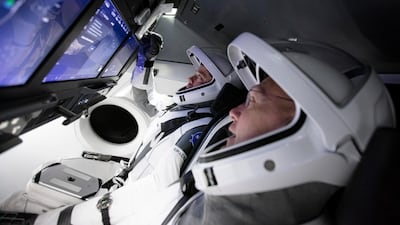
Astronauts Doug Hurley, foreground, and Bob Behnken in SpaceX's flight simulator. AP -
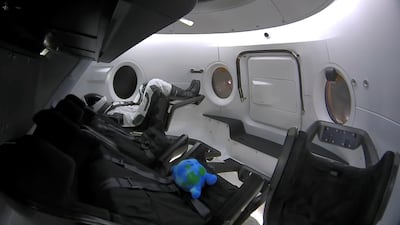
A life-size test mannequin and a stuffed toy are seen inside the capsule as it launches into orbit en route to the International Space Station, arriving 27 hours after take-off. AP -

The SpaceX Falcon 9 sits on Launch Pad 39-A. AP -
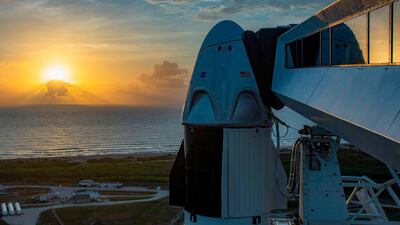
The rocket sits on the launch pad. AFP -

The rocket is raised into position. AP Photo -
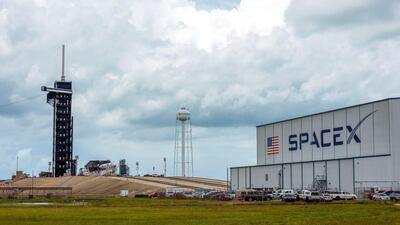
Crews work on the SpaceX Crew Dragon. Reuters -
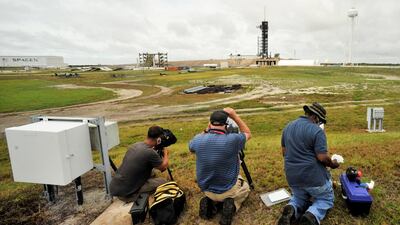
Photographers set up remote cameras for Nasa's first manned flight since 2011. Reuters -

Workers prepare the SpaceX Falcon 9 rocket. AFP -

Final preparations are made. AFP -

The sun sets behind the Vehicle Assembly Building. Reuters -

NASA broadcast technicians make preparations for coverage at the Kennedy Space Centre. AFP



