

When Ethiopia qualified for the African Cup of Nations (Afcon) in March 2021, its capital, Addis Ababa, exploded with joy.
Droves of flag-waving youths took to the streets in celebration, bringing what would have otherwise been bustling traffic in some areas to a standstill.
Drivers didn’t seem to care as the blaring of their horns filled the air.
“I remember boarding a taxi minibus and getting a ride home free of charge,” recalls Wondimu Temesgen, an Ethiopian football fan.
“A lot of public transportation drivers drove people free of charge that day!”
sports journalist
The success of the national team, nicknamed the Walias after the mountain goat endemic to northern Ethiopia, was a bright spark in an otherwise dark year.
Once listed as a beacon of stability in the Horn of Africa region and among the fastest-growing economies in Africa, a tragic reversal of fortunes plunged the country into a devastating civil war last year. Tens of thousands have died; famine and displacement have harmed millions more.
In the lead up to the final round of qualifying fixtures, members of Ethiopia’s national team have expressed a desire to not only win their country its first Afcon berth since 2013, but to foster unity in the process.
-
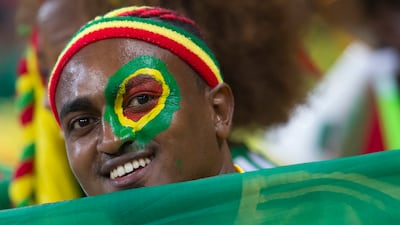
An Ethiopia fan enjoys the atmosphere during the 2013 African Cup of Nations match between Burkina Faso and Ethiopia from Mbombela Stadium on January 25, 2013, in Mbombela, formerly called Nelspruit, in South Africa. All photos by Getty -
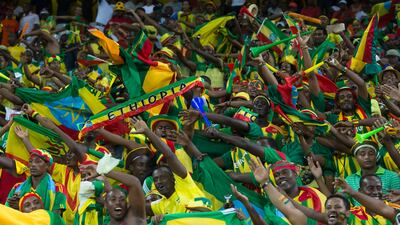
Ethiopia fans enjoy the atmosphere during the game. -
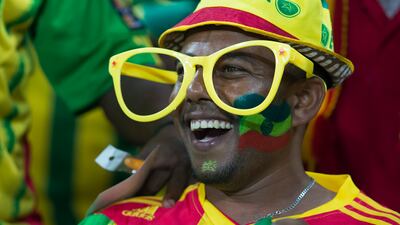
An Ethiopia fan. -
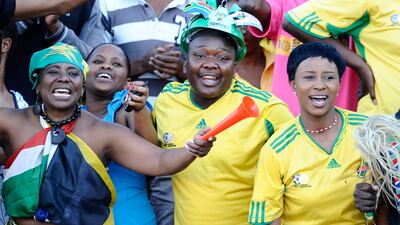
Fans during the 2014 Fifa World Cup Qualifier match between South Africa and Ethiopia at Royal Bafokeng Stadium on June 3, 2012, in Rustenburg, South Africa. -
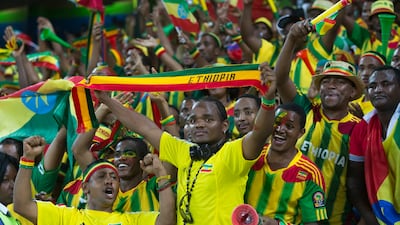
Ethiopia fans enjoy the atmosphere during the 2013 African Cup of Nations match between Burkina Faso and Ethiopia at Mbombela Stadium, South Africa. -
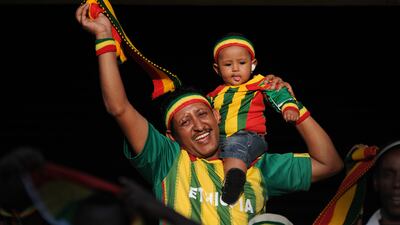
Ethiopia fans wearing the team’s colours celebrate during the 2013 African Cup of Nations Group C match between Ethiopia and Nigeria at Royal Bafokeng Stadium, Rustenburg, South Africa. -
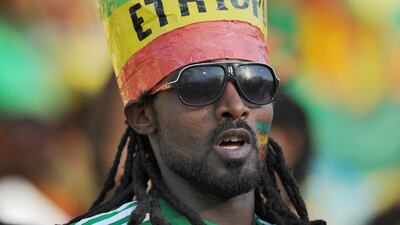
An Ethiopia fan in a distinctive hat watches his team’s 2013 African Cup of Nations Group C match against Nigeria, in Rustenburg, South Africa.


As the Walias prepare to face Cape Verde in the first round of the competition on Sunday, those calls for unity may not have reached Ethiopia’s northern Tigray region. Tigray is home to about 5 per cent of Ethiopia’s 115 million-strong population, as well as the Tigray People’s Liberation Front, which governs the region and has been at war with federal government forces since November 2020.
War in Tigray leaks out of restive region
Years of worsening tension between Addis Ababa and the TPLF eventually gave way to violence when Tigray forces launched late-night ambushes against federal army bases on November 3. Ethiopian Prime Minister Abiy Ahmed responded by declaring all-out war, deploying the full might of the Ethiopian army, backed by soldiers from allied neighbouring Eritrea.
As territory changed hands repeatedly during a year of conflict, Ethiopian and Eritrean soldiers were accused of ethnic cleansing, weaponised rape and civilian massacres. Tigrayans taking new territory were also accused of killing indiscriminately and looting.
Eventually, rebuffed by a strong Ethiopian recruitment drive and an arsenal of newly purchased drones, Tigrayan forces withdrew to their frontier, resulting in the current bloody stalemate.
-
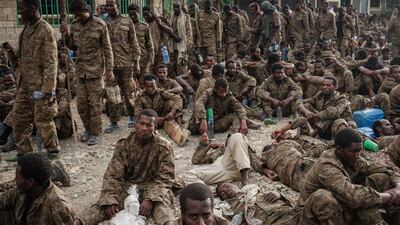
Captive Ethiopian soldiers arrive at the Mekele Rehabilitation Centre in Tigray, Ethiopia, after a four-day journey from Abdi Eshir. All photos: AFP -
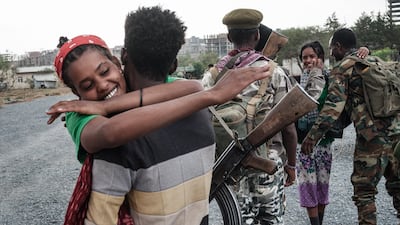
Women welcome Tigray People's Liberation Front fighters as they return to Mekele after seizing control of the city in June 2021. -
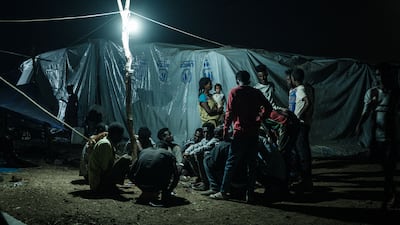
Ethiopians who fled the Tigray conflict wait to charge their phones at Um Raquba refugee camp in Gedaref, Sudan. -
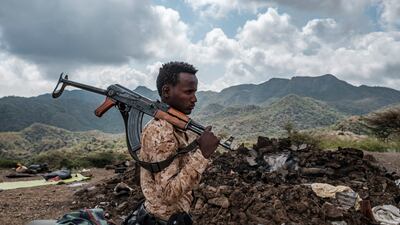
A member of the Afar Special Forces stands in front of the debris of a house on the outskirts of the village of Bisober in Tigray. -
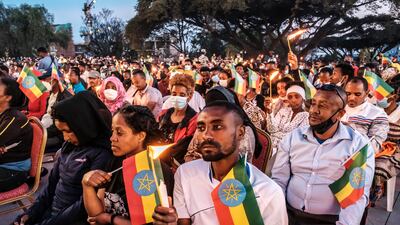
People hold candles and Ethiopian flags at a memorial service for the victims of the Tigray conflict in Addis Ababa. -

An Ethiopian refugee who fled fighting in Tigray waits behind a fence in a camp in Sudan. -
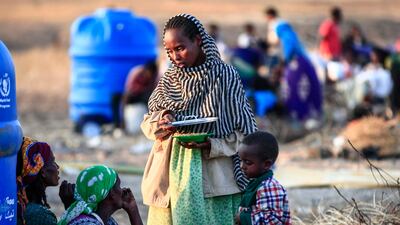
Refugees living in a camp in Sudan after fleeing violence in Tigray. -
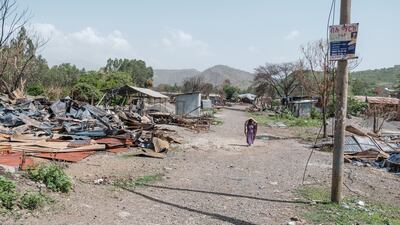
A woman walks among the remains of a destroyed factory in Ataye, Ethiopia, where more than 100 civilians died in a recent flare-up of violence. -
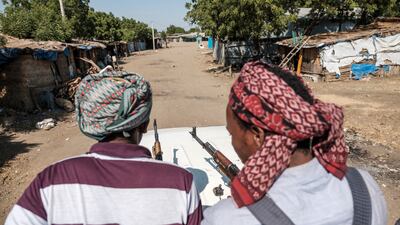
Two members of the Amhara militia ride in the back of a pick-up truck. Amharas and Tigrayans were uneasy neighbours before the current fighting, with tension over land sparking violent clashes. -

Militias from the Amhara region have been involved in the fighting in Tigray. -
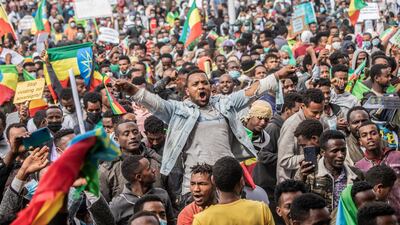
Tens of thousands of Ethiopians gather at a rally organised by the mayor of Addis Ababa to show support for the military's efforts in Tigray. -
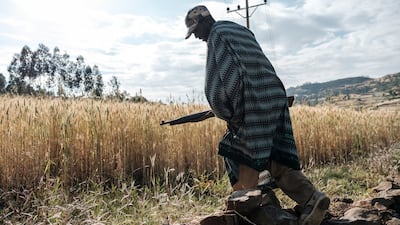
Zeleke Alabachew, farmer and militia fighter, tends to his land near the village of Tekeldengy, Ethiopia, Africa's second most populous nation. -
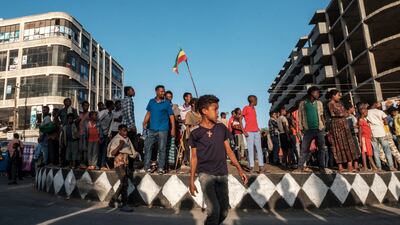
People celebrate the liberation of opposition leaders in the city of Alamata, Ethiopia. -
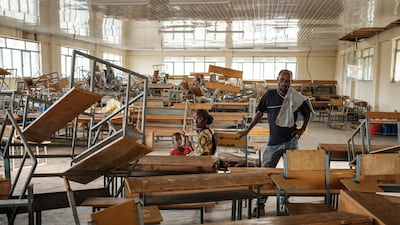
A family fleeing violence sit in a former classroom at May Weyni secondary school, now hosting 10,500 displaced people, in Mekele, capital of Tigray. -
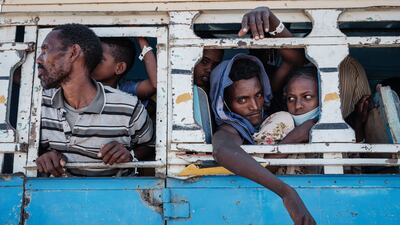
Ethiopian refugees travel to Sudan to escape violence in Tigray. -

Ethiopian refugees gather to celebrate the 46th anniversary of the Tigray People's Liberation Front at Um Raquba refugee camp in Gedaref, Sudan. The TPLF dominated Ethiopian politics before being ousted from their regional stronghold last year. -
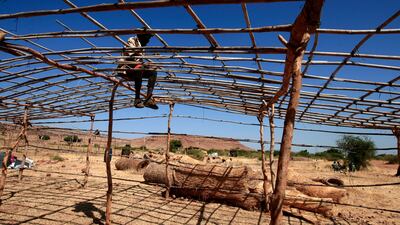
An Ethiopian refugee sets up a tent in a camp in the town of Gedaref, Sudan, after being transported from the border reception centre. -
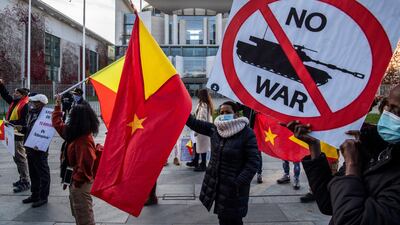
Pro-Tigrayan demonstrators display placards during a protest in front of the chancellery in Berlin. -
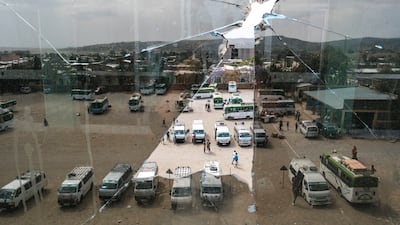
The aftermath of heavy shelling in Wukro, a city north of Mekele, in Ethiopia.


In Tigray, a federal government-enacted blockade has left millions without food and hospitals running out of medicine. The war has effectively torn the social fabric that had bound Tigrayans to the rest of Ethiopia. For Tigrayans who are increasingly contemplating separation from Ethiopia, the footballers’ exploits mean little.
“I don’t think there is a single Tigrayan who cares about sport right now, let alone the national team,” said 32-year-old Abraha, an ethnic Tigrayan who lives in Amsterdam.
Abraha, who asked to be identified only by his first name, says he was formerly a fan of the Walias, and recalls with bitter fondness now, memories of the last time Ethiopia qualified for Africa’s most prestigious sporting competition. On that day in October 2012, Ethiopia defeated Sudan 2-0 at Addis Ababa stadium, a result that led the Walias to a major international tournament for the first time since 1982.
Abraha was in Axum, Tigray, at the time.
“I watched the game on television with friends and neighbours. When the game ended, we ran into the streets where so many were already out with their faces painted in green, yellow and red colours,” he said.
“I know several who were celebrating that day who died in the massacre.”
He was referring to the killing of hundreds of men and boys in Axum by Eritrean soldiers in late 2020.
“They don’t see us as Ethiopians anyway. I won’t watch the games.”
Ethiopia’s successful qualification for the 2013 Afcon was a mini footballing renaissance of sorts and the team nearly qualified for the 2014 World Cup.
In the years that followed, new stadiums were built in an effort to maintain the momentum.

One of them was the Woldia stadium. About 500 kilometres north of Addis Ababa, it was built at a cost of $22 million and was largely paid for by Ethiopian-Saudi billionaire and Woldia native Mohammed Al Amoudi to cater to the city’s growing football potential.
Woldia was recently freed from rebel control after Tigrayan troops withdrew, ending their six-month stint in control of the town. Residents spoke to The National of shortages of food, water and electricity as the rebels looted homes and businesses, murdering those who stood in their way.
Images of the looted Woldia stadium’s café and recreation centre have made the rounds on social media. The surrounding area was heavily shelled by TPLF forces when they entered the town in August.
Mobile internet and phone services were only recently restored to the town. When asked about Ethiopia’s prospects of putting on a good showing at the Afcon, one resident broke into ironic laughter.
“There’s no power here. How would we be able to watch the games?” the young man said. “Soldiers were delivering water door to door just last week. We need our basic needs met.”
First to arrive at Afcon 2021
The Walias were the first team to set up camp in Cameroon, buoyed by a desire to provide some respite for their fans and facing no pressure to perform.
Headed to the tournament as minnows, the second-lowest-ranked side will mark their eight-year wait to return to major international football by a baptism of fire, including a January 13 match with host nation Cameroon.
At least one member of the country’s sports press corps hopes the team will inspire others with more than their feted short passing game.
“Our team is composed of players with different backgrounds and truly represents Ethiopia and its nations and nationalities,” sportswriter Ebawak Tesfaye told The National.
“During this period of turmoil and chaos, they are a symbol of unity. I am personally excited to see this team back where it belongs.”
Ethiopia will seek to emulate Iraq’s Asia Cup winning team of 2007, Libya’s African Nations Championship winning side of 2014 and, more recently, the Yemeni team that clinched the U-15 West Asian title last month, as war-torn countries that tasted footballing glory.

