
Russian President Vladimir Putin and Indian Prime Minister Narendra Modi have discussed the continuing crisis in Afghanistan at a summit in Delhi.
Both countries have a strong interest in ensuring that Afghanistan, which faces a growing food crisis and clashes between ISIS terrorists and the ruling Taliban militant group, does not create wider regional instability.
Afghanistan borders a number of former Soviet republics including Tajikistan, an ally of Moscow, as well as an unstable area of northern Pakistan, where some anti-Indian militant groups have been able to operate.
The Taliban's takeover of Afghanistan in August has led to a humanitarian crisis, which both New Delhi and Moscow have previously said could destabilise the region.
"The fight against terrorism is also a fight against drug trafficking and organised crime," Mr Putin said on Monday in introductory remarks broadcast by Indian media. "In that regard, we are concerned about developments of the situation in Afghanistan."
The visit by Mr Putin and several leading Russian officials comes as relations between Russia and the United States, also an ally of India, become increasingly strained.
Russian Foreign Minister Sergey Lavrov earlier on Monday said a deal to supply India with S-400 air defence missile systems was being arranged despite what he said were US efforts to undermine the accord.
India and Russia are expected to cement several trade and defence pacts at the summit.
"The relation between India and Russia is truly a unique and reliable model," Mr Modi said.
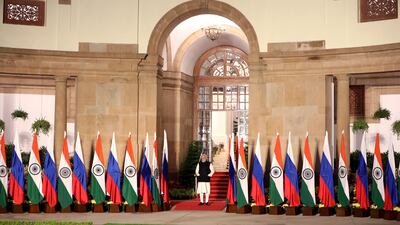
In pictures: Modi and Putin meet in Delhi
-
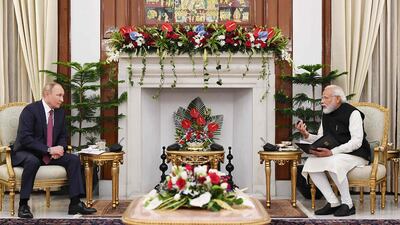
India's Prime Minister Narendra Modi and Russian President Vladimir Putin during their meeting at Hyderabad House in New Delhi. AFP -
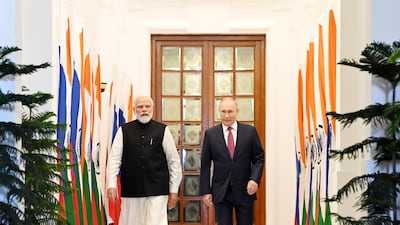
Mr Modi escorts Mr Putin to their summit talks at Hyderabad House in New Delhi. AFP -

The two leaders discussed defence and trade relations between India and Russia. AP Photo -
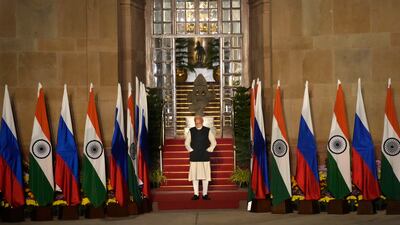
Mr Modi waits to receive the visiting Russian president in New Delhi. AP Photo -
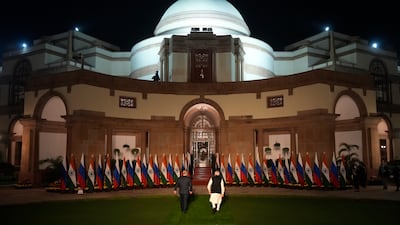
Mr Putin's visit comes as relations between Russia and the US, also an ally of India, become increasingly strained. AP Photo -
Mr Modi described India's relations with Russia as a 'unique and reliable model'. EPA



