

Once a sleepy village on a rocky hillside in central Armenia, Ishkhanasar suddenly became the scene of the heaviest fighting since the war erupted between Armenia and Azerbaijan.
Inhabited by 300 villagers engaged in farming, the village straddles Armenia’s vital north-south motorway at the country’s most vulnerable point, a bottleneck between Azerbaijan and the Azeri exclave of Nakhchivan to the west.
Last Tuesday, Azerbaijani forces launched a full-scale assault that lasted more than five hours. When a Russian-brokered ceasefire eventually brought it to an end, at least 13 Armenian and Azerbaijani soldiers had been killed, with more than 20 Armenian servicemen taken prisoner or missing.
In Ishkhanasar, the village closest to the battle, the sounds of artillery were fully audible.
“The children heard the shelling from the school,” said Marat Petrosyan, the village head. The fighting itself was “about 12 kilometres away” deep in the mountains on the border, he said, but the heavy artillery used meant the battle was heard for miles around.
“Fortunately they did not come close to the village,” Mr Petrosyan said the day after the clashes. “The situation is calm now.”
After initially gaining the upper hand, Azerbaijani forces were contained by Armenian reinforcements, witnesses said.
The unprecedented fighting – on Armenian soil itself, not in the disputed Nagorno-Karabakh region – has stalled the reopening of transport links that have been closed since the Soviet era, while undoing any tentative post-war gains in peace.
Baku wants to exert more pressure on Armenia for transit concessions, including a link between mainland Azerbaijan and the Nakhchivan exclave – an unfulfilled tenet of last year’s ceasefire deal that has broken down over differing interpretations of the text.
Azerbaijani President Ilham Aliyev has made repeated reference to the "Zangezur corridor", using an alternative name for southern Armenia’s Syunik province where last week’s fighting took place. He threatened to open the corridor ‘by force’ if necessary.
Armenia, meanwhile, views the term "corridor" as implying Azerbaijani sovereignty over the territory, noting that the 2020 ceasefire agreement makes no mention of this term and saying they will not discuss any corridor.
“The viability of the planned first stage agreement offering Azerbaijan new road and railway links to its exclave of Nakhchivan may be impacted by an absence of security on the ground,” said Richard Giragosian, director of the Yerevan-based Regional Studies Centre.
“This escalation of tension also erodes recent gains and some progress in a return to normalcy, marked by a more predictable and calmer post-war environment."
Locals in the region did not look kindly on the prospect of reopening transport links between Armenia and Azerbaijan.
“We don’t want any corridor,” said Mr Petrosyan. “What will it do for us? The Azerbaijanis will use it to go from Nakhchivan to Baku, but they won’t let us use it to go from here [Syunik province] to Yerevan [via rail through Nakhchivan],” he said.
Emotions are further inflamed by the history of the village itself, which Mr Petrosyan said was populated by Azerbaijanis until the first Karabakh War in 1991. “Now it is full of people who were forced from their homes in Azerbaijan: from Baku, Sumgait, and even from Karabakh last year. We won’t just hand it over,” he said.
The spread of fighting beyond the disputed Nagorno-Karabakh region to the Armenia-Azerbaijan border, and into Armenian territory, is another disconcerting element.
“This recent escalation of tension has little direct relationship with either the Nagorno Karabakh conflict or the Russian peacekeeping presence,” Mr Giragosian said.
“Rather, the tension is between Armenia and Azerbaijan, posing a new challenge from a broadening of post-war confrontation to a bilateral dimension,” he said.
There are hopes that coming diplomatic summits can both sides move away from the violence seen this past week.
“There are firm expectations for a planned return to the region by the OSCE mediators before the end of the year,” Mr Giragosian said. “Likewise, there are also preparations for a meeting of the Armenian and Azerbaijani heads of state in Brussels in December. Thus, the coming challenge is to leverage this return to diplomacy,” he said.
For those in the region itself, meanwhile, peace seems further away than ever.
-
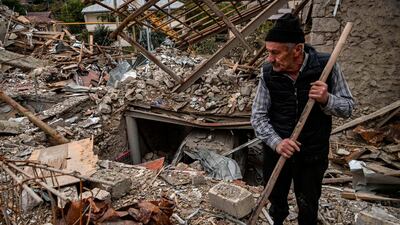
Retired police officer Guennadi Avanessian, 73, searches for belongings in the remains of his house, which he said was destroyed by Azeri shelling, in the city of Stepanakert. AFP -
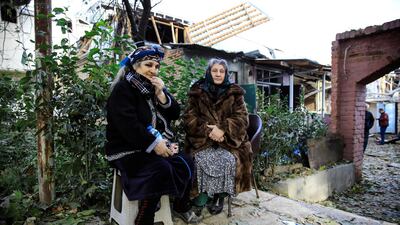
Women, whose houses are damaged, sit near the blast site hit by a rocket during the fighting over the breakaway region of Nagorno-Karabakh in the city of Ganja, Azerbaijan. Reuters -
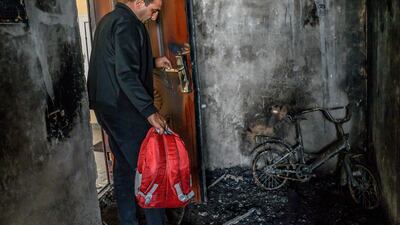
Razim Mehmedov, 40, holding his daughter's backpack stands in his flat that was damaged and burnt by shelling as residents return to their homes after a ceasefire in the military conflict between Armenia and Azerbaijan over the breakaway region of Nagorno-Karabakh, in the town of Terter, Azerbaijan. AFP -
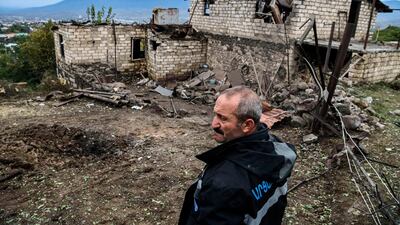
Ashot Aghajanian, 54, stands in the yard of his house destroyed by shelling in Stepanakert. AFP -
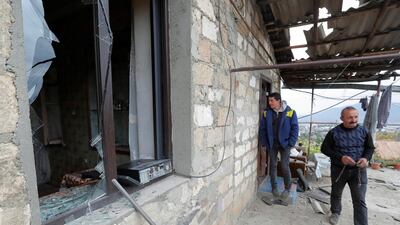
Men are seen next to a house damaged by recent shelling during the military conflict over the breakaway region of Nagorno-Karabakh, in Stepanakert. Reuters -
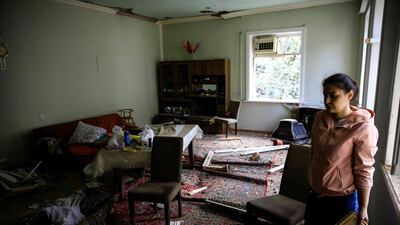
A woman searches for belongings in her damaged house hit by a rocket during the fighting over the breakaway region of Nagorno-Karabakh in the city of Ganja, Azerbaijan. Reuters -

Women are distraught after fighting broke out in the city of Ganja, Azerbaijan. AFP -
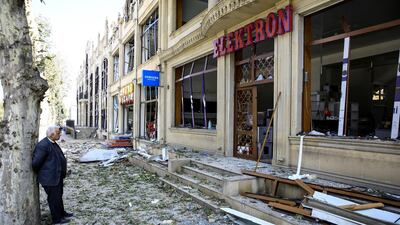
A shop owner stands in front of his destroyed premises in Ganja. Reuters -
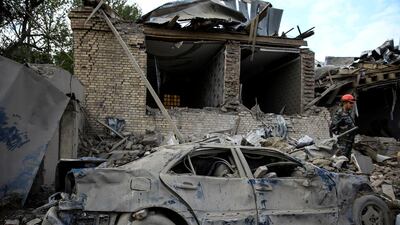
A damaged car in Ganja. Reuters -
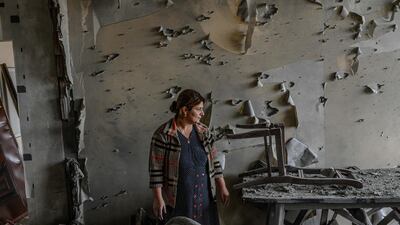
Xatire Celilova stands inside her destroyed flat after a ceasefire, in Terter, Azerbaijan. AFP -
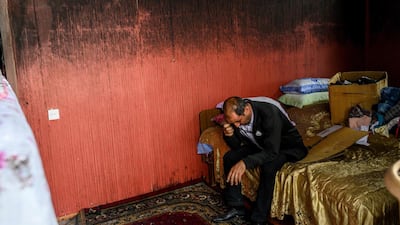
Razim Mehmedov, 40, sits in a bedroom of his flat that was damaged and burnt by shelling as residents return to their homes in Terter. AFP -
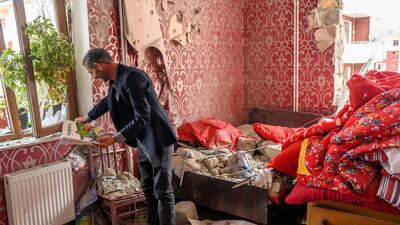
Yasin Budakov, 40, holds a book, which his child forgot to take when they were running out of the family’s damaged flat in Terter. AFP -

A man watches rescuers searching for victims or survivors at a blast site in the city of Ganja. AFP



